Organic Isn’t a Trend. It’s the Way It’s Been.

There was a post on Serious Eats titled Food Trend you wish would fade away?

Of the 160+ comments left, there were a handful that stood out to me. Those were left from the people who were hatin on the “organic” and “local” food trends.

These comments reiterated to me how disconnected from food we have become. I’m pretty sure, but organic and local aren’t necessarily food trends. It’s not until the last 100-200 years that we have had non-local and conventionally grown foods available to us.

Organic and local were your only options. You didn’t have the luxury of living in New York and being able to buy pineapples or mangos.

The trend that has developed is having these overly processed foodlike products available to us. It’s having unseasonal foods imported to us from thousands of miles away.

We don’t realize or appreciate how lucky and fortunate we are to have these options available to us. Instead, we take them for granted.

It’s more difficult these days for people to get local and organic food than to get the imported stuff.

One commenter said, “I have to agree with Organic. I know people who won’t eat anything that’s not organic and they pay out the wazoo! Ridiculous in my opinion.”

This is likely the same person who pays ridiculous amounts for prescription drugs, a large screen TV and SUV.

We have become so far disconnected from food that we see it as that…an expense that’s not warranted.

So eating local and organic isn’t a food trend. It’s our history.

The food trends that I’d like to see fade away are the overly processed, boxed and packaged garbage that’s being sold to us to disappear. I’d also like to see conventionally grown and GMOd crops to fade away.

What food trends would you like to see fade away?
The Organic vs Non-Organic Debate: Know Your Sources

One of my imaginary friends on Facebook, Michael Martz, said that he was listening to a local SoCal radio station. They were discussing how organic food wasn’t as nutritious as non-organic and that the farming practices couldn’t sustain the world.

He wanted my thoughts on this.

The show was titled The Non-Organic Future. I’ve heard these arguments and read these reports plenty of times before.
It all comes down to the same thing –

  • Who are the people making these claims?
  • What’s their affiliations?

Doing some quick research this is what I came up with.

Who is Pedro Sanchez?
The first “expert” was Pedro Sanchez, Director and Senior Research Scholar of Columbia University’s Tropical Agriculture & Rural Environment Program. He claimed the following:

If you ask me point blank whether organic-based farming is better than conventional, my answer is no.

Now coming from a professor at an Ivy League school this surely is a credible statement and one that we should trust. Let’s look deeper at Columbia’s affiliations.

Who funds Columbia University?
Back in 2006, Columbia University was awarded $15 Million to support science-based effort to end poverty in Africa from the Gates Foundation.

Ok, so this sounds great. What’s wrong with that? Let’s look into the Gates Foundation now.

What’s The Gates Foundation have to do with Monsanto?
According to this article the Gates Foundation was under scrutiny for heavily investing in Monsanto stock.

Ahh, now it makes sense why Sanchez would be saying that. He works for a University that has accepted money from a Monsanto backer. What do you expect him to say?

Who is Marks Rosegrant?
Now let’s move on to the other guest, Mark Rosegrant with the International Food Policy Research Institute.

When asked about organic farming he said:

It’s not an important part of the overall process to feed 9 billion people.

Who funds FPRI?
Let’s take a look into Rosegrant’s background. If you look a the very bottom of The International Food Policy Research Institute’s website it says, “IFPRI is supported by the Consultative Group on International Agricultural Research (CGIAR).”

What is CGIAR?
CGIAR, “…is a global partnership that unites organizations engaged in research for sustainable development with the funders of this work.”

This sounds great and wonderful, but after doing a quick search, I came up with this article from InMotionMagazine titled CGIAR Turns to Outsourcing.

The opening paragraph of the piece starts out with:

The Consultative Group on International Agricultural Research (CGIAR), once the harbinger of green revolution that swept through parts of Asia and Latin America in the early 1970s and 1980s, is in an advanced stage of decay. In a desperate effort to survive against all odds, the 16 international agricultural research centers that operate under the aegis of CGIAR, have therefore donned a new role – to serve as an agricultural research outsource for the multinational corporations.

It then goes on to explain that one of the people in control of one of CGIAR’s main projects is an old Monsanto executive.

The USDA ain’t helpin
We shouldn’t be too surprised by this type of research and studies finding such information. An article in The GMO Journal titled Regulatory Independence Myth Lives On At USDA explains how the USDA is allowing these companies to perform the safety studies themselves or allow them to fund the studies. So what would you expect the results to be?

What to do?
When listening to the “experts” weigh in on such issues or when you are reading reports, do a little digging and see what the connections are. Don’t just take them at face value.

What are your thoughts on the organic vs non-organic debate?

Food Activism: Make a Political Statement and Vote with Your Garden

There was a post on Nourished Kitchen titled The Fight to Label GMOs & 7 Ways You Can Avoid GMOs.

The post was about fighting to have GMO (genetically modified organism) foods labeled as such. They currently aren’t. The author of the post, Jenny, writes how the food choices you make are becoming political statements and, “No longer do you choose whether you’ll serve oranges or apples with that peanut butter sandwich, but also, too, you must choose whether those apples and oranges are grown locally, grown sustainably.”

She concludes the post with seven ways that you can avoid them. One of those ways is to grow your own food, which I’m all about.

This got me thinking about some of the posts that I’ve received some heat on lately about politics and gardening. Especially about Michelle Obama and the White House Garden.

Some of the comments were saying that anything to do with gardening is great, politics and gardening don’t go together and that I am being too negative.

I received a comment a few weeks ago from a new reader that said, “I really hope, as a newcomer to this site, that it stays with gardening and does not become political. Politics, to me, are like weeds – they will take over if you’re not careful. :)”

Gardening and politics are related and growing your own food is a political act of sorts. With the current state of our food system, to stick my head in the sand and not speak on this would be a shame.

Yes it’s about gardening and growing food, but that’s just at the soil line. There is much more going on under the soil with the roots (had to use the bad pun).

One of the goals of this site is to empower people to grow some of their own food for that reason. To stand up against the big corporations because we don’t have to tolerate what’s being pushed on us.

Growing your own food helps to keep you off of GMOs and products produced by industrial agriculture. By not supporting those industries and growing my own, I am voting. I’m voting for my garden and not for their corporate greed and you can too.

What are your thoughts? Is growing your own food a political statement?

Food Quotes That Get You Thinking

Books are what really got me started down this path of wellness and health. They are the ones that made me want to start growing my own food.

Not gardening books, but books about food, health and the environment.

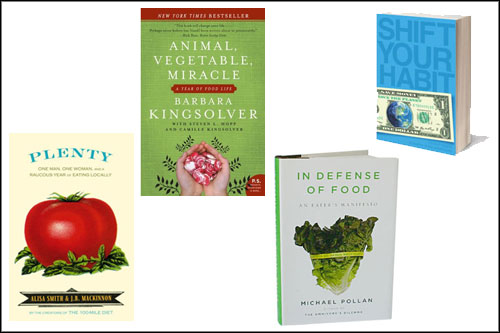
Here are four food quotes from books that are eye opening and can really get you thinking.

Ideally, a meal should be enjoyed at the dinner table with friends and family, instead of gulped down in front of the television.

From Shift Your Habit

At one time I was definitely guilty of doing this. I’d rarely eat at my kitchen table. Instead I would pull a tray in front of the couch and watch TV while I ate.

It’s easy to get caught in the trap of this. It often leads to mindless eating, as there are a lot of food ads constantly run. This also prevents discussion to possibly happen during the meal. You also don’t focus on the meal as much either because you are focused on the television.

A lot of people eat their food on the run from one activity to the next. Food and meals are seen as a task instead of nourishment.

When you sit down at the kitchen table and eat your meal, it’s your chance to slow down, get grounded and fully appreciate the meal before you.

Is it just a coincidence that as the portion of our income spent on food has declined, spending on health care has soared?

From In Defense of Food

If we were to look at our eating habits over the past 100 or so years and our health, there is definitely a correlation between the two.

I’ve been called a conspiracy theorist by some when I talk about the food, pharmaceutical and government, but in looking at what is going on, it’s hard for me not to think that.

People are more willing to spend money on cable TV or their cell phones than they are on food. People are also willing to take as many medications as they can that their doctors prescribe.

Instead let’s shift that spending to food that nourishes and keeps us healthy rather than puts us on medications.

Growing food was the first activity that gave us enough prosperity to stay in one place, form complex social groups, tell our stories, and build our cities.

From Animal, Vegetable, Miracle

This is one that I often reference in one form or another as to why you should grow your own food. Look back at the early cities and civilizations. They were built around fertile land and access to water.

Food brought people together on so many levels and fostered communities. We are far from that these days and our culture is suffering because of it.

Despite eating more than ever before, our culture may be the only one in human history to value food so little.

From Plenty: One Man, One Woman, and a Raucous Year of Eating Locally

This is another quote that I reference often as well. We are very fortunate to live in a time where we don’t have to rely on growing our own food or sourcing it locally. The global agriculture system takes care of that (or at least it’s supposed to).

At any time on any day we can go to the grocery store and pick up nearly anything that we want to eat. That is a luxury that we take for granted. There is no appreciation for food and what it takes to get it to our plates.

Not only that, but people are eating cheaper food like products instead of real whole foods. This goes back to the quote above about the healthcare spend.

These are only four of my favorite quotes regarding food. What are some of yours?

6 Ways to Celebrate Earth Day Everyday

Earth Day is coming up this Friday and every company is jumping on the Earth Day bandwagon. They are doing “ABC in honor of Earth day” or “XYZ to celebrate Earth Day.” It’s all a bunch of BS and greenwashing.

I mean it’s great that people are acknowledging it, but unless true habits form, it’s all for naught and just another way for companies to sell you crap that you don’t truly need.

So in honor of Earth Day here on Urban Organic Gardener, I want to share with you “6 Ways to Celebrate Earth Day Everyday” because that’s when the Earth should be celebrated.

  1. Consciously Eating Who gives a damned about the difference between being a vegan and omnivore. Let’s unite against something that we can all agree is wrong and that’s factory farming.
  2. Conscious Consuming. This goes hand in hand with conscious eating, but let’s be conscious consumers as well and know how our purchases effect not only the environment, but other human beings as well. For instance, did you know that the exploitation of women goes on in a large amount of farm fields? Know how your purchases are supporting such practices and vote with your dollar.
  3. Give Thanks for Your Food. This is something that’s usually reserved just for Thanksgiving. It should be something that’s done on a daily basis. Thanks should be given to the workers who grew, produced, tended to and harvested the ingredients that make up our meals. Even if it’s just a quick, “thanks to everyone that helped get this meal to my plate.” Slow down and show some appreciation.
  4. Support the Locals. This is important especially with the rising food prices. It will help to keep money and jobs in the community. This also helps to cut out the middleman and costs that go into shipping of products.
  5. Avoid Using Additional Plastic in the Kitchen. Instead use or reuse glassware. This will not only help the environment, but will be good for your health as well.
  6. Grow Your Own Food You don’t have to have a huge garden or lots of space. Growing one herb or vegetable will make a difference for you and for the environment.

What are other ways that you can celebrate Earth Day everyday?

httpv://www.youtube.com/watch?v=q9sh_Z2_ViE

Budget Cuts Threaten Food and Water Safety Programs: What You Can Do

There was a post on Change.org, Federal Budget Cuts Threaten Food and Water Safety Programs, which should give you another reason to grow your own food and source as much of it locally as you can.

Here’s an excerpt:

Congress recently proposed a federal budget that threatens to eliminate critical funding for food safety and clean water programs, placing the health and safety of all Americans at risk.

Since our country is in such an economic crisis, Congress sees it fit to cut the budget when it comes to the safety of our food and water. As a citizen, this is something that I’d like to vote on. Would you?

There are already food safety issues with the salmonella and other recalls. The S510 Food Safety Act was supposed to address this concern, but this proposed budget cut pretty much negates that.

We don’t get a chance to vote on this, but there are still things that we can do:

  • Continue to take food back from corporations.
  • Shop locally at farmers markets, CSAs and food co-ops.
  • Start growing your own food.

Between these proposed budget cuts and safety concerns that will follow and the rising food prices, do you really need another reason to take action?

What are your thoughts on these proposed federal budget cuts?

httpv://www.youtube.com/watch?v=qoLdWL7mKag

Photo credit: Kevin Dooley via Flickr

People’s Gardens: Why Would the USDA Want People to Register Their Gardens?

Update: I was corrected by someone and told that People’s Gardens are the name for Community Gardens, not people’s individual gardens. It still doesn’t sit well with me.

Last month the USDA announced People’s Gardens.

I’m sure that my thoughts on why this database will be questioned by the “anything having to do with gardening is great crowd,” much like my post on Michelle Obama and the White House Garden was, but this just doesn’t sit well with me.

When the S510 Food Safety Act was being discussed, I thought it smelled a bit funny. I think this smells even worse.

The headline that of the press release for the launch was, “USDA Launches Database for Public to Sign-up and Show their People’s Gardens on Interactive Map; Promotes Access to Healthy Food, Sustainable Practices.”

The press release goes on to describe the program:

With the opportunity for the people to enter their People’s Gardens into the database, they will be able to describe each garden, identify who is involved¸ where it is located as well as attach photos and add the contact information for their partners. For those who start a People’s Garden, they can ask to have a People’s Garden sign shipped to them. To view the interactive People’s Garden map and access the database, go to www.pubinfo.usda.gov/garden.

Of course USDA Agriculture Secretary Tom Vilsack wants to promote access to healthy food and sustainable practices. I mean he did greenlight Monsanto’s genetically engineered alfalfa and has been in the pocket of the biotech company for years.

Come on. Let’s be real here. If Monsanto does indeed want to control the food and seed supply and Vilsack is one of their puppets, why would I ever register my garden and give them all of my information. Why would you?

Maybe I’ve read 1984 or other conspiracy theories too much. This screams of them wanting to know more about us and who is indeed growing their own food to eventually crack down on that. It would be the perfect chance to fine us for growing too much of it.

With all that’s going on and what the USDA and Vilsack have done, I just don’t believe that they want this information to promote what they are saying. I certainly will not be registering my garden.

What’s your thoughts on People’s Gardens?

Conscious Eating: Vegans and Omnivores Unite

There was a post on EcoSalon titled The Conscious Case Against Veganism by Abigail Wick.

The gist of the post was that just because one is vegan that doesn’t mean that they are eating in a more sustainable way than an omnivore. This is a topic that I wrote about in the past on GreenLifestyle Magazine.

To me what was most interesting about her post were the comments. The people who left comments were so tied to their label – be it vegan or omnivore.

“As a vegan…”

“Veganism is about…”

People are so tied to this label that they cling to it and let it define them. Like there are bylaws that have to define you. As someone who eats a predominantly plant based diet, I’m often told that I’m not a “true vegan” because I consume honey.

Who really gives a shit? I don’t want to be a “true vegan.” I just want to be me. Food is just one small aspect of me and who I am.

What I’d like to see is more people becoming conscious eaters. I’d love to see “vegans” and “omnivores” unite together against something that both can see something inherently wrong with…factory farming.

Let’s drop the labels that have been bestowed upon us by society and do something against this atrocity that’s now known as the industrial agriculture system. This issue is much larger and will have a greater impact on the environment and our health than the bickering that is currently going on.

So who’s down to join the conscious eating movement? How are you going to start today?

Tom Philpott beat me to the punch on this one. He wrote a similar article on Grist.org for the Vegan/Omnivore Alliance against Animal Factories. Let’s all join in on this and make some true change.

httpv://www.youtube.com/watch?v=lEF5VsKPlbE

Are the White House Garden and Michelle Obama Just Smoke and Mirrors?

When President Obama was campaigning in 2008, there was all this promise of “change”. That was the rallying cry “change.” Everyone jumped on board and was happy when he was voted in.

One of the first things that happened when he moved into office was his wife, Michelle, became the poster child for healthy living, especially for kids, with her Let’s Move program.

She also received and continues to receive a lot of press coverage from traditional media about the organic garden in the White House that she had created. She recently planted the third garden. Now she is coming out with a book on healthy food. It’s exactly what I want – a woman who joins forces with Walmart to tell me about healthy eating.

I mean this is awesome. We have a first lady that is promoting healthy living and organic gardening to the nation. Doesn’t get better than that does it?

At face value this might seem like the change that we were hoping for, but take a look at what her husband is doing such as appointing former Monsanto Executive Michael Taylor to the Food Czar role in the FDA and possibly being behind the push of GMO alfalfa.

So this gets me thinking.

Is she doing this because she believes in it?

Or is she doing it as a distraction while her husband does the dirty work behind the scenes and continues to undermine the American people and our food choices?

Every time she has one of these events based on the garden, traditional media outlets eat the shit up, but shy away from what her husband is doing.

She flashes her smile, takes a few pictures with some kids and a garden bed on the White House lawn and the world is a better place. To me it wreaks of a public relations cover-up and a photo-op. We need to look beyond the photo and look at what’s really happening to our food system and not be lulled by what she’s doing.

I don’t want to hear the she is an independent woman and can have varying views from her husband reason either. The opposing viewpoints of organic and GMO are like a Jew and a Nazi being partners.

Am I being a cynic by thinking this? Should we be happy that she is promoting organic gardening and healthy living? Or should we be outraged that she’s providing a decoy for her husband?

httpv://www.youtube.com/watch?v=cnpWagp-Pxo

Photo courtesy of USDAGov

Food Culture: Create Your Own

There was a post on SimpleBites.net by Aimee titled Why (and How) You Should Create a Healthy Food Culture for Your Family that got me thinking about the food and health culture that I’ve created and the one that I grew up with.

Aimee’s talks about food culture as it relates to couples and kids, why food culture is important today, the food culture of her family and how you can create one of your own. I’d like to address some of those same issues and some others as well.

My Food Culture Growing Up
Growing up I always had to be home for family dinner at 6pm – no excuses and no exceptions. At the time I hated it. All of my friends would be at the park or on the street hanging out, and I’d have to go home to eat dinner with my family.

Looking back it wasn’t such a bad thing. Though there aren’t many fond memories or recipes that have been passed down from generation to generation. That aspect is lost. To be honest my mom isn’t a great cook.

I don’t care if she reads this (she likely won’t), but she ain’t good. So there was and is no yearning for one of her home cooked meals.

When it comes to food culture people automatically think

  • Pasta – Italian
  • Borscht – Russian
  • Noodles – Chinese
  • Fat – American

My Food Culture Now
Nearly every night my girlfriend, Anita, and I eat a home cooked meal together. No matter what’s going on or how busy we are, we share that time to sit down, talk about the day and enjoy our meal together. Prior to each meal we give a quick thanks for the food and everyone that went into getting it to our plate.

Why You Should Create Your Own Food Culture
One of the biggest reasons that you should create your own is because your current food system is so jacked and screwed up. I’ve given plenty of reasons to grow your own food and those same ones apply to starting your own food culture. There is also the exploitation of women that happens in our current food system.

These are reasons to start your own food culture to start appreciating food, where it comes from and how it nourishes us.

Start Your Own Food Culture
You don’t necessarily have to have a spouse and kids to start your food culture. You can do it on your own or with friends and family. Once a month you can get together with friends and family to host pot lucks or dinners that feature whole foods and bring people together that way. Get creative with it.

What is the food culture that you have already created or want to create?

httpv://www.youtube.com/watch?v=WuNdeOA0qmc

Rising Food Prices: What You Can Do About Them

The rising food prices have been in the news a lot lately. I mean c’mon it helped to cause an uprising in Egypt.

Here in the States, the food prices are starting to rise as well. While indeed that may be true, it’s not the food that is too expensive it’s everything else that goes into getting the food to your plate that’s causing the price to increase.

The Daily Green had a great post titled For Every Dollar You Spend on “Food,” Less than 16 Cents Pays for Food. They broke down where the money goes based on what the USDA reports.

Wait how much actually goes to the food?
As you can tell by the title less than 16% of each dollar goes towards the actual food. The other 84% goes towards the marketing of the food.

They break down that 84% even further. Food processing (19%) and services (34%) make the lion share of that 84%.

Food processing are the ones that process your food into the “food” products that can be found on the shelves. Food services are the ones that distribute, package and label the food.

Pretty much what this means is that most of the money that we are paying for food goes to the middleman NOT to paying for the food. This system doesn’t seem like one that can work and is sustainable in the long term.

That is the real issue.

Great food prices are rising, but what can we do?
Our current food system relies on these middlemen to provide us with our food. I say we cut these middlemen out of the equation thus bringing down the price of food.

There are a few ways that you can cut out the middleman and get your food from closer to the source.

  • Start to grow your own food. You might not be able to fully survive off of what you grow, but every little bit matters.
  • Go to your local farmers market and buy directly from the grower. There is no middleman involved there.
  • Join your local CSA. This is a good way to connect with others in your area and to support the local farmers.

By doing any of those or a combination of them, we can combat the high prices of food and help to cause the change that we want to see.

What are other things that we can do about the rising food prices?

httpv://www.youtube.com/watch?v=4txpTgGpvBw

Sources for Buying Non-GMO Seeds

One of the questions that I often get and have had myself for a while is where can you buy non-gmo seeds or seeds from companies that aren’t owned by Monsanto.

Monsanto owns something like 90-95% of the seed companies out there. So the company might not be selling genetically engineered seeds, the money is still going into the pockets of Monsanto. I’m not down with that.

Here are some seed companies that I’ve either worked with or have been highly recommended by others.

SeedsNow.com

SeedsNow is a family owned business right in Los Angeles that provides 100% Pure GMO-FREE Non-Hybridized/Heirloom seeds. All their seeds are raw and always un-treated.

Without getting into the specifics, the seeds they have are the most natural most pure form of seed you can get.  Knowing that their site doesn’t offer any hybrid seeds is a really good thing for me.  With their heirloom open-pollinated varieties I know that I’ll be able to save my seeds after harvest. Can’t do that with hybrid or GM seed!

One of the things that I like most about SeedsNow.com is that they have seed sampler packs starting out at  99¢. At those prices you can afford to try growing a lot of different things.   A lot of people don’t know this but their “sampler” packs actually have the equivalent amount of seed (or more) than regular sized packs form other companies.

They have a huge variety of NON-GMO seeds for you to start growing your own food. Definitely a site worth checking out:  www.SeedsNow.com

You can get 10% off your SeedsNow.com purchase by using the code URBAN10.


Botanical Interests

I also contacted, Botanical Interests to find out where they source their seeds from and their stance on genetically engineered seeds.

This is the response that I received from one of their representatives:

We understand people’s concerns regarding food safety and the health of the environment, and we do our best to be good stewards of the environment and to help people have access to safe, nutritious food.

Companies that care as much as we do

For this reason, these are companies that I can support and get behind. There are some seed companies out there that sell a small amount of Monsanto seeds (less than 10%), but it’s not like they are weening themselves off and going strictly non genetically engineered seeds.

I know that this is a business decision and much more goes into than I likely know. It’s easy for me to sit here on my laptop and spout off, but it takes action for things to change. Supporting these giants, as small as that support may be, will keep them growing and alive.

When it comes to the choices and purchases that we make, it’s best to know the source of where our stuff (be it food, clothing, seeds or whatever) comes from and support what we believe in. We cannot pretend to be blind to what really goes into and the results of our purchases.

Your turn…

What other non-Monsanto owned, non-GMO seed companies do you know of?

Women Exploitation: How Your Dinner is Supporting It & What You Can Do

There are plenty of safety problems in the food industry and your dinner is linked to them. These safety problems are why you should grow your own food and organic gardening makes sense to me, but right now I want to discuss problems beyond the food.

Let’s talk about how the workers are treated, but more specifically the female workers. There was an article on Alternet.org titled “Why Women Who Pick and Process Your Food Face Daily Threats of Rape, Harassment and Wage Theft.”

That’s a pretty heavy title. Here’s an excerpt from the first paragraph:

The report, “Injustice on Our Plates: Immigrant Women in the U.S. Food Industry,” compiles the experiences of 150 immigrant women who came from Mexico or other Latin American countries to work in the food industry, both in fields and in factories, across the United States. The picture it paints is grim. Women, who make up nearly a quarter of U.S. farmworkers, face the same indignities that immigrant men face — and then some.

It makes it difficult to sit down and enjoy your meal today, doesn’t it? To know that anyone, especially a woman, is being treated this way so that we can enjoy our food. Can you really enjoy your food knowing this?

As you read what goes on in the post, it hits you like a ton of bricks. There is no way that I could consciously support these practices and companies that employ them.

This is why I like to vote with my dollar, since George Washington is the most powerful man in this country.

Even though it’s a depressing post, there are things that you as an individual can do to stand up against the way these women and workers are treated.

Totally removing yourself from the industrialized food world might not be possible right now, but here are somethings that you can do:

  • Be self-sufficient. This is a long term goal of mine, but one that many might not be able to do right now.
  • Start your own garden. You can start to grow some of your own food. Space shouldn’t be an issue or excuse because I’ve already shown you what can be done on a fire escape and balcony.
  • Support local growers. Shop at your local farmers markets or join your local CSA.
  • Buy organic produce. At the very minimum, you can buy organic produce. If these workers are going to be working the fields under these horrible conditions, at least let them be fields that are free from chemicals.

The next time you sit down to eat your meal, think about where you food came from and how it got to your plate.

How else can we join together to not support this exploitative food system?

httpv://www.youtube.com/watch?v=tebyf2y7_Y4

How To Avoid Storing Food in Plastic Containers: My Almost Plastic Free Kitchen

Rodale.com has dubbed this month Plastic-Free February. From their site:

We’re going plastic free in February—or at least, trying to. Follow our efforts, share your advice…and join us if you dare!

After reading the difficulty that my fellow bloggers Christa and Theresa have experienced and what rock star Michael Nolan is already doing to reduce his dependence on plastic, I felt inspired to get involved.

To start I wanted to share with you what I’m doing to avoid plastic in my kitchen to cook and store food. There are definitely some areas that need work, and hopefully you can help me out with those.

Screenshot 2014-04-10 17.34.55The reasons to avoid plastic when it comes to cooking and storing your food are for both environmental (plastic can take up to 1,000 years to decompose in the landfill) and health reasons. Yahoo! Green has a good story on which plastics to never use with food.
Cookware. This is the area that I need the most help in. Nearly all of my cookware is non-stick. I need to change over to cast iron and stainless steal. Read more about the dangers of using non-stick cookware from NaturalNews.

Kitchen appliances. I nearly used my food processor, juicer and Vita-MIx all on a daily basis. They are all almost completely made from plastic. I’m not sure of any alternatives for these. Anyone?

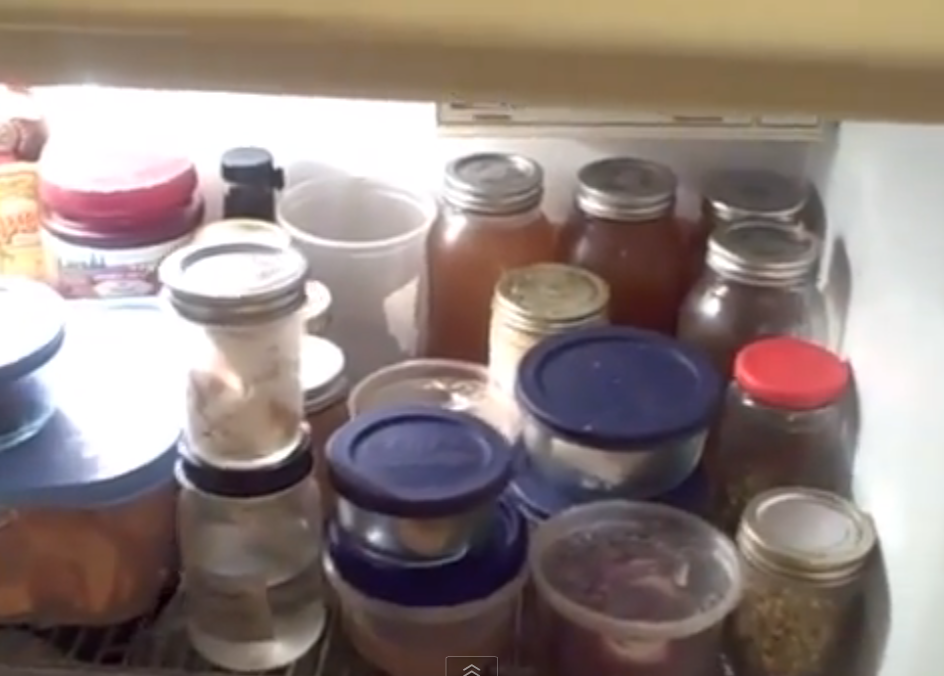
Screenshot 2014-04-10 17.35.46Freezer. My freezer is the area where I (re)use the most plastic in the form of Ziploc bags. They are what I store my scraps in to make my veggie broth. Not sure of alternatives for that.

Also the wheat and gluten free bread that we buy comes packaged in plastic. I know you can buy bread with no packaging at the farmers market, but not sure if they have wheat and gluten free.

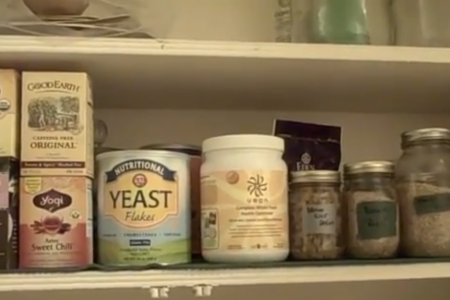
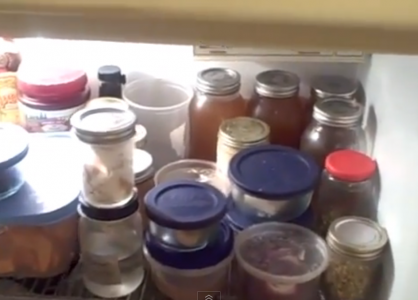
Spices and bulk goods. Lately we’ve been buying items in bulk from our local co-op. This includes spices, grains, nuts, seeds and flours. We’ve been bringing out own glass jars to load-up. It winds up being cheaper and cuts down on all of the wasteful packaging.

Single-use plastics. There are a few scattered items that we have that were impulse or convenience buys that came in plastic packaging like sea salt and buckwheat. These are definitely items that could be bought in bulk.

Glass jars. We intentionally buy certain items in glass jars, like applesauce, so that we can reuse the jar afterwards. We now have a pretty big collection of jars that we are always reusing.

Herbs. Pretty much everything in my fridge is stored in glass jars, except for the herbs. We continually reuse plastic bags to help keep them fresh.

That’s what my almost plastic free kitchen is like. Does anyone have any suggestions for food processor, juicer and Vita-Mix alternatives? Or of another way to store the herbs?

You can check out the video below for a more detailed look.

I Still Say The Organic Elite Surrendered to Monsanto and GE Alfalfa

One of the biggest news stories over the past week has been the USDA’s announcement that it’s going to be deregulating Monsanto’s genetically engineered alfalfa.

There has been a lot of confusion circulating around this news. This confusion started with Organic Consumers Association report that the “Organic Elite” of Whole Foods, Stonyfield Farms and Organic Valley decided to surrender the fight. They decided to give up and select what amounts to the lesser of the presented evils.

I’m always for listening to all sides of the story. Initially I jumped to the conclusion that these companies caved and surrendered. After reading through lots of posts in the past week and the PR statements issued by all of the parties, I still hold that same opinion.

First off, it’s nearly impossible to read the entire PR statements issued and understand what they are saying and the point. That’s the first problem. They are company issued and crafted PR statements. They are not true and genuine statements. At least they don’t seem that way to me.

Here’s an excerpt of the statement as posted on Stonyfield’s blog:

In December, to no one’s surprise, the USDA took a complete ban of GE alfalfa off the table as an option, leaving only two choices: complete deregulation or deregulation with some safeguards to protect organic farmers, which they called “co-existence.” The choice we were faced with was to walk away and wait for the legal battle in the courts or stay at the table and fight for safeguards that would attempt to protect organic farmers and consumer choice, still maintaining the option for legal battle later.

Read Stonyfield’s full statement.

This is an excerpt from statement Organic Valley’s that was posted on their Facebook page:

However, as of December, they had left only two options on the table: allowing unrestricted commercial growing, or partly restricted growing. As much as we wished a complete ban could still on the table, it wasn’t, and we knew we needed to throw our whole weight behind advocating for certain rules, so that farmers would have legal recourse in the face of contamination, and contamination could be avoided by mandating sizable buffer zones and geographical planting restrictions.

Read Organic Valley’s full statement.

Besides the fact that both of those statements are pretty similar (think their PR people spoke with each other about crisis control?), here is how I interpret these excerpts:

We didn’t have any options. We didn’t want to fight anymore. We caved and chose the lesser of the evils presented.

What happened to standing up for what you believe in and fighting? At this point, I don’t think you can continue the fight. They know that if they stand still long enough that you will cave. So they will wait you out, and you’ll cave again.

Thank you “Organic Elite” of Whole Foods, Stonyfield Farms and Organic Valley for opening up my eyes to what you truly are and stand for – just another corporation making a dollar. I can say that I will no longer be supporting any of your brands anymore.

This is just another reason why you should start to grow your own food. We don’t need these corporations controlling our food and making decisions for us. Go to your local farmers market and support your local farmers. Get to know them and ask them questions about their farming practices. Join your local food co-op or CSA. The power is truly in your hands to make a difference.

Beth Buczynski did a good write up on the Care2 blog about this situation called 3 Major Organic Brands Surrender To Monsanto’s GE Alfalfa. She received some heat and copy and pasted corporate response from some of the companies involved, and I’m sure that I will as well.

When David from The Good Human asked the Organic Elite to outright deny the Organic Consumers Association piece, they wouldn’t. They just responded with their cut and past PR statement. Sad.

In the ideal world, I hope that I’m wrong and that they did fully stand-up against Monsanto and GE alfalfa. Maybe I am misinterpreting what has gone down. I’m just stating my opinion as to how I see the situation. I vote with my dollar and will not be supporting these brands.

What are your thoughts on this whole scenario?

httpv://www.youtube.com/watch?v=fz01BVgW2cE

Calorie Counting: Eat Real Food and Don’t Worry

Last week the Eatocracy section of CNN.com posted an article titled – Study shows people don’t give a crap how many calories they eat.

The results of a study showed that, “Posting calories on menus has little effect on what customers buy, according to a recent study.”

Besides the fact that it’s slightly awesome that CNN put the word “crap” in their headline, I think that calorie counting in and of itself is a bunch of crap.

If you eat real whole foods, you won’t have to worry about calories. Ok, let me rephrase that because it’s not just about eating real whole foods. It’s about being active as well.

Sitting around in front of your computer or on the couch all day isn’t going to help. So if you eat real food, remain steadily active, then I don’t think that obesity and being overweight should really be that much of an issue.

My girlfriend used to be overweight and she tried nearly every diet out there. She was on Atkins, Weight Watchers, The Zone, Isagenix and the list goes on.

None of them worked. They weren’t sustainable. She cut out the processed foods and began to eat more whole foods. She dropped 30 lbs.

She remains active through yoga and other exercises, but that kind of lifestyle is sustainable. It doesn’t come to an end. It’s part of the journey.

Same thing goes for being active. You don’t need a fancy gym membership. There are plenty of body weight exercises that you can do. Check out my boy Al Kavadlo for some tips on that.

Growing your own helps with that because you are taking care of your mind, body and planet when you are in the garden. You are moving around. You are connecting with the earth.

To conclude – eat real whole foods that you can recognize the ingredients. No ingredients is even better because it’s a whole food. Keep active and you won’t need to count the calories.

You know what else..start growing some of your own food too.

What’s your thoughts on calorie counting?

httpv://www.youtube.com/watch?v=1zBozj0YPsQ

Why Organic Gardening Makes Sense

There was a post on Rodale.com on rodent control and how it was effecting barn owls. Even though this post wasn’t specifically about gardening, it can certainly be related to why organic gardening makes sense.

Here’s an excerpt from the post:

Other studies have found these dangerous chemicals building up in the bodies of herbivorous animals like squirrels and deer. Scientists aren’t sure why they’re building up in herbivores, but the evidence suggests that the chemicals are extremely persistent in the environment and do damage far beyond the rats and mice they’re intended to kill.

This is part of a larger problem. We see a problem and we attempt to fix that problem. The whole picture isn’t looked at. Rodents are the problem and we do something to get rid of them.

Often a spray, toxic chemical or something else is used. We don’t think or see how it effects everything else. There are other animals that interact with that rodent afterwards that become effected.

It goes beyond just effecting the “problem” (rodent). The entire eco-system becomes disturbed and a trickle down effect occurs.

This happens once you start to use sprays and chemicals. This is why organic methods make sense because they take the entire eco-system into consideration and works within it. Whether it’s through using beneficial insects, non-toxic sprays or another method, it’s more sustainable for everyone and thing involved.

You might get rid of one problem, but you start to create others such as with the owls mentioned in that post.

What are your thoughts and methods you use?

httpv://www.youtube.com/watch?v=M9ncUzs367w

My Food Trend Prediction for 2011

One of the food blogs that I regularly read, Fooducate, had a post 2011 Food and Nutrition Trends.

It was a recap from some of the top food industry experts Marion Nestle, The Food Channel, Food & Wine and Mintel.

I’d like to contribute my predicted 2011 food trend as well. I am going to predict that people will continue to take their food back from the hands of corporations.

More people will start to grow their own food and reestablish that connection with their food source. It’s already begun, and I believe will continue to.

Personally, I receive several emails on a weekly basis from people saying that they have started already, whether it’s one herb on a windowsill, raised beds in their backyard or a little something on the patio.

People are starting to get sick (figuratively and literally) of what’s being produced and pushed off as food. That includes all of the processed, packaged, genetically modified and sprayed foods. I can give plenty of reasons why to grow your own food.

I’ve said it over and over again, it doesn’t have to be a huge garden. Just one plant will make a difference for the health of you, your friends, family and environment.

My other predication for 2011 is that this won’t be a trend and it will become a lifestyle choice for people. Trends come to and end. This won’t.

What’s your food trend prediction for 2011?

httpv://www.youtube.com/watch?v=eWYWY3YYQz8

The S510 Food Safety Act Smells Funny

One of the biggest stories and bills that’s out there right now is the S510 Food Safety Modernization Act that recently passed Senate.

There is lots of speculation and to do about this bill because it can have a huge impact on growers both large and small. It’s written in legalese and has a bunch of amendments and additions to it that it’s confusing to follow and understand what’s going on. Grist.org has been covering the bill in more detail.

With all of that being said, there is one thing that I definitely don’t like about it with no question. The fact that former Monsanto Vice President, Michael Taylor is the Food Czar that would be overseeing the act and oversees the FDA.

That’s like appointing Charles Manson in charge of the prison system or a assigning a pedophile the role as principal. It’s just ridiculous and makes absolutely no sense. So much for the “change” that Obama was offering.

It’s just the same ol crap with politicians appointing people that have ties to be large corporations in authoritative positions. They don’t really have the best interest of people in mind. They have the best interest of their wallets and friends in mind.

This act is under the guise of food safety, but it’s just another way to control the people even more by giving more control to corporations (such as Monsanto).

In the jargon, the “Tester Amendment” has been included, which I think excludes individuals and small growers from all of the expensive measures that need to be taken to ensure “safety” of the food.

The larger issue is that they would even think about enacting something like this on all growers. It’s wrong on many levels.

Yes the small farmer and individuals have been spared, but like Public Enemy sang “Can’t Trust It.”

I think that this was done to get under the rug and something else is going on. Maybe I’m just being pessimistic and could be totally wrong. Hopefully I am, but I don’t feel good about this.

I’m all for celebrating the small victories, but this just smells worse than Staten Island in the 1990s.

We all need to continue to stand up start to grow our own food. Just one plant will show that you don’t want these huge corporations to control us and to control our food.

Knowing what is going on and being able to grow our own food is our given right. Exercise it!

httpv://www.youtube.com/watch?v=pSpteG6WJXo

Giving Thanks For Food: It’s Not Just for Thanksgiving

Most people only give thanks for their food during their Thanksgiving (or other holiday) meals. It’s usually done as an afterthought.

My question is why is being thankful for the food on our plate part of our daily routines? Why is it something reserved for Thanksgiving?

To me this is another example of how disconnected we’ve become from our food source. Thanksgiving is usually a time when friends and families congregate together to be thankful for each other. Giving thanks for the food is done as a, “Oh yea thanks for this food too.”

The feasts that are set out on our tables likely contain ingredients that have been compiled and traveled from all over the world. Let’s not mention what has happened to them during their journey – between the hormones in the turkeys and the sprays on the veggies. (Ok, so I mentioned it)

Giving thanks for food is an act that has been all but lost. I’m not saying that it should be a religious thing because I am far from religious.

What I am saying is that the food that sits on most of our tables, we have come to take for granted. We have no connection to it, nor understand the true importance of it. It’s just there and we expect it to be there on a daily basis.

One of the great parts about Thanksgiving is that it brings friends and families together to share food and enjoy each others company. For most, it’s a great time to kick back and relax from the daily grind.

That celebration and sharing of food is something that shouldn’t be reserved solely for holidays. Food is communal. It brings people together.

So this Thanksgiving when you are sitting around the table be sure to give thanks for your food. The next day give thanks for it again before you eat. Do the same the day after that.

You know what else you should also start to do? Grow some of your own. Just one plant and you’ll become much more appreciative and have a better connection with the food that’s on your table.

httpv://www.youtube.com/watch?v=5EbZMhr-Iok