
What to Do With Your Extra Harvest

I received an email from Amy asking what she should do with the extra peaches that she harvested. She wasn’t talking about 10-15 extra peaches. She was talking more like 150lbs worth of extra peaches.

She said, “I like peaches as much as the next girl, but there is no way, even after jams, jellies, preserves, conserves, chutneys, freezing, and all the pies I can handle that I will be able to even make a dent in that amount!”

This was a great opportunity to tap into the Urban Organic Gardener community on the Facebook Fan Page, where I posted the following question, “You’ve grown way too many of a certain crop. You’ve already pickled, fermented, can and preserved your brains out. What do you do with all of the extra?”

Here are some of the responses or view all of them here.

Me say…“If you are growing something that your neighbor can’t, it’s a great way to share your harvest with them and trade.

Tracy Gould said…“Donate to your local food bank, low income school, church pantry,There are so many places that would LOVE to get fresh organic produce!. See Food for Thought’s page! My favorite food bank.?”

Lauren Kelk recommended…“Cropshare!”

Lee Robertson said…“Share the bounty,that’s my rule….we “shared” enough zucchini this year to supply 10 households will all they could use. Also enough tomatoes that 4 households ,besides our own, were able to can up a good amount for the winter.”

Nathan Blakesley said…“I figure if God gives me a bountiful harvest and has provided me and mine more than enough for our needs, then it’s only right that I share with those around me.”

Susan Doane said…“In my world there is no such thing as “to much” but if there were my neighbors and near by family love the extra’s. We also have a family pantry close by for those who are struggling. Although they prefer canned product, they do accomodate for fresh every so often. Especially around holidays. ♥”

Elizabeth Frazee Fisher said…“Our farmers market has a booth set up where you can drop off extra produce and also the vendors can donate at the end of the morning also. I had a meeting at my house Mon night and sent zucchini home with several people. Our community food pantry will take homegrown excess also. I am thinking our Salvation Army food kitchen probably would take excess. I can and freeze as much as I am able, more than I need as also give to son and daughter and their households. I would feel terrible if anything went to waste!”

Mary Kaschak said…” I always take my extra eggplant to the local Greek restaurant. The owner is so delighted he dances around to his Greek music and gives me a free Greek coffee and baklava. I don’t expect that of course but it sure is lots of fun for both of us.”

Micron Cat said…“Take it to the nearest Title I school and give to the social worker to send home with the kids.”

What are some other suggestions that you can add to the list below?

How to Transplant Mint into a Container

Mint grows like crazy and can easily take over your garden if grown in a raised bed or in ground garden. After all mint is a weed. You almost always want to grow mint in a container.

What you will need to transplant your mint into a container:

  • Container filled with potting mix
  • Mint plant
  • Water

How to transplant the mint:

  • Pour a little bit of water into the plastic container that the mint plant has been growing in.
  • In the center of the container, dig a hole that is about the same size of the container that the mint has been growing in.
  • Gently pop the mint out of the container that it’s currently in and lightly break up the block a little.
  • Insert the mint into the hole that you dug and add a little bit of water.
  • Cover up the hole with the soil and secure the mint plant.
  • Add water to the container.

What are some of your favorite ways to use mint? Don’t say mojito, it’s not original.

How to Make Spicy Roasted Squash Seeds

    Here’s what you’ll need:

  • Pumpkin seeds from the pumpkin you just carved
  • 1-2 tablespoons of olive oil
  • Cayenne pepper, paprika, sea salt and black pepper to taste
    How to make:

  • Soak the seeds in water for 10-15 minutes to get off the orange stringy stuff.
  • Strain the seeds and put them in a bowl.
  • Sprinkle sea salt, black pepper, cayenne and paprika over it.
  • Put in oven at 400 for 10-15 minutes.
  • Open the oven and mix them up.
  • Put back in for 5 minutes.
  • Remove from oven to let cool.

“No Food Choice” Judge Now Works for Monsanto Law Firm

The Wisconsin Judge, Patrick Fiedler, who said that we do not have a fundamental right to consume the food that we grow or raise has stepped down.

This might seem like great news at first, but he now works for the law firm, Axley Brynelson, LLP.

Why is this such a big deal? Because according to InfoWars.com, this firm has worked for and defended Monsanto in the past.

This isn’t the first time that time that a situation like this has happened where a high ranking US official either comes from a large corporation into office or goes from office to a large corporation.

In the comments section of the initial post, some people mentioned this is why it’s important to vote. To me, voting doesn’t matter. It’s choosing one clown over another.

The strongest action that we can take that will make a difference is to shift our dollars and where they go. George Washington is still a very powerful man in this country.

Start growing your own food (at least some of it). This will keep money away from the big corporations. Each and every time you make a purchase, of any kind, you are voting.

If enough of us take that action and shift our spending habits, then change will follow. Every little bit helps.

As long as we continue to keep spending the way that we do and deciding who to vote on, clowns like Patrick Fiedler will continue to take away our rights and ruin our lives.

The power is in our hands. What are some other things we can do to make a difference?

Photo courtesy of shyb


Why Not to Use Chemicals in Your Garden

We already know some of the effects of chemical gardening and why organic gardening makes sense, but I posed an open-ended sentence on the Urban Organic Gardener Facebook page that said, “I don’t use chemicals in my garden because ___.”

Over 70 comments were left by people giving their reasons why. All of which were simple and to the point. Most of the responses mentioned not wanting to eat the chemicals and respecting wildlife and the environment.

Here are some of the comments that were left:

Carolyn Madison said…“because I do not want to eat chemicals – Chemicals create toxic food!”

Missy Gullickson said…“if a bug won’t eat it, I won’t either…”

Randy Smith said…“I don’t like to eat stuff that has skull and crossbones on the package.”

Roberta Clay said…“I don’t use chemicals in my garden or on my farm, because it can harm or kill my bees, the wildlife, the earth and anything the land produces!!!”

Matthew Lee said…“‎…they harm my family and ultimately impede the sustainability of my farm.”

Michael Van Varenberg said…“‎ i like pulling weeds.”

Pam Howe said…“…cancer sucks.”

Michele Dangelo said…“My kids eat the food.”

Lynn Johnson said…” i already have more than enough unwanted chemicals in my life–in the air i breathe, the water i drink, the food i eat…”

Urban Hillbilly said…“Really I don’t use chemicals because I almost lost my 2 1/2 yr old baby to appendicitis. Not one doctor could tell me why someone so young got so sick….I fed her good food but it was NOT organic… SO this is how I became the Urban Hillbilly.”

Robin Gwen said…“I like to squish bugs.”

Deanna Rolfe Dunn said…” I don’t want to eat chemicals – there’s enough stress to our bodies without adding to it!”

What are some other reasons not to use chemicals in your garden?

Photo courtesy of andypowe11

Using a Scarecrow to Scare Birds From Your Garden

Just because you have a balcony garden or are gardening in a small space, doesn’t mean that birds won’t be picking at your food.

Screenshot 2014-04-10 17.22.38

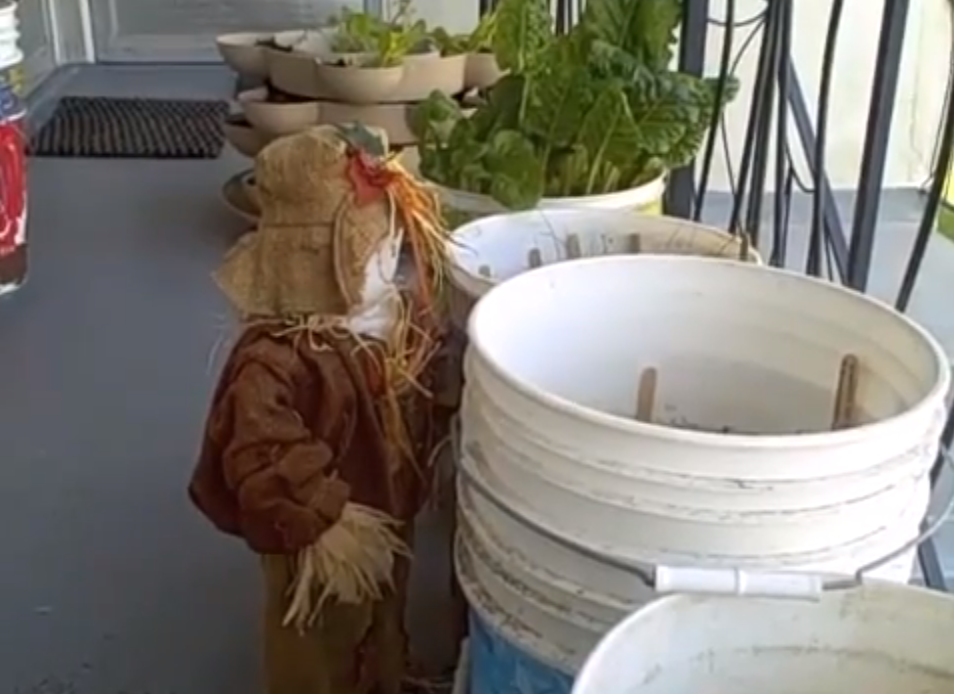
What I’ve started to do is use a scarecrow to keep the birds away from the seedlings and sprouts in my containers. No clue why birds are scared of scarecrows, but it works. My guess is that they think it’s a person.

All you have to do is put the scarecrow by the containers. Make sure that you move him or every day or frequently. This will trick the birds into thinking that it’s alive and moving, so they won’t go after your stuff.

What are some other ways to scare birds away from your garden?

Petition to Get GMOs Labeled

GMOs (genetically modified foods) are something that I frequently discuss on this site and Facebook.

When I saw the Just Label It campaign, I thought it fitting to share here.

The goal of the campaign is to get GMO foods labeled by getting enough signatures and flooding the FDA with them. I’m not one for signing petitions and all that, but thought the cause was worth sharing. Whatever it takes to work.

There are some pretty big names behind the group including the Environmental Working Group, The Organic Trade Association and Robyn O’Brien.

What are your thoughts on the Just Label It campaign and its efforts to get GMO foods labled?

Harvesting Parsley Seeds: A Simple How To

There is a parsley plant on my balcony garden that has been going to seed for a few weeks now. The seeds have finally developed.

They emerged in about 3-4 stages, which are difficult to explain, but the the picture about clearly shows what the seeds look like.

You just have to carefully pull them.

What is your favorite way to use parsley?

Judge Says Our Food Choice Is Not a Fundamental Right

When I asked about what food news has caught your attention, most people mentioned the cantaloupe listeria outbreak.

One person, David Csonka, mentioned a story from Food Renegade that no one else did called Is Your Choice of Food a Fundamental Right?.

I’m surprised that this one didn’t get more attention.

There was a court decision in Wisconsin where Judge Patrick J Fiedler said that we do not have a fundamental right to consume the food you grow or raise.

His words were:

“no, Plaintiffs do not have a fundamental right to own and use a dairy cow or a dairy herd;”
“no, Plaintiffs do not have a fundamental right to consume the milk from their own cow;”
“no, Plaintiffs do not have a fundamental right to produce and consume the foods of their choice”
source

He is saying that we don’t have the right to grow and/or raise our own food to consume. I would somewhat understand if he was talking about selling that food, but he’s not. That’s what makes this ridiculous.

This is not an issue about being Democrat or Republican. It’s an issue about saying that we as humans and Americans do not have a right to grow and consume our own food.

I’m not sure about what this ruling means and what is going to happen. I just wanted to bring it to your attention and get some discussion going around it.

I thought getting fined for growing too much food was a bit much, but this definitely supersedes that one.

Here are my thoughts – I say screw Judge Fiedler and what he has to say. I’m going to continue to grow my own food. I might even get some miniature cows and goats for my balcony garden too.

What are your thoughts on this? Is your food choice and being able to grow and consume your own food a fundamental right?

Photo courtesy of SocialRobot on Flickr.

Collecting Rainwater for Your Small Space Garden

A rain barrel is something that would be great to have to be able to collect rainwater, but the reality is that it won’t work for those of us apartment gardening.

One reason is that since we are dealing with small spaces, so every little inch counts. Something as large as a rain barrel really isn’t practical.

That doesn’t mean that we can’t collect rainwater though.

The other day when I woke up, it was raining. It hit me that I could put some of the empty 5-gallon containers close to the edge of the balcony and harvest a bit of the rain water. It helped that the gutter is a bit busted and was overflowing at that spot.

It wasn’t a horrible rainstorm and lasted only a few hours, but during that time I was able to fully fill up two 5-gallon containers. Those will last me at least two weeks and will help to conserve some excess water usage as well.

Much like growing your own food, every little drop of conserved water matters.

What are some ways that you conserve water in your garden?

Watermelon Basil Salad

    Here’s what you’ll need:

  • Cut up watermelon
  • 1 lime
  • 1/4 cup of olive oil
  • Handful of fresh basil
  • Tablespoon of paprika
  • Dash of sea salt
  • Dash of black pepper
    How to make:

  • Put the watermelon into a large bowl.
  • Pour olive oil over watermelon.
  • Sprinkle sea salt, black pepper and basil over it.
  • Squeeze lime on top.
  • Tear up and add your basil.
  • Toss to coat and serve.

Back From Break. Balcony Garden Update.

Damned. Hard to believe that it’s been well over a month since I took my break. Much to your delight, I am back though and back to posting.

I appreciate all the comments and feedback that were left during that time to let me know what you are liking and not liking. It will all certainly be taken into consideration.

Screenshot 2014-04-10 17.27.07

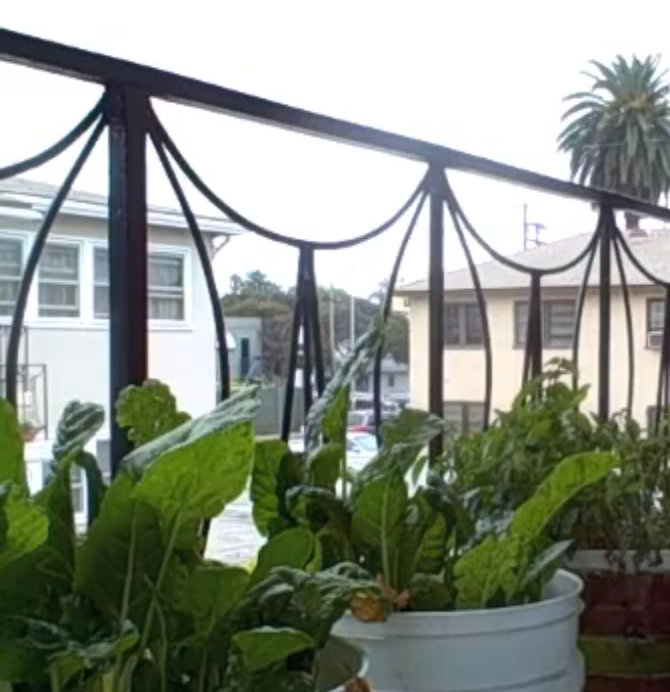
When I was gone, nobody really took care of the garden. Anita was with me for most of the trip. Since they are self-watering containers, they can survive a bit longer than most traditional containers without being watered. Though one of my neighbors said that she did sprinkle some water on the containers for me.

The two chard containers didn’t look so well when I got back. After Anita watered them, they perked up and are doing great.

The mint container which was doing amazing….isn’t anymore. It looks like crap. Hopefully it will come back around.

Now the pumpkin container, that I pruned because it was getting powdery mildew, ain’t doing well. By ain’t doing well I mean it’s dead. Was able to get a tiny little pumpkin from it though. All good.

Now it’s fall time and I have a crap load of containers and lots of space on the balcony garden to get some fall veggies growing.

Have you started your fall garden? If not, what’s up with that? If so, that’s what’s up and please share what are you growing in the comments below. Good to be back!

Taking a Break and Asking For Your Feedback

This is going to be my last post for a few weeks. Going to be taking some time away from the site to travel and visit friends and fam. Time to rejuvenate so I can get some new life into the site.

During the time off, I will be taking a look back at the past few months and evaluating what’s been done to see what has done well. That will to help come up with new ideas and to keep the site fun and interesting. The last thing I want is to become is another boring gardening site.

One idea that I’ve had that I want to work on is rigging so that it can be used to water all of the containers. That way if you have multiple containers, you only have to water one of them.

Most importantly is – what have you really enjoyed and really hated? Be honest, I can take it. If I don’t like your opinion, it obviously means that you are dumb and I won’t fault you for that.

For reals, please provide me with your feedback to help grow and shape this site.

Do you like the quick gardening tips? Dislike?

More or less on the effects of chemical gardening and alternatives?

What about the food news? More of it? Less of it? Cut it out all together?

Have you been enjoying the recipes or can do without them?

What else would you like to see that hasn’t been covered?

Lemme know in the comments and I’ll check you when I get back to posting on Monday, September 19.

How to Easily Cut a Watermelon

Cutting a watermelon has usually been a pain for me. When I was at the farmers market one day, I learned this simple way to cut them.


Cut the ends off of each side.


Stand the watermelon up flat and cut the rind off in a downward motion.


Cut off any remaining white part.


Your watermelon should now look like this.


Cut it down the middle in half.


Lay it down, then slice it across.


Slice it perpendicular.


You can cut it up again or enjoy it as is.

GMO Grass: What’s Next?

The latest in crazy GMO news that I read on Rodale.com is that there will soon be a genetically modified kentucky bluegrass. According to the article:

The grass is still in its research-and-development stage, so it’s not available in stores yet, but experts fear the recent USDA decision to not regulate it as a noxious weed or plant pest could push it onto the market faster, since there are few regulations to hold it back.

Even though this isn’t food, it scares me for many reasons. The first reason is that the USDA is doing nothing to regulate GMOs infiltrating our lives. They’ve done this before with the genetically modified alfalfa and sugar beets, now the grass.

Kentucky bluegrass is usually used in public places such as golf courses, parks and ball fields. It will be resistant to Round-Up, so we will be exposed to even more chemicals in our daily lives. The leisurely picnic or round of golf will be accompanied by a nice dose of Round-Up and chemicals.

Since our government and its agencies are in the pockets of the big chemical companies and don’t have our best interest in mind, it’s up to us to do something about it.

We need to stop supporting companies such as Scotts Miracle-Gro, even if it’s their Organic Choice.

We need to stop using the chemicals in our homes and gardens.

We need to vote with our dollars and support the companies and business practices that believe in.

What do you think about this genetically modified kentucky bluegrass and what else can we do about it?

Photo courtesy of George Eastman House on Flickr

How to Prune a Pumpkin Plant to Allow Circulation

I searched the internet for a few hours looking for how to prune a pumpkin plant. All I could find was the same mumbo jumbo gardening speak of secondary, tertiary and blah, blah, blah with no pictures or visuals of what the hell people were talking about.

The reason for looking on how to do this is because my pumpkin plant is starting to get some powdery mildew and pruning your plant to allow for better circulation is supposed to help prevent that. Makes sense to me especially since I am growing them vertically in a container.

Based on what I read, I think I figured out how to prune a pumpkin plant. What I did was remove the leaves and stems that were most infected with the mildew. I cut them at the point where they met the vine. This was done for all of stems that had the dead leaves.

When I was done I had more than a handful of dead and powdery leaves. There are still some leaves left on the plant and much more room for circulation.

What are some other tips you have for taking care of pumpkin plants?

Sharing Your Garden Harvest With Neighbors

I was fortunate to have one of the great experiences of growing my own food this past weekend – the experience of sharing the harvest with others.

While on my balcony garden taking care of my mint, I noticed a neighbor across the way harvesting some herbs for their meal. Since my mint container is overflowing, I shouted across the way to ask if he needed any. He came over to get some mint and we bs’d for a few minutes.

Though we have seen each other before, this was the first time that we actually spoke to each other and conversed.

A few hours later, he knocked on my door with some fruit salad that had some of the mint in it. That really brought it all together for me.

I’ve mentioned before that one of the simplest of reasons that we should grow our own food is that because we are human and it’s what we’ve done for hundreds of thousands of years.

Instead of me yapping and talking about it, it was apparent to me that growing your own food does help to bring people together through sharing.

What are some stories that you have about sharing your garden harvests?

Creamy Garlic Dressing

    Here’s what you’ll need:

  • 5-6 cloves of garlic
  • 1/4 avocado
  • 1/2 lemon
  • 2 tablespoons of olive oil
  • Dash of sea salt
  • Water to consistency
    How to make:

  • Bust open all of your garlic and add it to your blender or food processor.
  • Squeeze in your lemon and add the rest of your ingredients.
  • Blend it up, adding tablespoon of water at a time until desired consistency is reached.
  • Serve atop a salad or as a veggie dip.


Aminopyralid: Know Your Manure Source

I read a story in the Guardian UK about a plant disease called aminopyralid and how it’s affecting small growers and home gardeners. Even though it’s a disease that seems to have just hit the UK, how it happened is what’s alarming to me.

What is aminopyralid

Here is what happened. The chemical company, Dow Chemicals, produced a hormone based herbicide, aminopyralid, that started being used in the UK back in 2005.

According to the Guardian article:

It is used by farmers to kill broad-leaved weeds growing in fields of grass. It locks onto the cellulose in the plants, passes through the guts of the animals that eat them, and retains its potency in their manure, sometimes for two or three years or more. It is not believed to present a risk to human health.

How it affected growers

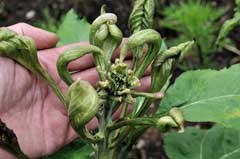
What wound up happening is that the small growers and home gardeners like you and I who were using animal manure instead of chemical fertilizers were being hit hard because the chemical was being passed through the manure into the gardens. Plants were shriveling up and dying. You can read more about the whole story on the Guardian web site.

This is why we need to not only get as close to our food source as possible, but also do our best to know the source of all/most things that we are using.

In the case of aminopyralid, they are having a hard time tracing it back to the exact source. There is all kinds of paperwork and redtape that needs to be filled out to prove that your manure is safe, etc.

It’s not easy to separate conventional and organic

This just shows that it’s not as simple as having conventional farming over here and organic/sustainable practices over there. There will be cross contamination through run-off, wind and other means. We don’t live in bubbles. Everything affects everything.

As an individual it’s disempowering because you think you are doing something that you believe in by using animal manure, but then it results in plant disease from chemical companies. The worst part is that there is no retribution that can be sought against the chemical companies.

In this specific instance, this is a problem that is happening overseas. I would think that similar instances with other chemicals and diseases are occurring here in the States as well.

The responsibility is on us

It puts more of the responsibility on us the consumers and individuals to question and really know the source of what we are buying. What’s your thoughts on the situation?

Photo courtesy of John Mason, on Gardeners’ Alert: Aminopyralid-contaminated manure – a problem that has not gone away.