Record-Eagle.com – Today’s mass-produced food landscape is often detrimental to food sovereignty efforts.
Indigenous ancestral teachings are anchored in creation stories and cover science, math, history, and sociology. They shaped the food systems of each community for thousands of years before colonization.
“Our foods speak their own ancestral language,” said Kirsten-Kirby Shoote, from the Tlingit tribe in what is now Alaska. Shoote has dedicated her life to bringing back Indigenous foods to her communities through seed saving.
She works for I-collective; a nonprofit organization of Indigenous chefs, farmers, activist, seed and knowledge keepers, and refers to herself as a “food activist, seed saver, chef and urban farmer.”
She grew up in Chinook territory in what is now Oregon, and moved to Waawiiyatanong (Detroit) in 2015 to explore urban Indigenous food sovereignty. Her project Leilu’ Gardens focuses on “cultivating relationships with plants to heal generational wounds through revitalizing urban gardening and seed saving. She hosts pop-up dinners for the community to explore dishes together.
It’s the dream of millions of people: To live off the land and to never need to make a trip to the grocery store. But for nearly everyone with that dream, it’s just that — a dream. Our current global, industrial food system is just too convenient and easy to resist. Our modern lives are too busy and monetized to go that far back to the land.
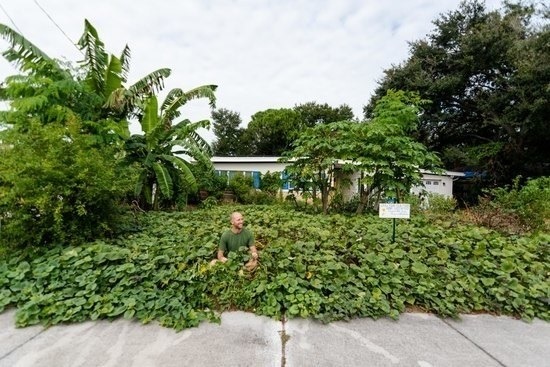
I’ve been exploring food for nearly a decade and since the beginning, I’ve had the burning question: Would it be possible to produce 100% of my own food in the times we live in? Could I exist without grocery stores and restaurants? Nothing packaged or processed? Nothing shipped from far-off lands? Could I grow and forage everything I ate for an entire year?
That’s the question that I set out to answer just over a year ago. One big thing though: I didn’t have a farm or even a house with a front yard. All I had was a backpack and I didn’t have much growing experience, either. You could say I was jumping off the deep end.
I chose to do this in Florida for the year-round growing season and the local “grow-your-own” movement I had stumbled across while traveling through a few years prior. I quickly got to work, meeting people in my neighborhood and proposing that I turn their lawns into gardens. It wasn’t hard to find takers. I’d cover all the costs, do pretty much all the work and they could eat as much food as they’d like. What’s not to love about that deal?
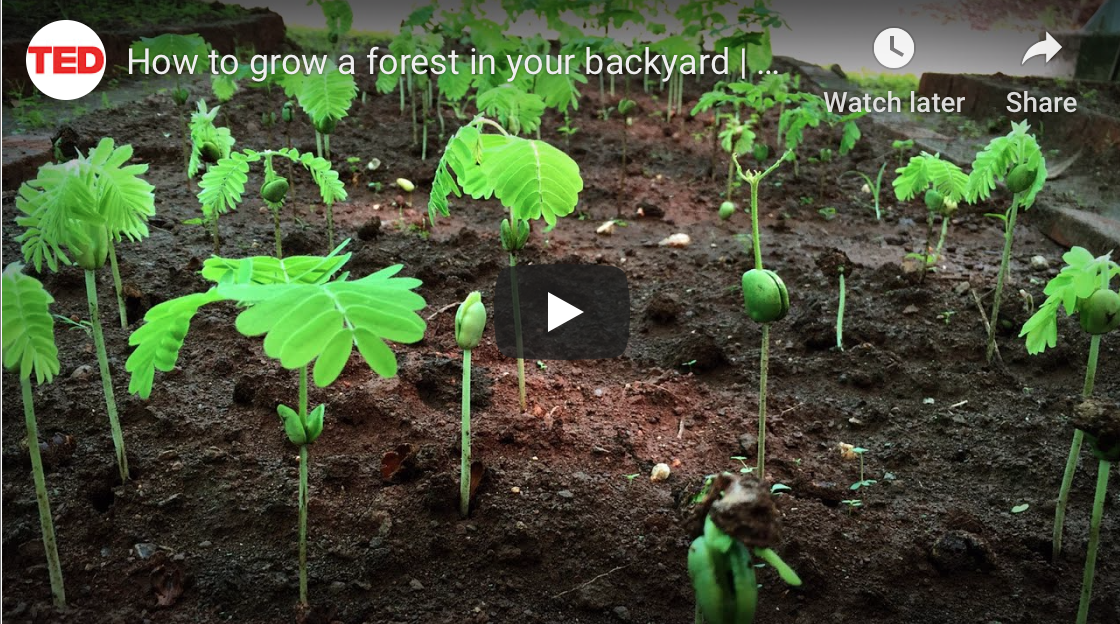
Forests don’t have to be far-flung nature reserves, isolated from human life. Instead, we can grow them right where we are — even in cities.
Eco-entrepreneur and TED Fellow Shubhendu Sharma grows ultra-dense, biodiverse mini-forests of native species in urban areas by engineering soil, microbes and biomass to kickstart natural growth processes.
Follow along as he describes how to grow a 100-year-old forest in just 10 years, and learn how you can get in on this tiny jungle party.
TEDTalks is a daily video podcast of the best talks and performances from the TED Conference, where the world’s leading thinkers and doers give the talk of their lives in 18 minutes (or less).
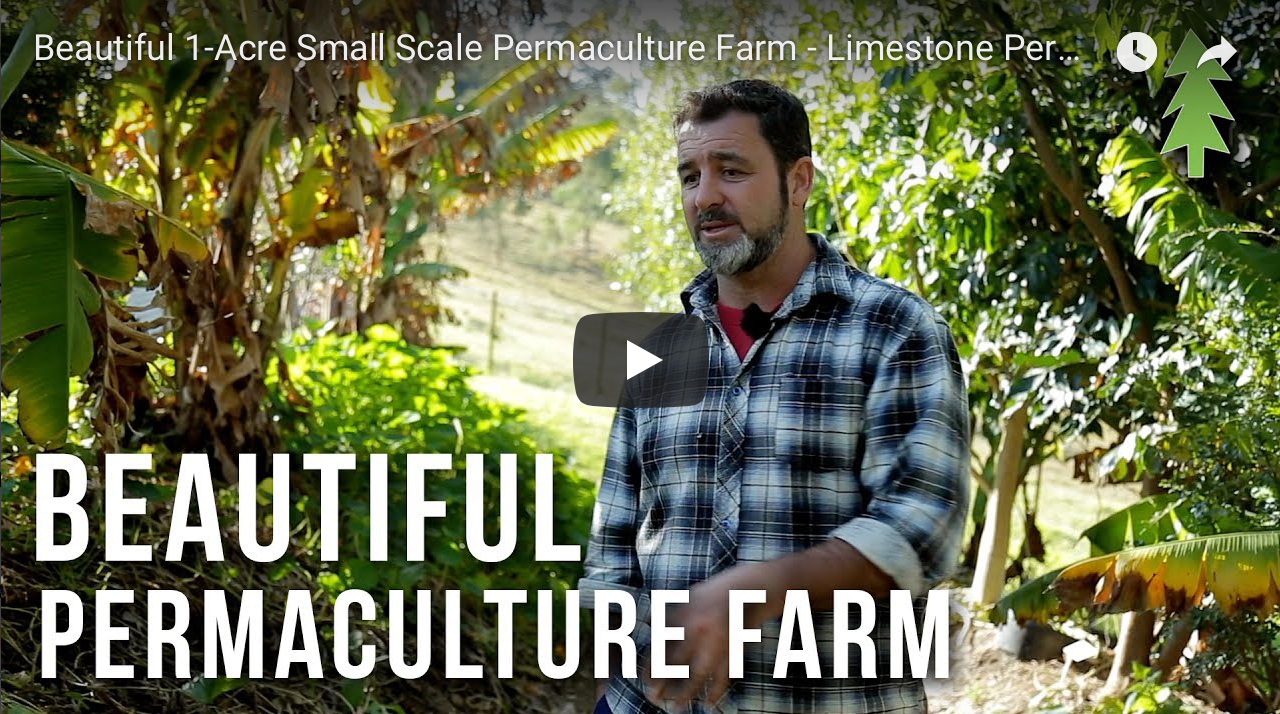
One-acre garden provides fruit, veggies and eggs for 50 families with very little labor
More and more people are learning growing food doesn’t have to be hard work. When you work with nature instead of against it, it does much of the work for you.
It’s called permaculture. While permaculture gardens require a year or two of work up front — mostly restoring land laid waste by agriculture — once they are set up, they almost tend themselves.
We want to be where our fans and fellow gardeners are, so we’ve headed over to snapchat and created an account! We hope you’ll share all of your awesome gardening successes/tips/and learning experiences with us over there.
Let’s be friends! Just use the snap code below to quickly and easily add us and see more great content from us, everyday!
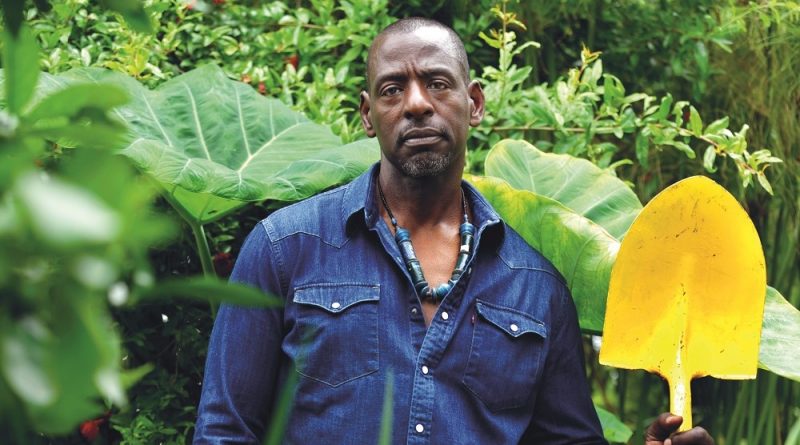
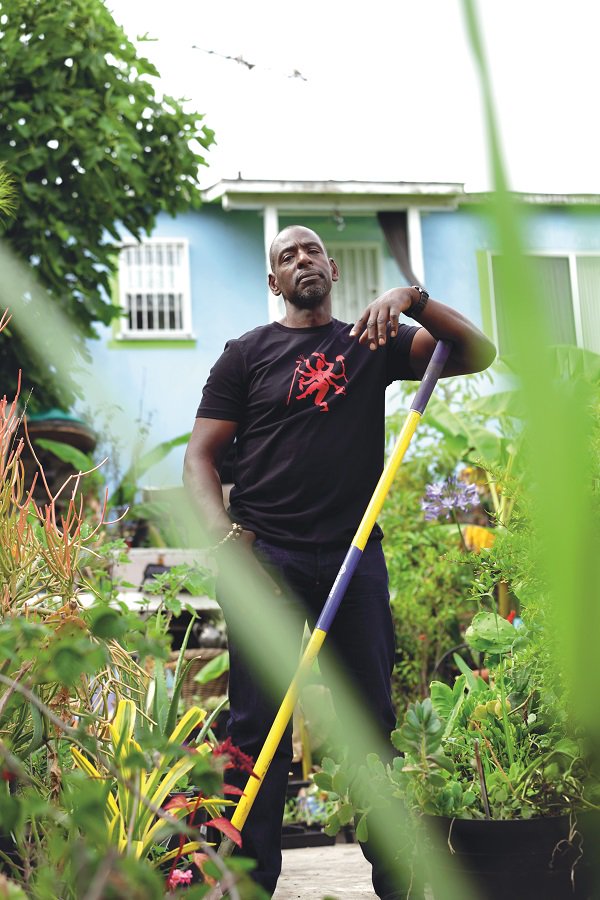
“Los Angeles-based ‘gangsta gardener’ and community leader Ron Finley is determined to redefine ‘gangsta’ as being about building thriving communities, not machismo.”
“Gardening is gangsta: Mother Nature is gangsta. Being educated, creative and self-sustaining is gangsta. That whole concept was about turning a negative into a positive. If you want to be gangsta about anything, make it about building your community, sharing knowledge.
Men are brought up being told that we’re supposed to be provider and protector. But, as far as I can see, a lot of our communities are basically designed to kill people, because you can’t find healthy or nutritious food in them. Why is it easier to get alcohol than an organic apple? Why, in certain communities here, is it easier to get a gun than it is to get an organic carrot? Cities are designed for commerce, not for people.”
This article was first published by Positive News and is republished with permission.
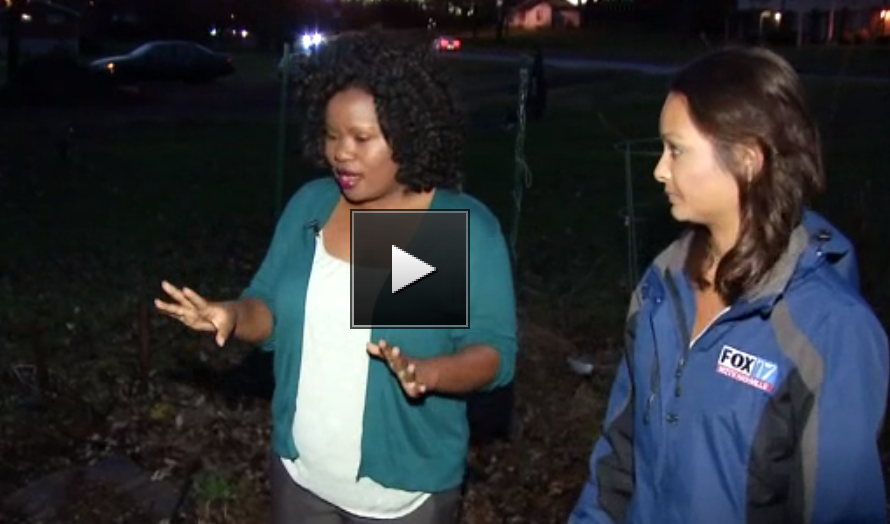
NASHVILLE, Tenn. (Jen French) — Beatrice Gatebuke’s roots are actually in Rwanda. She’s a refugee. At the age of 13, she and her parents escaped genocide.
“Nothing was familiar,” Gatebuke said. “It’s a brand new environment. We didn’t speak the language; we had to go through translators.”
Gatebuke started an urban garden for refugees off of Paragon Mills Road. She said many refugees can’t afford their own vegetables. The non-profit is called FASHA, or Fervent Assistance to Survivors for Healthy Adjustments.
“We had tomatoes,” Gatebuke said. “We have bell peppers. We had okra. Some of our people can’t afford to buy vegetables from the store because it’s just so expensive.”
Gatebuke graduated from Northwestern and now works as an information systems analyst for Community Health Systems in Franklin. She came to the United States through the refugee program.
“We were resettled by the Catholic Charities,” Gatebuke said.
According to the Catholic Diocese of Nashville, Catholic Charities gets federal grants and is contracted by the US government to distribute grants for resettling in Tennessee.
When it comes to state money, such as TennCare and SNAP, State Senator Bill Ketron would like to know how much is going to those forced to settle. He is drafting financial transparency legislation that he plans on introducing next session.
“In the past, nobody would ever give us those numbers,” State Senator Bill Ketron, R-Murfreesboro, said. “We’ve worked diligently to combine these numbers to base our claims on. “What my bill will do is expose a lot of those expenses that nobody knows that we’re paying currently.”
Gatebuke said both of her parents are employed. When her family came to the United States, they were required to pay the federal government back for the plane tickets that got them here.
Gatebuke understands there’s growing tension over the Syrian refugee crisis in Europe. She hopes she can cultivate relationships with new refugees so they can flourish here.
“We are all working and trying to contribute to American society,” Gatebuke said.
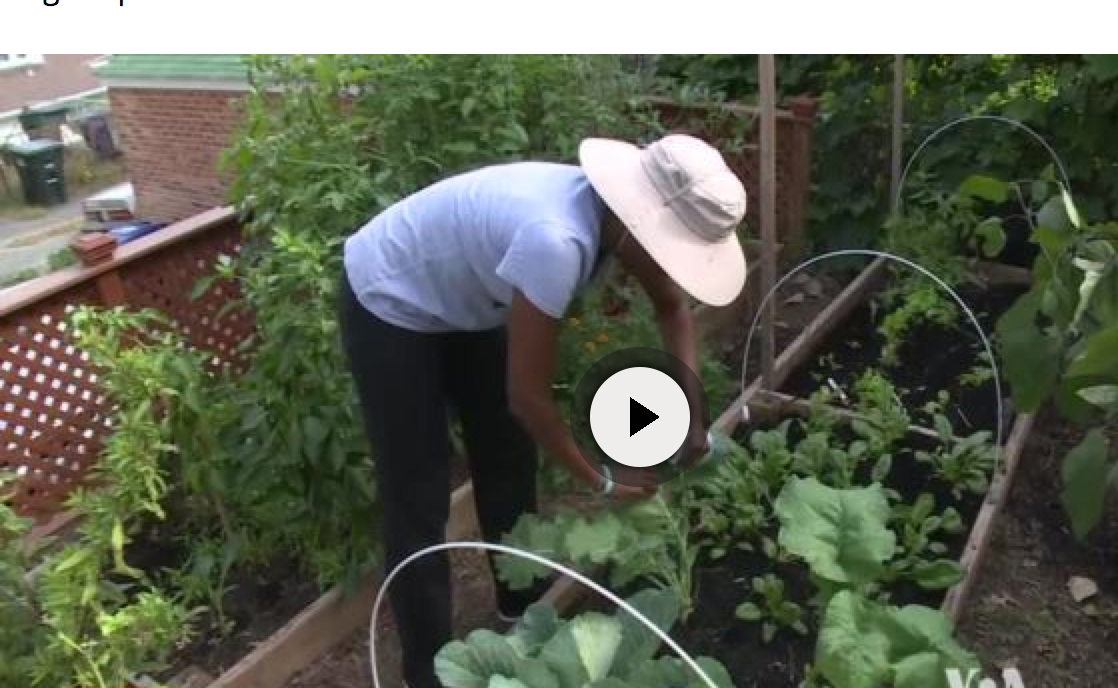
The most precious time of the day for Shari Miles-Cohen is dinnertime, when her family gathers around the table and eats the food she cooked. On a recent day, she prepared a vegetable dish consisting of eggplant, okra, onions and garlic. All these vegetables came from her garden.
When her family moved to Washington last year, Miles-Cohen started a vegetable garden, inspired by some of her family memories.
“When I was a kid,” she recalled, “my aunt had a garden and she grew all sorts of staples; greens, potatoes and onions. I’ve always loved to sort of get my hands dirty in the soil.”
Now she plans family dinners around her garden harvest. “We have tomatoes and eggplant and okra, sweet peppers and all kinds of greens you can imagine,” she said proudly. “I had to become more creative with recipes. I spend a lot of time on the Internet trying to look up recipes for the vegetables that have been really prolific, like the eggplant.”
Be creative
Miles-Cohen gets help twice a month from gardening coach Natalie Carver, from the garden design company Love & Carrots.
“Here we’re growing out of raised beds,” Carver pointed out. “So there is this structure in the soil, and we really try to plant every square foot. A lot of our favorite summer vegetables, all of our tomatoes and basil, all the things that people want out of their garden, they need lots of sun.”
Planting vegetables in small spaces — urban gardening — is a growing trend, said Meredith Sheperd, who founded Love & Carrots.
“People are interested in where their food comes from these days,” Sheperd said. “They are interested in eating really healthy. They might not trust what they’re buying in the grocery store anymore, so they want to grow it themselves.
“I read a statistic that something like 70 percent of Americans are gardening these days and it’s growing at a rate of 20 percent since 2009. So it’s really just taking off. It has been historically young women who are mostly interested in gardening, but I think young men are catching up.”
Sheperd admitted that urban farming has its limits, but insisted that it doesn’t have to be limiting. She helps her clients find creative ways to grow their favorite vegetables, no matter how small their gardens are.
“If you have a wall that’s nice and sunny, we’ll put a nice, sturdy trellis on the wall and grow something like beans or cucumbers or peas — make use of the vertical space,” she said. “Then have another thing spilling over the front of the garden.
“On a balcony, we’ve used containers. We’ve even used 5-gallon buckets, if people are tight on a budget, to grow tomatoes or cucumbers or something like that. You just have to make sure it can drain and fill it with good soil and keep it watered and healthy.”
Fresher, cheaper
Kaliza Hutchensin grows her vegetables in a tiny garden in front of her townhouse. She said she gets the best flavor and variety, and the food is cheaper.
“I don’t go grocery shopping for vegetables at all. A hundred percent of my vegetables come from my garden,” she said. “I only like to plant what I can eat. Every year I learn what I’ve wasted, what I used practically. In a busy home, where both of us are working, I mostly try to create meals around what I’m growing.”
Hutchensin, who was born in Zambia and grew up in the United States, said her small garden means a lot to her.
“My dad was a farmer, so that was the major reason why I was looking to settle down in a place [where I could have a garden],”she said. “I still enjoy being in an urban environment, but I also missed out on feeling [like] being a part of nature, the environment.”
Her vegetable garden adds color to her home’s entryway and helps her family eat better.
Viviana Franco is founder and executive director of From Lot to Spot, an organization that spearheads efforts for more community gardens and green space throughout Southern California. photo courtesy of Viviana Franco/From Lot to Spot
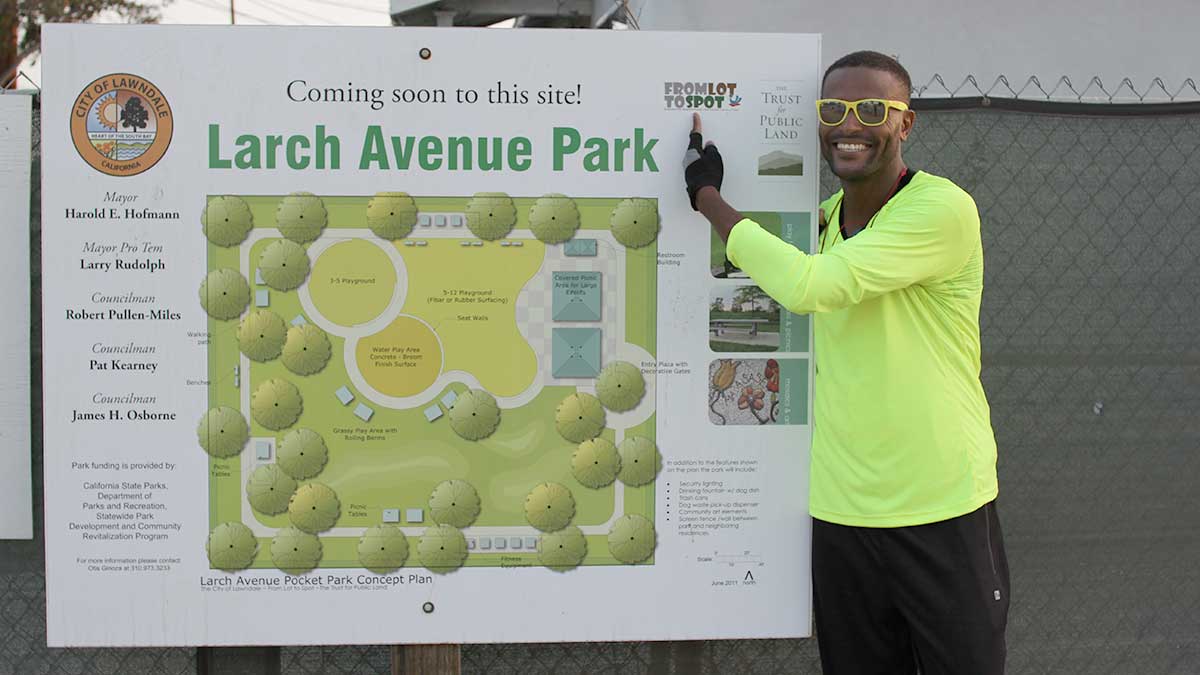
Los Angeles-headquartered From Lot to Spotis true to its name—the organization transforms unused, vacant lots into vibrant spots of green space and parkland.
According to founder and executive director Viviana Franco, From Lot to Spot has spearheaded several urban and community garden initiatives throughout Southern California, including several in Riverside.
Franco says Riverside hired From Lot to Spot as a partner in building up the gardens, specifically in capacity building and leadership processes. These gardens include Tequesquite Community Garden, Arlanza Community Garden, and East Side Community Garden at Emerson Elementary School.
The Tequesquite Community Garden consists of 1.12 acres at Bonaminio Park. Open to all community residents, it opened in June 2013 and offers garden plots. Arlanza Community Garden was spearheaded by Child Leader Project participants from nearby Norte Vista High School, in partnership with the City of Riverside. Also open to all in the community, the effort has revitalized an underused lot in a strong effort of investment for social change. Founded in 1980, the East Side Community Garden at Emerson Elementary School is Riverside’s oldest. It offers a “garden to salad bar” for Emerson students, and represent a collaborative effort between the school and the City of Riverside.
From Lot to Spot still works with all three gardens. “It’s been an amazing experience,” says Franco. “Every garden has its own different dynamic.”
Other From Lot to Spot projects in Southern California include: 118th & Doty Pocket Park in Hawthorne, a community without many parks; Lennox Community Garden, the first community garden in Lennox; Bicentennial Park in Hawthorne, a revitalization project; Larch Avenue Park in Lawndale, another park addition in an area devoid of parkland; Dominguez Enhancement & Engagement Project, a revitalization effort of Dominguez Creek; Stanford/Avalon Community Garden in Los Angeles; and more.
While most of From Lot to Spot’s work takes place in the Los Angeles area, Franco said her group will work anywhere they are needed. “There are no geographical limits of low access to healthy foods,” she says.
“I founded From Lot to Spot seven years ago out of a need in my personal neighborhoodHawthorne and Inglewood,” Franco says. “There was an abundance of vacant lots. So I went to school to learn.” She earned a bachelor’s degree in history and a graduate degree in urban planning from UCLA.
The efforts of From Lot to Spot are concentrated on low-income communities, “food deserts” with little access to fresh, quality food but an abundance of fast food establishments and liquor stores. Franco said that this problem impacts many African-Americans and Hispanics, and often results in obesity and associated diseases such as diabetes.
“From a health and sustainability standpoint, local food is intrinsic,” says Franco, who sees links between green spaces such as parkland and access to good food. These associations include more health and walking benefits and a greater awareness of the importance of diet to health. Also, she believes that both community gardens and parks strengthen their respective local economies by increasing home valuesof which the business community takes note. “I call it a great green circle,” she says.
Franco acknowledges that parks are often at the bottom of the barrel of many cities’ budgets, but she firmly believes that parks and gardens bolster the tourist economy and increase connectivity between neighborhoods.
Despite the successes enjoyed by From Lot to Spot, Franco says the journey has not been without its obstacles—chief among them are bureaucracy and the difficulty of coming into a new community, where people may wonder what will be done with a vacant lot. Timeliness is also an issue, she says, as it can take a long time to convert an area into green space. “We’re not there yet,” she says.
So how is “there” defined? According to Franco, the future goal, at least for right now, is 20 more green spaces by 2020. She hopes to attain this goal through From Lot to Spot’s many partnerships, which include Los Angeles County and numerous Southern California cities. An unexpected partnership was one with the Los Angeles County of Public Worksshe was surprised that engineers would want to work with environmentalists.
From Lot to Spot is committed to fostering urban agriculture, says Franco, who is working hard alongside her From Lot to Spot colleagues in increasing local food access in Riverside and throughout Southern California.
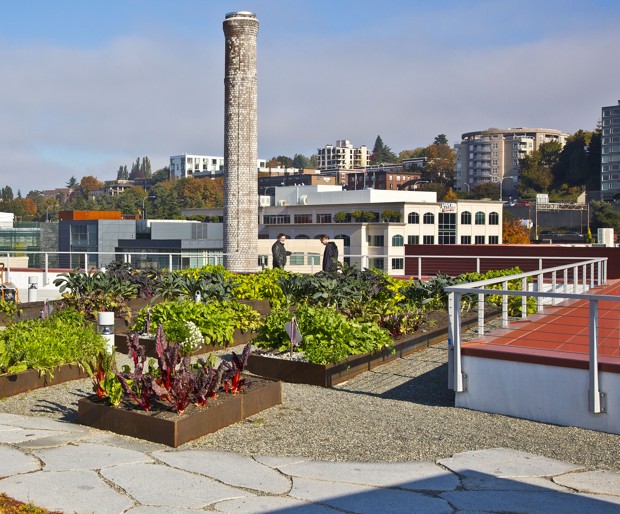
The roof garden on the Stack House Apartments in Seattle’s South Lake Union neighborhood. (Michael Walmsley/Vulcan Real Estate)
At the Stack House Apartments in Seattle’s now-trendy South Lake Union neighborhood, residents can walk out onto a terrace and pluck a tomato right off the vine.
In the South Bronx, an 8,000-square-foot hydroponic greenhouse atop an affordable housing development is creating jobs and food for the residents below—along with cooler summers and warmer winters.
And in Somerville, Massachusetts, Assembly Row, a still-under-construction mixed-use development, features a small garden that serves several local restaurants and is a learning site for area employees.
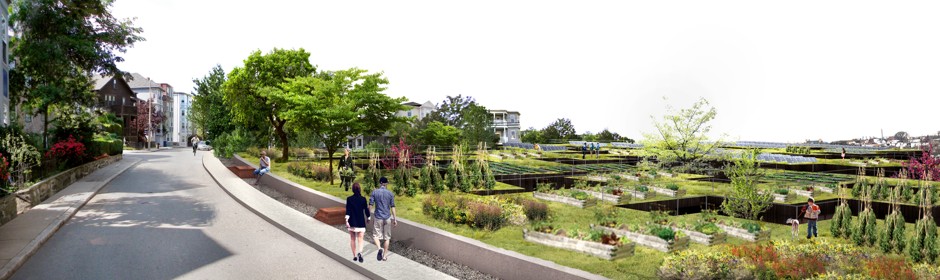
Environmentally conscious construction and building systems are old news at this point, but building-integrated food production is a relatively new, though growing, area of focus. And it’s led to a bit of a strange bedfellows situation: As both urban agriculture and real estate boom in a number of U.S. cities, real estate developers are looking to small-scale local growers to augment their plans. At the same time, food activists are beginning to recognize how even luxury builders can advance their cause.
Henry Gordon-Smith, who advises schools, builders and cities as they roll out vertical farming projects, says he now receives up to 10 calls a week from builders and architects inquiring about such technologies or, increasingly, seeking experienced growers.
A rendering of Sebastian Mariscal Studio’s forthcoming Mission Hill project in Boston, a mixed-use development that will incorporate a rooftop community roof garden and solar farm. (Courtesy SMS)
“The building has to be productive,” he says. “All of that creates better occupants, and better citizens. Food is the next frontier in this.”
Instead of seeing Boston’s building boom as a threat to her urban farming business, Jessie Banhazl, founder and CEO of the Somerville-based Green City Growers, looks at new development as a positive. She started out installing terra firma gardens in backyards and public spaces, but says much of her work of late has been meeting with major developers and architects to build rooftop and grade-level farms into their plans from the conception stage.
“It’s really important that developers understand the value of this, and that they can provide amenities and lots of value to their property by having a rooftop farm,” she says. “There’s so many different applications where the tenants would value having food growing on the property.”
Indeed, many of these developments view urban agriculture as an added amenity for tenants, similar to a gym or a media lounge. As a perk for tenants like Google and Akamai, commercial property management company Boston Properties asked Green City Growers to initiate a garden and education program at its Kendall Center building in Cambridge. Another firm, Beacon Capital Partners, collaborated with a local beekeeper to put beehives in a number of its Boston buildings, which allows building managers to bring little jars of honey to their tenants, providing a “rare opportunity for a landlord to come by when they don’t need something,” says Noah Wilson-Rich of Best Bees.
Across the country in Seattle, the same is true for a number of newer residential developments. Vulcan Real Estate, run by Microsoft co-founder Paul Allen, has included rooftop community gardens in many of its recent projects. At the 24-story Martin apartment building downtown, residents chose to tend their rooftop gardens themselves, while the terrace garden at the Stack House Apartments in South Lake Union is maintained by Colin McCrate and a team of farmers from Seattle Urban Farm Company. McCrate and Vulcan are now working together on another, larger residential development, and they say gardens appeal to a younger generation of Seattleites who carry with them “a more holistic environmentalism.”
“A lot of our residents wished that they had some green space to tend rather than just a shoebox in the window,” says Brandon Morgan, development manager at Vulcan. “It’s also a visual amenity, as part of our landscaping, it’s sort of a centerpiece on that roof deck. And it also encourages healthy living by basically providing residents with greens, if they want it, for consumption.”
Food activists are starting to see the long-term benefits of integrating agriculture into existing or new infrastructure, says Holly Fowler of Northbound Ventures, who facilitated the yearlong urban agriculture visioning process on behalf of the City of Boston that ended this summer. “Typically, the land that is slated for housing,” she says, “agriculture is not going to be competing with that land. Period. The end.” When conversation at meetings turned to combining development and agriculture, Holly says, “reactions were always, ‘we should do more of this.’”
This is not to say concerns do not exist among the urban food justice crowd. Chief among them is the fear that access to an urban garden is an amenity available only to those who can afford it, says Andrea Dwyer, executive director of Seattle Tilth, a large nonprofit with a variety of urban agriculture projects throughout the city. And after the initial luster of that new bed of veggies at the apartment complex or office wears off, she adds, what will become of the project then?
“I do worry that some of these trendier developments, that while it’s a fad, people will incorporate it, but it will fade and they’ll do the equivalent of asphalting over it and turn it into something else,” she says. “In order for urban food production to have staying power, there has to be a real commitment and dedication to it from all perspectives—from people who are developing the buildings, the planning departments, the politicians.”
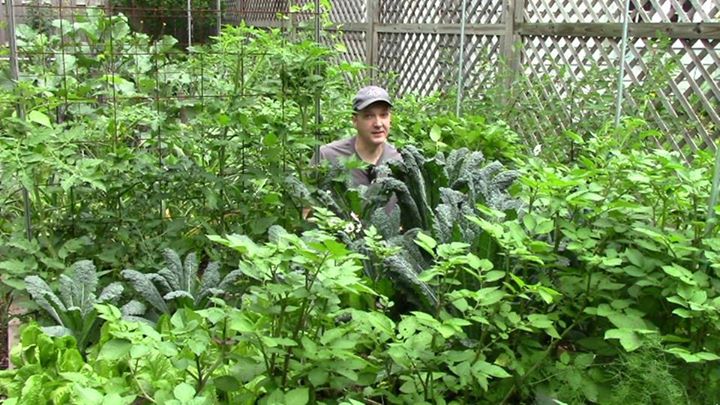
My wife Karen and I live in Chicago and love organic gardening. We started with a small vegetable garden many years ago, but over time it expanded to take over most of the backyard. Now we’re growing in the front yard too. During the summer and early fall, we don’t buy any vegetables from the store and buy very little fruit as well. We also use cold frames and hoop houses to extend the growing season, so we always have some fresh food to harvest, even in the winter.
How did you get started with your One Yard Revolution YouTube channel and Facebook page?
I started my YouTube gardening channel and Facebook page in hopes of promoting a low cost, low effort, sustainable approach to organic gardening that relies minimally on store-bought products. There has been huge a proliferation of organic gardening products in recent years. If you believe the marketing, you could easily get the impression that growing your own food requires a wide array of costly fertilizers and amendments that need to be applied year after year.
Our approach improves soil fertility with compost and mulch from free local resources like autumn leaves, grass clippings, wood chips, and used coffee grounds. We also plant a nitrogen fixing cover crop in late summer. We don’t use any store-bought fertilizers, and we get excellent results. Soil testing has proven that our approach provides more than enough organic matter and nutrients.
I’m passionate about this approach, first of all, because it works very well. But, more importantly, I think all the marketing creates false barriers. It creates financial barriers for those who don’t have the financial resources. It creates access barriers for those who don’t have access to the products. I want to advocate an approach that has few, if any, barriers.
There are also environmental issues with many organic products. For example, rock dust and rock phosphate are mined resources. Bat habitats are disrupted when bat guano is collected, and harvesting kelp from the ocean disrupts a very fragile ecosystem. Using free local resources, on the other hand, actually improves the environment by building soil fertility with material that otherwise may end up in a landfill.
I hope to advocate an environmentally friendly approach that anyone can use to grow healthy food no matter where you live and no matter how much money you have.
Did you start your YouTube channel when you started your transition to live this life style?
In my case, the lifestyle definitely came first. I’ve had a vegetable garden nearly all my life, but I didn’t start my YouTube channel until the spring of 2013.
Have you always been growing your own food? If not, what sparked your passion?
Both of my parents grew up on dairy farms in Pennsylvania, where they produced most of their own food, including vegetables. Though my father wanted to remain on the farm, my grandfather was all too aware of the economic challenges faced by small family farms and insisted my father learn a new trade and find work elsewhere.
When my parents moved to a small town to start their family, they took a little bit of the farm with them by always planting a vegetable garden. Though my approach is somewhat different than that of my parents, I learned a lot of what I know today from my experiences in our family’s vegetable garden.
My wife Karen also grew up with a garden, so it was almost inevitable that we would start our own when we bought our home 25 years ago.
Have you ever made mistakes or failed doing something? How did you overcome any obstacles?
Sure, I make mistakes all the time, but I just learn from them and move on. One great thing about growing your own food is that it’s a lifelong learning experience. No matter how much you learn, it’s still just the tip of the iceberg. This makes gardening both challenging and endlessly fascinating.
Have you ever dealt with a person who disregards your lifestyle?
Not really. I’m a vegetarian, and sometimes get teased about that, but I don’t take it to heart and it’s usually in good fun. As far as my YouTube channel goes, I’ve found that the overwhelming majority of people who leave comments are very kind, positive, and supportive. I think this says a lot about the online gardening community.
What are some of your greatest rewards with a lifestyle such as the one you live?
To me, gardening is a form of meditation. It helps me relax and keeps me grounded and connected to nature, despite the fact I live in a heavy populated urban area. It’s also something my wife and I enjoy doing together, which is great for our relationship. And because we rely on free local resources and nitrogen fixing cover crops to improve soil fertility, our gardening costs are very low and we save a lot of money on groceries. Of course, the flavor and nutritional value of homegrown produce simply can’t be beat.
What are some of the things you would like to have other people understand about living a healthier and self-sufficient lifestyle?
For someone new to gardening, the idea of growing more of your own food might seem like a daunting task. As I mentioned earlier, there are so many gardening products and practices marketed to consumers that it’s easy to get the impression that starting a new garden is very expensive, time consuming, and complicated. I’d like people to know that, while some products can be helpful, most are not needed and many are of questionable value. You can improve soil fertility with homemade compost and mulch from free local resources. You can fix nitrogen in the soil by growing inexpensive nitrogen fixing cover crops. You can all but eliminate weeding by using mulch. Simply put, my message is that you can grow a lot of food on a little land using sustainable organic practices without spending a lot of money or working very hard. This is the message I try to communicate in my videos, and I share specific strategies on how to make it a reality.
What are your favorite plants to grow in the garden?
That’s a tough one to answer, because we grow a wide variety of crops and love them all. Given our goal of working less and growing more, though, I have to say that I really enjoy growing edible perennials like strawberries, blackberries, blueberries, sorrel, Good King Henry, and sun-chokes. They come back year and year with very little effort on our part. Of course, you have to love annuals too. Our garden wouldn’t be the same without tomatoes, peppers, potatoes, kale, and squash. Like I said; it’s really hard to pick favorites.
Some people are happy with a patio tomato on the porch.
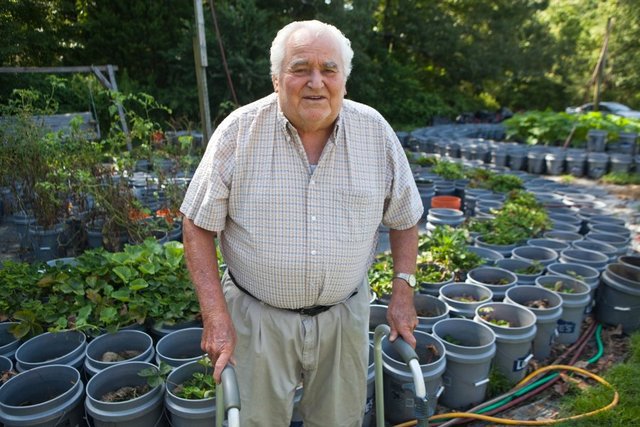
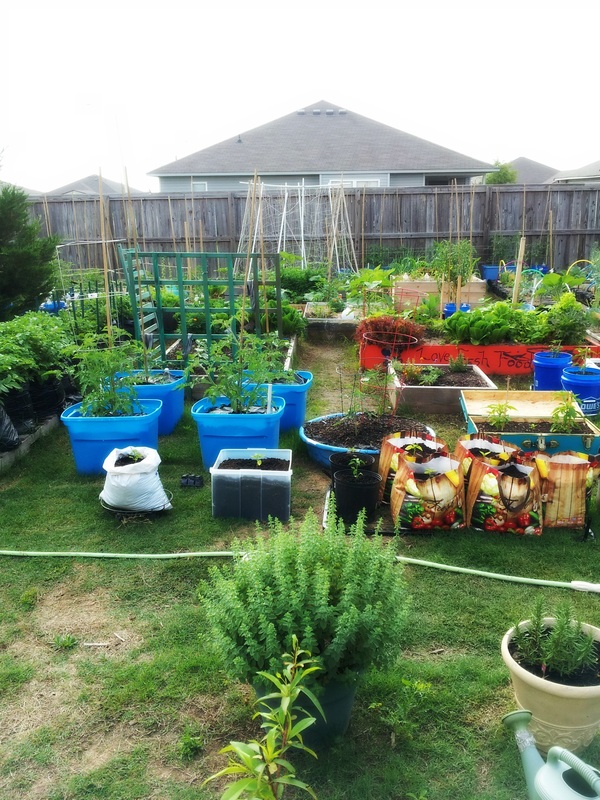
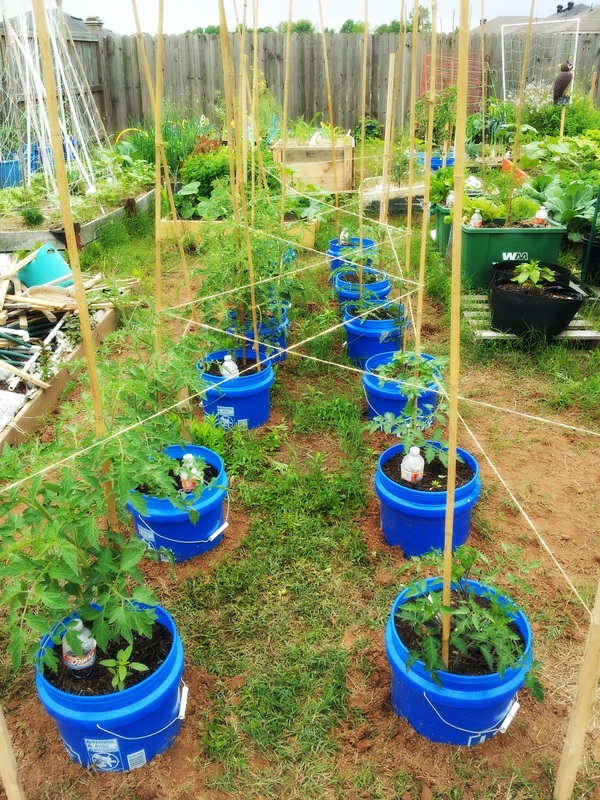
Willie Anderson, 82, took container gardening to another level; he planted tomatoes, cucumbers, corn, okra, squash, peppers and eggplants in five-gallon plastic buckets in his yard in Red Banks, Mississippi. He now has plants in more than 1,000 buckets.
Willie Anderson, 82, maintains a garden of 1,000 fruit and vegetable plants in buckets at his home in Red Banks, Miss. The garden requires no special equipment. There’s no hoe on the place, he said. And it’s totally organic. I use grass clippings, soybean stalks, cotton hulls, he said.
It’s easier to grow an entire garden if you’re planting everything in buckets, Anderson said. “There’s no hoe on the place,” he said. “We don’t need one.”
“You don’t have to have any equipment,” said his son, Ron Anderson. “You don’t have to have any utensils to farm with as far as hoes and shovels. You don’t have to have a tiller. All you do is plant, water and harvest.”
The garden is totally organic. “I use grass clippings, soybean stalks, cotton hulls — that’s the waste that comes out when they gin the cotton,” Willie said.
Ron came up with the idea of the bucket garden for his dad nine years ago. Willie always was a robust man, he said. He was in farming, raised hogs and cattle and went into the home building business with Ron and his other son, Mark Anderson. “He had a hip that deteriorated and he had to have hip surgery and replacement,” Ron said of his father. “When he had that, he was pretty much home bound and his hopes and dreams were just going down. He had cabin fever. He didn’t have anything to look forward to or to do. He couldn’t get out like he had all his life.”
Willie liked the idea of the bucket garden. “I was just tired of sitting up in the house,” he said.
Ron bought 100 buckets from Lowe’s and some Miracle-Gro potting soil. He said, “Dad, let’s try this and see if we can do this for your hobby.”
Ron punched holes in the bottoms of the buckets for drainage and put them on sheets of black plastic to keep weeds from growing around them. “We raised our own tomato plants from seed,” Ron said. “We planted one tomato to a bucket, one squash seed to a bucket, one corn seed to a bucket.”
Willie didn’t want to stay in the house anymore. “We got him a little four-wheel scooter and he’s out the first thing every morning to check his garden,” Ron said.
“You can garden in the shade,” Willie said. “It needs to get at least five hours of sunshine a day. That’s enough for the plants.”
Their first harvest was better than they expected. “We probably had about 10 cases of tomatoes that weighed 30 pounds apiece,” Ron said. “I sold them to some pizza companies in the Olive Branch area. They froze them and canned them for soups.”
Now they mostly give away the produce they don’t use. “I thought at first there might be a little money to be made in it,” Willie said. “But I don’t think there is. I just give what I grow to whoever wants it.”
They stopped using Miracle-Gro after the first year and went organic. “We don’t use any kind of chemical fertilizer and we use the same dirt year after year,” Ron said. “We plant them in the same pots every year. After people cut their grass and sack the grass cuttings on the side of the curb, my brother and myself go around with a trailer and bring home 20 to 30 sacks. He puts it around the top of the buckets. The grass fertilizes every time you water.”
To irrigate, they attach water hoses to sprinklers atop 10-foot landscape timber posts, which are stuck in the ground. They use one sprinkler per each group of 350 buckets. “All I do is turn the faucet on,” Willie said. “It wets everything down in about an hour and a half. It usually lasts about a week if it’s not too dry.”
They’ve experimented with different vegetables. “We had a cabbage big as our granddaughter,” Willie said. “I got a cantaloupe this year. It’s ripe down there now. It’s the first one we’ve been able to raise in the buckets. We haven’t been able to raise a watermelon. I don’t believe the bucket’s big enough to raise a watermelon.”
They haven’t tried everything. “We haven’t grown any field peas, but they’re so simple to grow,” Willie said. “I don’t see a problem with them.”
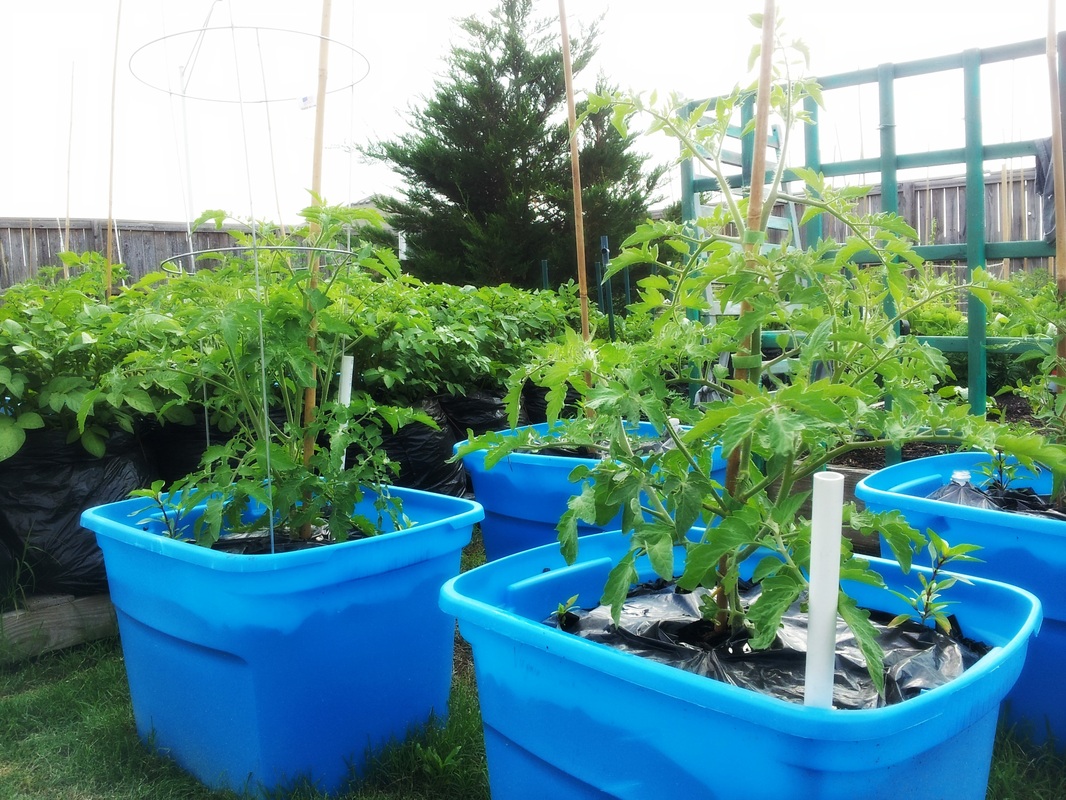
Plastic buckets aren’t the only container gardeners can use, Willie said. “These gardens can be grown in a plastic shopping sack like you get at the grocery store if you want to, but they’ll only last one year and you’ll have to redo it every year,” he said. “I have done it. It’ll work. But the plastic will rot out by the end of the year.”
Ron, his mother, Geneva, his wife, Gidget, the grandchildren and a hired man help with the garden. Willie basically oversees the garden.
Willie also gives the plants pep talks. “I say, ‘Now, y’all got to do better than that,’” he said.
“He does go down there and talk to them three times a day,” Ron said.
Garden writer Felder Rushing, a former Extension Service urban horticulture specialist, is a fan of bucket gardening. “I have grown veggies and herbs in five-gallon buckets in my Mississippi garden for years,” he said. “So cool. So easy. Just the right size. Can’t grow a decent tomato or pepper in anything smaller. And no worries about soil diseases.”
Rushing doesn’t stick with drab-colored buckets. “I spray paint mine to make them more cheery.”
As for Willie’s 1,000-plus bucket garden, Rushing said, “I totally agree with the sentiments of Mae West, who once said too much of a good thing is — wonderful.”
Read the full story here: http://www.commercialappeal.com/entertainment/lifestyle/home/bucket-crops-mississippi-man-takes-container-gardening-to-another-level-ep-1211661529-324126561.html
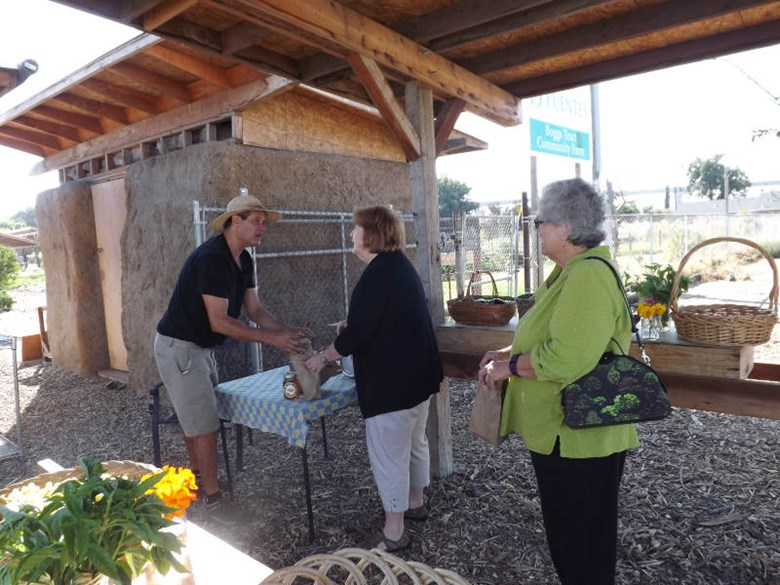
An urban farm in Stockton may serve as a model for the Central Valley. The non-profit group “Puentes” built the Boggs Tract Community Garden on a three-acre plot in a poor neighborhood where garbage had piled up for years.
Puentes Director Jeremy Terhune says the organic garden allows more than two dozen families to farm their own 20-by-20 foot plots with seed, water, and compost provided to them.
At a fruit stand on the Boggs Tract Community Garden, Sally Edmonds buys fresh organically grown produce.
“I bought some tomatoes and some zucchini,” says Edmonds.
Puentes leases the land for a dollar a year from the Port of Stockton.
Puentes Director Jeremy Terhune says the community garden gives people everything they need to grow their own food.
“Each family gets a 20-by-20 foot garden plot, and we give them all the free organic compost they can use, free water, seeds, training and everything they grow in the plot is theirs to do with as they wish.”
Jesse Hughes, a volunteer, is chopping down weeds on his garden plot. Hughes says he shares what he grows.
“You find joy and peace when you able to help and reach out and touch others in the community that’s sometime less fortunate because sometimes it’s very hard to even put food on the table.”
Volunteers are building an outdoor kitchen, and raising produce for home delivery.
Across the street another three-acre plot will become the next urban farm.
Puentes hopes to develop urban gardens in other cities as funding becomes available.
Read the entire post here: http://www.capradio.org/articles/2015/08/27/stockton-urban-garden-nonprofit-provides-fresh-produce-in-poor-communities/
Post/content/images are from CivilEats.com – and – anderson.slhn.org
Are Hospital Farms the Next Big Thing in Healthcare Reform?
When it comes to improving the food on today’s hospital trays, some medical institutions are finding that onsite farms are the next logical step. By Jodi Helmer on July 21, 2015
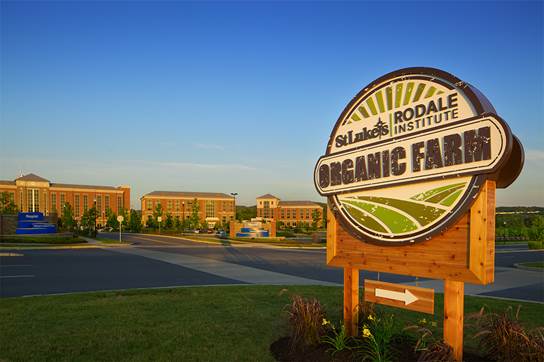
St. Luke’s Rodale Institute Organic Farm
This summer, St. Luke’s Hospital started sending all new moms home from the hospital with a basket of fresh produce, recipes and literature about the importance of a healthy diet.
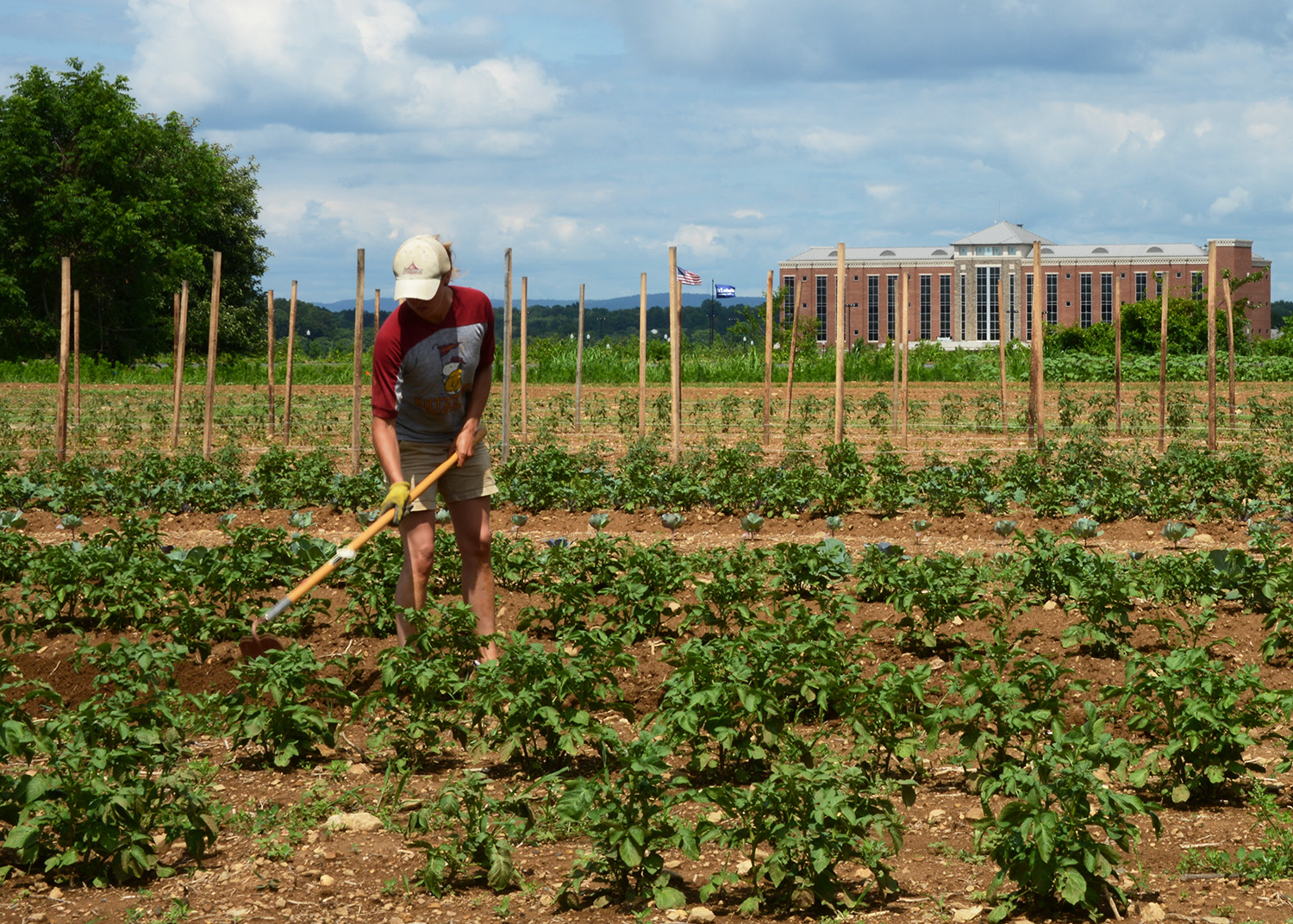
All of the produce in the basket was grown on an organic farm on the hospital’s Anderson campus in Bethlehem, Pennsylvania. The hospital—part of a six-campus network—has been running a farm on the 500-acre grounds since 2014.
“Our mission is to provide great healthcare and part of that is educating patients about the benefits of a plant-based, organic diet,” explains Ed Nawrocki, president of the Anderson campus. “One of the best ways to do that is to lead by example and show them how delicious produce grown on our farm tastes.
Produce from the farm will be utilized in our network cafeterias and served to patients, employees, and visitors.
But it’s not just new moms who benefit from the hospital’s bounty. In its first season, the farm at St. Luke’s grew 12 varieties of vegetables on five acres, producing 44,000 pounds of produce that was served to patients, incorporated into the cafeteria menu, and sold at weekly farmers markets on several hospital campuses. This year, the farm expanded to 10 acres and 30 varieties of fruits and vegetables.
Mark “Coach” Smallwood, executive director at the Rodale Institute, the nonprofit organization that worked with St. Luke’s to help get its farm off the ground, believes there is a growing interest in serving organic, locally grown produce at hospitals.
Some, like the University of Wisconsin Hospital, buy produce from local farms, others allow the community to use land on their campuses for community gardens. Now, a few hospitals are taking the next step, starting farms on hospital campuses. Among them are Stony Brook University Hospital on Long Island and Watertown Regional Medical Center in Wisconsin. Both are now using produce grown onsite to replace fruits and vegetables that are packaged and shipped thousands of miles before reaching patients.
“Hippocrates talked about food as medicine and we believe that to be true,” Smallwood says. “There is a paradigm shift happening and hospitals are realizing the value of producing fresh, local, organic food to serve to their patients.”
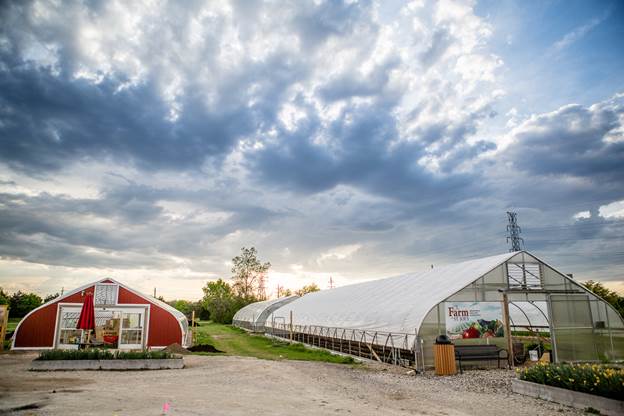
St. Joseph Mercy Ann Arbor Hospital in Ypsilanti, Michigan, planted the first crops on a 10-acre onsite farm in 2010 after patient satisfaction surveys revealed a demand. Over the past five years, the farm has grown to 25 acres, three hoop houses and four beehives. The farm grows fresh spinach, garlic, basil, collard greens and strawberries.
“The farm helps us support a culture of wellness in the hospital,” says director of nutrition and wellness Lisa McDowell. “We can’t grow enough to meet the needs of all of our patients and staff, but we can make an educational statement about the importance of eating a healthy diet.”
While farm-to-hospital efforts have been well received by patients and created PR opportunities, operating a hospital-run farm is not without its challenges.
For starters, administrators are experts in healthcare, not agriculture.
To help launch its farm, St. Luke’s partnered with the Rodale Institute for assistance in creating and implementing a plan, hiring a farmer, and managing operations. At St. Joseph Mercy, the hospital invested $32,000 in two hoop houses, hired a full-time farmer to manage farming operations for the 537-bed hospital and relies on interns and volunteers to handle most of the labor.
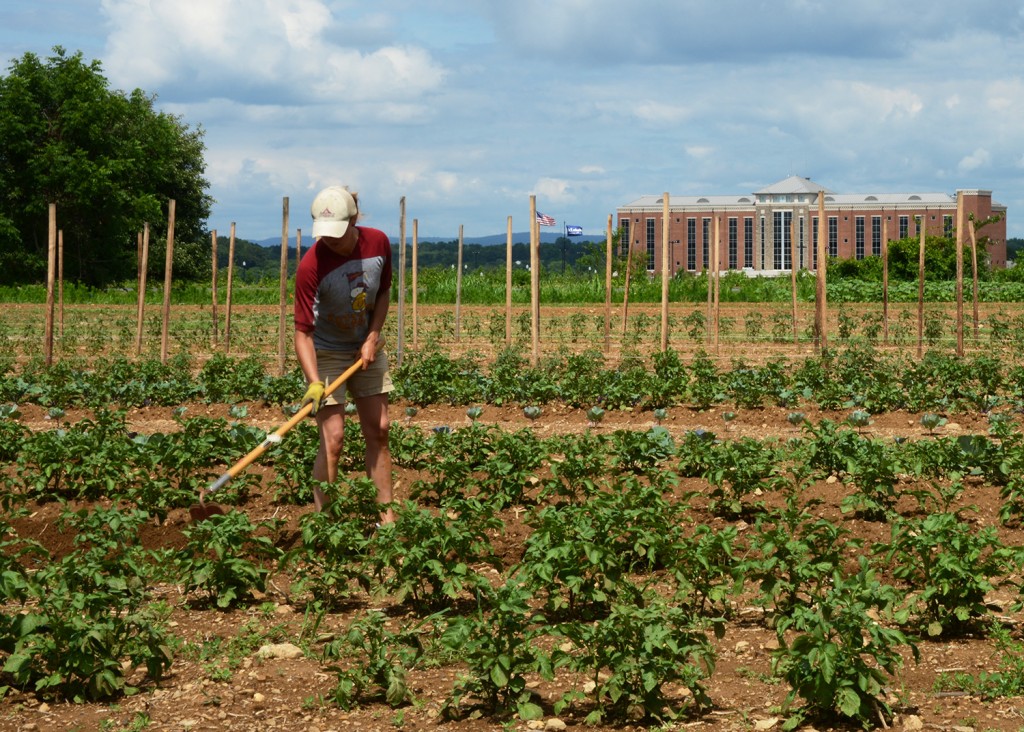
As an employee of the Rodale Institute, Lynn Trizna, an organic vegetable farmer, is excited to work with St. Luke’s on developing the St. Luke’s Rodale Institute Organic Farm. Farmer Lynn’s passion for organic agriculture began the summer of 2007, when she spent the summer working on her first farm.
It took a $125,000 capital investment to start the farm at St. Luke’s and, after two growing seasons, the farm is operating at a loss (with a goal of breaking even in 2016). The reason: Growing organic produce on the farm is more expensive than purchasing it through a foodservice supplier or sourcing it from local farms. But Nawrocki still champions the idea, explaining that encouraging patients to eat healthier diets now could improve their health in the future.
In addition to the capital investment to start farms, hospitals that want to serve fresh produce must invest in recipe development and training foodservice workers to transition from heating and reheating prepared foods to making dishes from scratch.
“When we order produce from a food service provider, it comes peeled and chopped and portioned; all our staff has to do is open the package and add it to the recipe,” McDowell explains. “Cooking with fresh foods from our farm is much more labor intense.”
In the future, the hospital hopes to partner with a local culinary program, using interns to offset the additional labor costs and make its hospital farm cost neutral by 2020.
Whenever UC Berkeley student Sara Cate Jones has felt the blues coming on, she’s relied on the same remedy: she goes to the student garden on the corner of Walnut and Virginia streets and picks herself a bouquet of flowers.
“The garden is always here for you,” said Kate Kaplan.
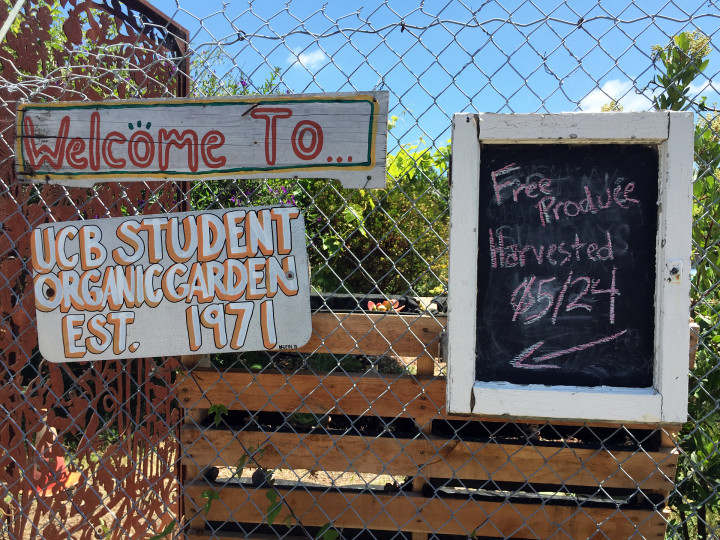
Established in 1971 by a group of students shortly after the first Earth Day, the garden has offered students and the community at large an urban oasis in North Berkeley for over 40 years.
About a quarter acre in size, the garden sits on a plot of university-owned land and is overseen by SOGA’s student volunteers. SOGA was founded in 1999 when the university gave the garden space to EBMUD for a pumping station. The students protested and a compromise was reached; the pumping station is now adjacent to the garden.
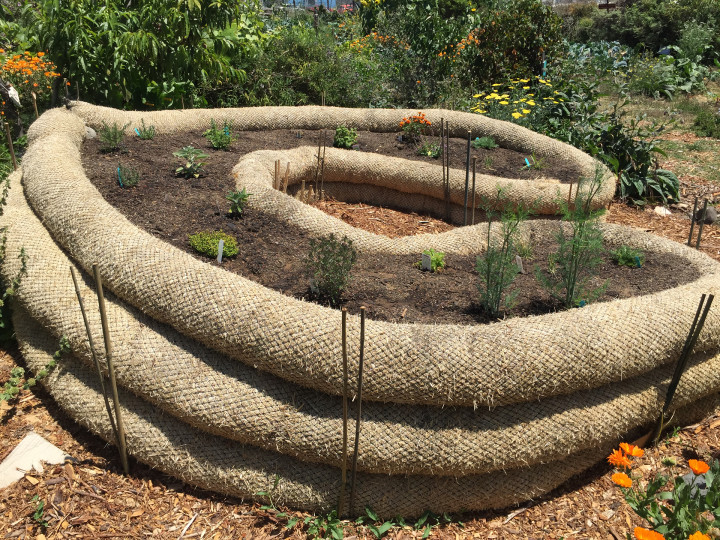
This keyhole raised bed, in which herbs are growing, is made out of straw wattles. It was a student project to experiment with cheaper solutions than planter boxes to grow above ground. Photo: Alix Wall
As for what’s planted, it’s entirely up to the students. There are several varieties of apple, plum and fig trees, flowering plants and bushes like sunflowers and lavatera, succulents and native plants, and of course, plenty of vegetables.
Though the garden gets some funding from student fees, SOGA is responsible for applying for grants to keep the garden running, and is also “meant to be the stewards of the garden, to make sure something like that doesn’t happen again,” said Kaplan. “We also make sure relations are good with the administration, and make sure they know what’s going on,” said Jones.
(For example, at one time students brought in chickens and goats without university approval – they are not allowed to raise animals.)
Kaplan emphasized that the garden gives students a chance to connect to a more nontraditional education, which “allows them to build off the lecture-based education we receive and get their hands in the dirt with hands-on experience.”
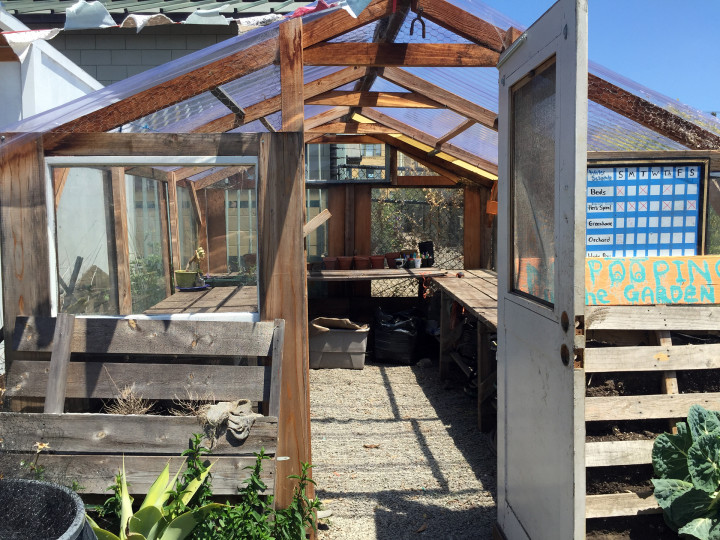
Several classes are held inside the garden. Organic Gardening and Food Justice is one and Garden Leaders is another, which “teaches students how to do project management within the context of a garden,” said Jones, while showing off several projects that were conceived of and brought to fruition by students recently. One such project was a greenhouse made entirely of reclaimed wood and glass.
Then there’s also what’s known as BUGI, or Berkeley Urban Gardening Internship, which connects students with other urban gardens in Berkeley and teaches students how to manage a garden.
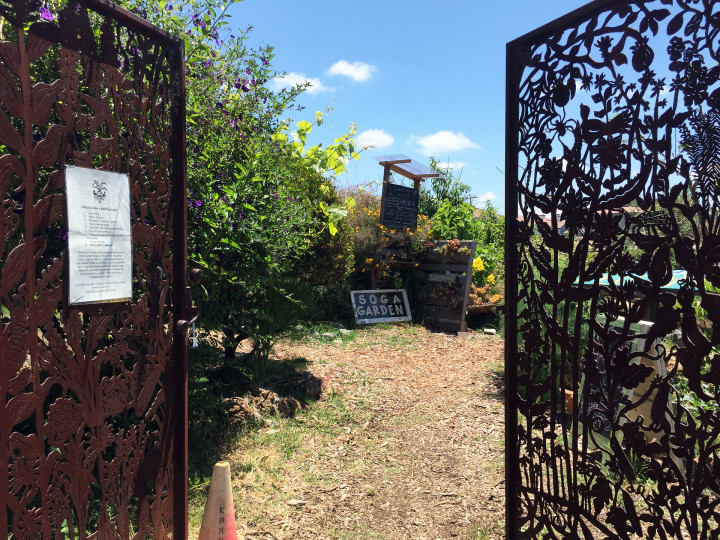
The entrance to the garden is on the corner of Walnut and Virginia Streets in North Berkeley. Photo: Alix Wall
And while those who take care of the garden tend to have more than a passing interest in environmentalism, those who take classes in it run the gamut of the entire campus.
In a class of 150 students this spring, their majors were “all over the map,” said Kaplan. “They had majors like math, business, French, everything.”
While only organic practices are used in the SOGA garden, the piece of land next door, called the Oxford Tract, is used by professors for their various research projects and the students worry about non-organic pesticides drifting over the fence.
One of the allies of the garden, Agroecology Professor Miguel Altieri, often tries to rent the space closest to the garden where he too gardens organically, but the students can’t control what happens on the other side of the fence.
While they sometimes put a sign outside offering the latest harvest to passersby, they don’t have a regular food giveaway because their output isn’t that regular.
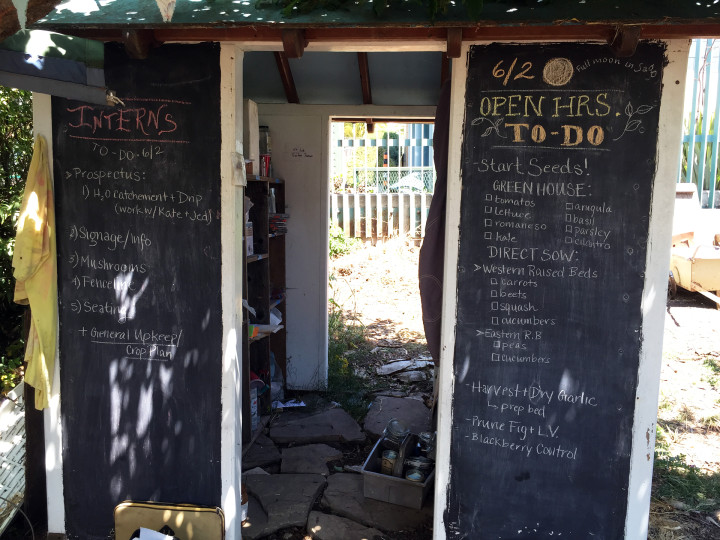
Several summer interns are getting paid to help oversee the garden while the students are away on summer break. Here they keep track of their to-do list. Photo: Alix Wall
“Last year we partnered with the UC Berkeley Food Pantry, providing fresh produce for them to give away,” said Kaplan, noting that their grant money only provided the pantry with non-perishables.
The students often take the produce to share with their roommates, and community members are welcome to drop by when the garden is open, to see if anything has been freshly harvested. (During my visit, one woman dropped by to ask advice about why her apple tree wasn’t fruiting, and another man came by to see if he could score some kale or chard leaves.)
However, many longtime neighbors barely know the garden is there.
“Most neighbors who come in are super excited to see it,” said Kaplan. “Most say they have to come by more often.”
While the students have led some programming for local schoolchildren, and offer workshops through Berkeley Unified School District, they admit that because of a lack of continuity in management, sometimes they aren’t the best at marketing what they have to offer.
“We’re trying to expand beyond the campus community,” said Kaplan. “Many people think it’s just for students, but we’re trying to break that barrier. The garden was started by students and is mostly run by students, but it’s open to everyone. We never turn away anyone if they want food or just want to walk around.”
This green house, made of reclaimed wood and glass, was completely student implemented and built. Photo: Alix Wall
Many students are also not aware of the garden’s existence.
“It does seem kind of hidden,” said Jones. “My favorite part of it is its ability to teach students. But it’s also such a great place to create community, especially in a university that can be so competitive, and that is so big, that students can get lost in it. It provides a kind of safe haven for us.”
The SOGA Garden is always open on Sundays from 10am to 2pm. This summer, it’s also open Tuesdays and Thursdays from 10am to 2 p.m. It is located on the corner of Walnut and Virginia Streets in North Berkeley.
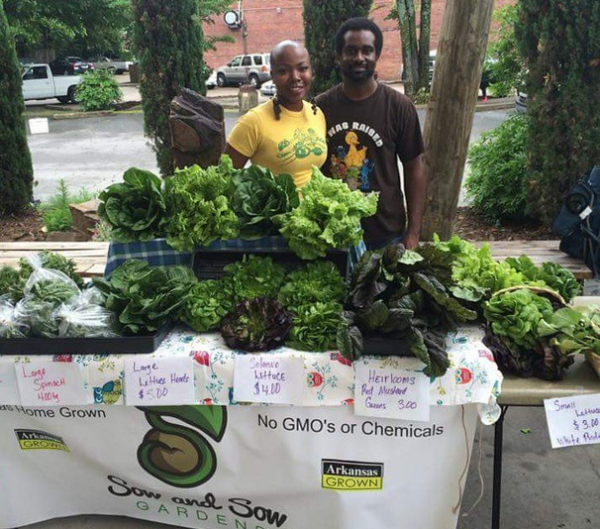
At Urban Organic Gardener, we’re all about sharing inspiring stories of how people are growing food in small spaces. A while back, we found Sow and Sow Gardens on instagram and have been following them ever since. What they’re doing is truly inspiring.
How did you get started with your blog/Instagram page?
“I got started with my personal Instagram page. I would post all kinds of things about what I was going and what troubles I was having in the garden. Then someone asked me on Instagram if I had blog. At the time, I felt like I was no expert and how could I possibly write a blog. About a year later I decided I really enjoyed growing food and why not write about it.”
Did you start your blog/Instagram when you started your transition to live this life style?
“I was let go from my job of almost 7 years and decided I wanted to help my husband out with growing food. We had two mortgages and bills. I figured that growing food would help and that it would be less of a grocery bill.Yes, I began to have many followers on my personal page who was interested in my gardening. I wanted to come up with a creative name. I asked my sisters for their help. My sister Nnenna was like “you are in the South…you know they always say thing like….you know….so and so down the street”. “Why not Sow and Sow Gardens, like sowing seeds.” It was perfect!”
Have you always been this way? If not, what sparked your passion?
“No, I was not always this way. I started learning about GMO’s about 7 years ago. I started reading the labels on things I was buying from the store. Then I started reading about more issues about the food that we were consuming into our bodies.I started telling people at work but of course they would look at me funny. I was the “Earthy One” was what they started calling me. When I started growing food, it was something amazing to see a seed pop its little head out of the dirt. It was just magic to me. It was so beautiful. It was my creation is how I saw it.I know this might sound corny but I wanted to be the change I wanted to see in the world. It has to begin with ourselves if we want to see any change come about on this planet.”
What are some of the other things you would like to have other people understand about living a healthier and self-sufficient life style?
“There is nothing like growing your own food…Period. You know where it comes from and how it was grown. I feel great that I don’t have to depend so much on someone else to provide food for my family. It’s much healthier and taste better than what you will get from the stores. I also like teaching my daughter about where her food comes from and how it grows. As one can see, there have been a lot of issues on this planet when it comes the weather. California is going through a drought. I would not be surprised if the prices rose due to the drought. It’s something my family will not have to worry about . I have started 2 apple trees, goji berries bushes and artichokes. I want to have a little food forest in my backyard. Start off little and work your way up. I started growing my own food 3 and half years ago. I started with a 7×4 raised bed.”
What tips and tricks could you share with other people?
“Always see for yourself how things grow. I was told that radishes did not transplant well. I wanted to see for myself. I transplanted radishes and carrots. The radishes came out great but not the carrots. There are always different results for different growers. I also like to start my seed on paper towels. For two years I could not get pepper seeds to germinate. I was on youtube one day and put in the search engine how to germinate pepper seeds. Someone started theirs from paper towels. I gave it try and now I germinate all my seeds this way. I have the hardest time trying to germinate seeds in the dirt. “
Have you ever made mistakes or failed doing something?
“Oh my!!! Yes, I learned to NEVER put mint in the ground. I have been trying to contain that mint in the backyard. The first year, the soil was bad bad bad. I didn’t amend the soil well. Nothing would grow. I thought planting it was all I needed to do. I started researching and reading lots of books. I was on the internet and YouTube a lot. That’s how I really learned how to grow food. I have never really been able to grow tomatoes well. Looks like this year, I might have some luck. Leafy greens always grow best for me.”
How did you overcome any obstacles?
“My first and second year was hard. I was learning the whole process. I had to learn about the soil.I wanted to give up but I just kept trying because I loved gardening…my creation. I dealt with flooding last year and it ruined most of my crop. It just sat in water. So I had to find another method of growing food with lots of water involved. On my blog I showed the whole process for months of what I went through for the backyard transformation. I tried the double dig method. It’s a lot of work but it worked for me. You have to see what works for you. The double digging method was the way to go. The beds were high enough that the rain did not affect the food. The book that saved me was ‘How to Grow More Food’ by John Jeavons. For me, this is my garden bible.”
Have you ever dealt with a person who disregards your life style?
“No I haven’t met anyone. The only thing I hear from people is that they don’t like to get dirty. I love it!”
What are some of your greatest rewards with a lifestyle such as the one you live?
“It brings a peace of mind. Just walking out of my back door to get herbs to cook is a wonderful thing. We have less of a grocery bill. Knowing where my food comes is the greatest reward there is.”
To follow their journey of building a backyard food forest, you can subscribe to their blog.