4 reasons why the world needs more urban farming post-pandemic

WeForum.org – Since lockdown, public interest in growing fruit and vegetables at home has soared. Seed packets are flying off shelves and allotment waiting lists are swelling, with one council receiving a 300% increase in applications. Fear of food shortages will have motivated some, but others with more time on their hands at home will have been tempted by the chance to relieve stress doing a wholesome family activity.

The seeds of enthusiasm for home-grown food may have been sown, but sustaining this is essential. Urban farming has much to offer in the wake of the pandemic. It could help communities boost the resilience of their fresh fruit and vegetable supplies, improve the health of residents and help them lead more sustainable lifestyles.

As the Pandemic Continues, Urban Gardening Is Growing on New Yorkers

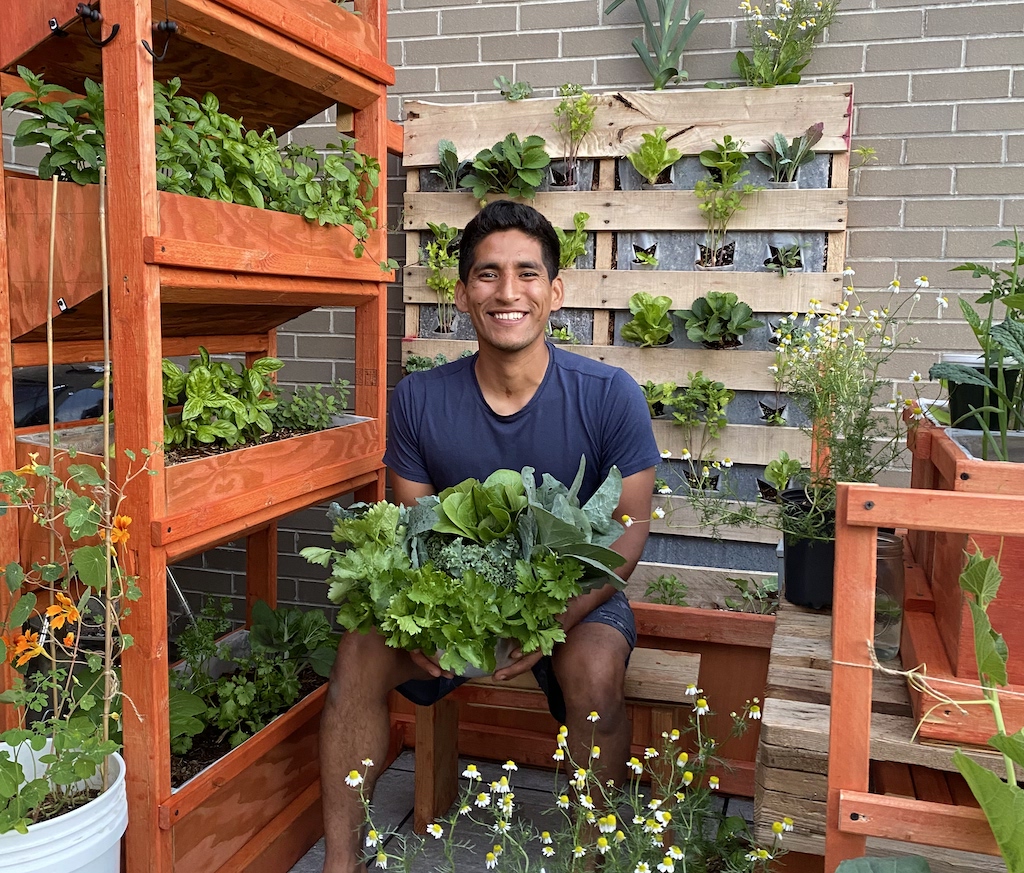
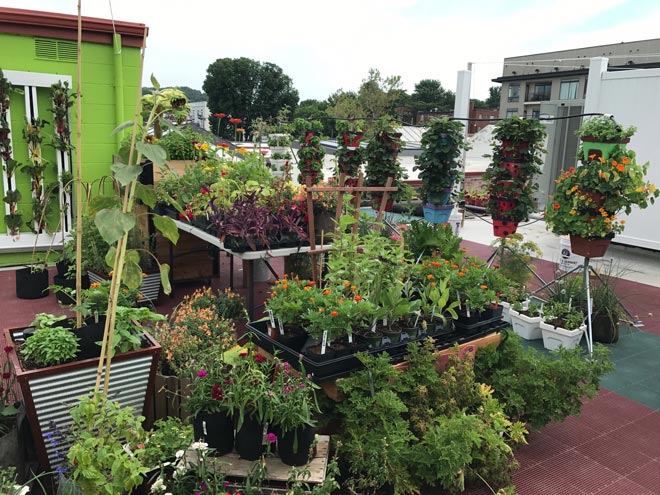
Samuel S. T. Pressman had wanted to build a food garden on the rooftop of his Clinton Hill apartment for years. The artist and sculptor had lived on a farm when he was younger and had studied Sustainable Environmental Systems at Pratt. But in a city with a “time is money” mentality, he never found the right moment to start his passion project.

That changed when New York underwent a statewide Pause order in mid-March. Now, Samuel’s Food Gardens is tackling the city’s food insecurity problem by providing fresh fruits, vegetables, and herbs to community gardens that advocate for food security. “I wanted to explore what most people’s living situation is here,” Pressman said, “where they don’t have any land and have hardly any outdoor space that they own, and how they can still be able to grow some food using a system that is designed to actually make it possible to grow more food than you think per square foot.”

READ THE FULL ARTICLE: https://bedfordandbowery.com/2020/07/as-the-pandemic-continues-urban-gardening-is-growing-on-new-yorkers/

Residents plant more gardens; retailers see revenues grow

Photo by: Kendra Caruso

BELFAST — Since Belfast resident Elsa Mead started her “victory garden” over two months ago, she said she has noticed more raised bed gardens in people’s yards. The coronavirus has given people more time for gardening and provided local garden and hardware centers a business boost.

Victory gardens are rooted in World Wars I and II, when people started growing their own food to supplement the nation’s limited food supply and to lift people’s spirits during a time of uncertainty and economic hardship.

“It’s something to look forward, to have something beautiful to look at, to be involved with growing food, be able to share our harvest. That’s why we call it a victory garden,” Mead said.

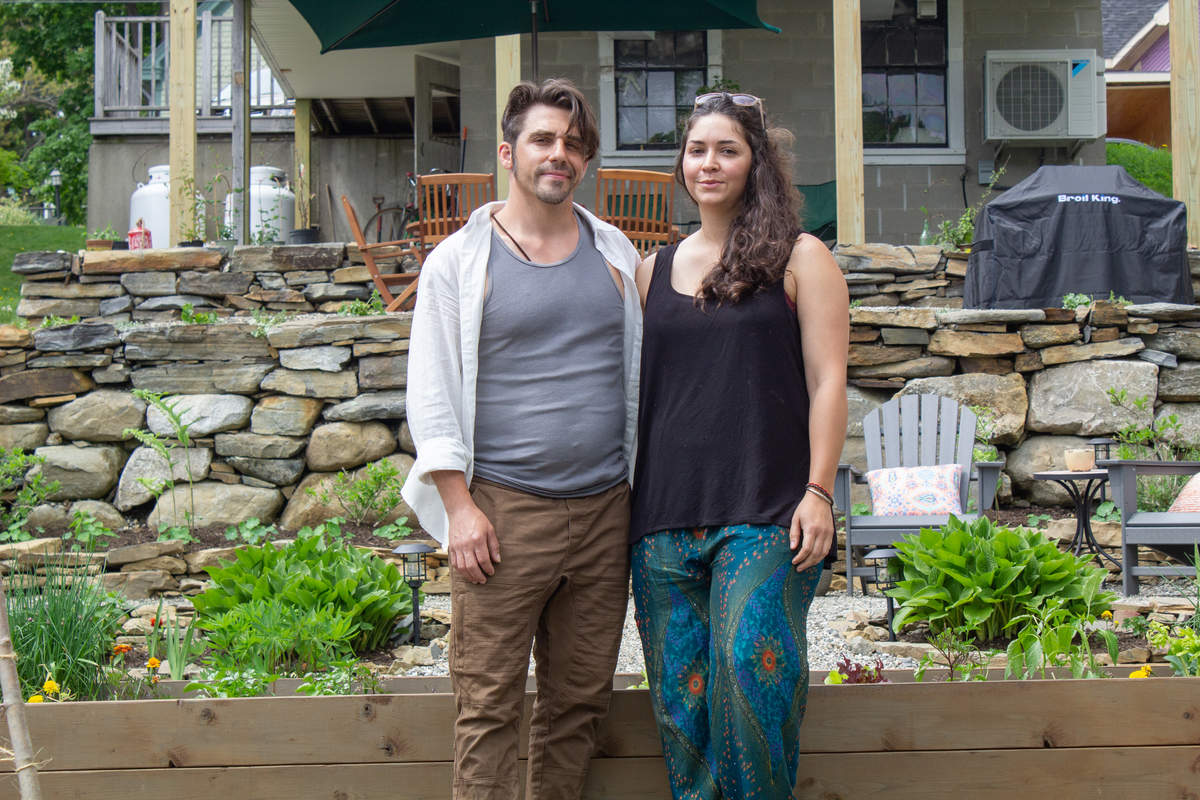
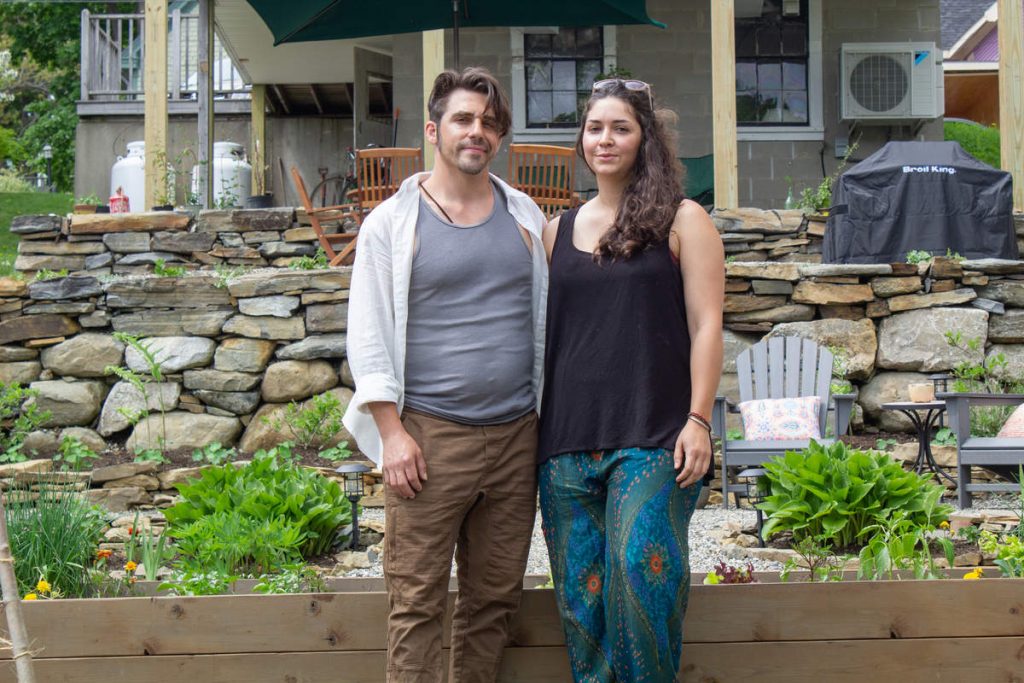
She said she is not traditionally a gardener, but when her daughter, Stephanie Mead, and her boyfriend, Erich Winzer, came for a visit right before a coronavirus outbreak around their New York City neighborhood, the two decided to wait out the pandemic in Maine and spend their time planting a garden with Mead.

Stephanie and Winzer have an urban garden on the rooftop of their apartment building, where they grow much of their own food, they said. The couple had been looking for properties in upstate New York to have a little farm and workshop for their work of building sets and props for theaters and TV shows like “Sesame Street,” Stephanie said.

READ THE FULL ARTICLE: https://waldo.villagesoup.com/p/residents-plant-more-gardens-retailers-see-revenues-grow/1860748

Urban Gardening: The Rooftop Gardens of Cairo

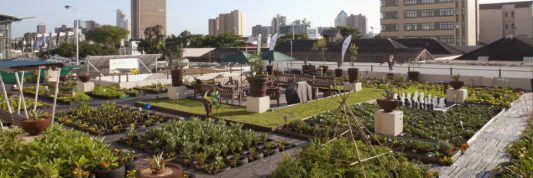
In recent years, there have been several initiatives and campaigns, promoting urban gardening on rooftops and elsewhere, to encourage more eco-friendly solutions across the country. Fortunately, there has been a positive response from both Egyptian residents and the government in following and implementing such initiatives.

Founded by brothers, Sherif and Tarek Hosny due to their interest in plants and nature, Schaduf is a social enterprise that initially started off by offering microloans in the form of rooftop gardens for low-income Egyptians, and later expanded to creating more green spaces on rooftops of the entire country.

Today, Schaduf is a leader in designing and implementing green walls and roof gardens, as well as vertical and roof landscaping.

READ THE FULL ARTICLE: https://www.greenroofs.com/2020/05/28/urban-gardening-the-rooftop-gardens-of-cairo/

Let them eat the city, say the urban farmers of Paris

Paris, France – Parisian mushrooms are reclaiming their space in the dark spaces under the City of Light.

“When cars arrived in Paris in the 1930s they pushed out “champignons de Paris” (known in English as button mushrooms),” explains Jean-Noel Gertz, CEO of Cycloponics, the start-up that has transformed an abandoned car park into La Caverne, an organic underground urban farm.

Huge quantities of button mushrooms used to be grown using the manure of the city’s horses, so the rise of the car led to an abrupt drop in production. But things have now come full circle.

“Now, with car use declining, Paris mushrooms are pushing out cars,” says Gertz, who is testing the growing of the variety at La Caverne’s existing site below the concrete near Porte de La Chapelle, with plans to launch larger-scale production in a new underground site in the city’s 19th arrondissement next March.

READ THE FULL STORY: https://www.aljazeera.com/news/2019/12/eat-city-urban-farmers-paris-191205152844562.html

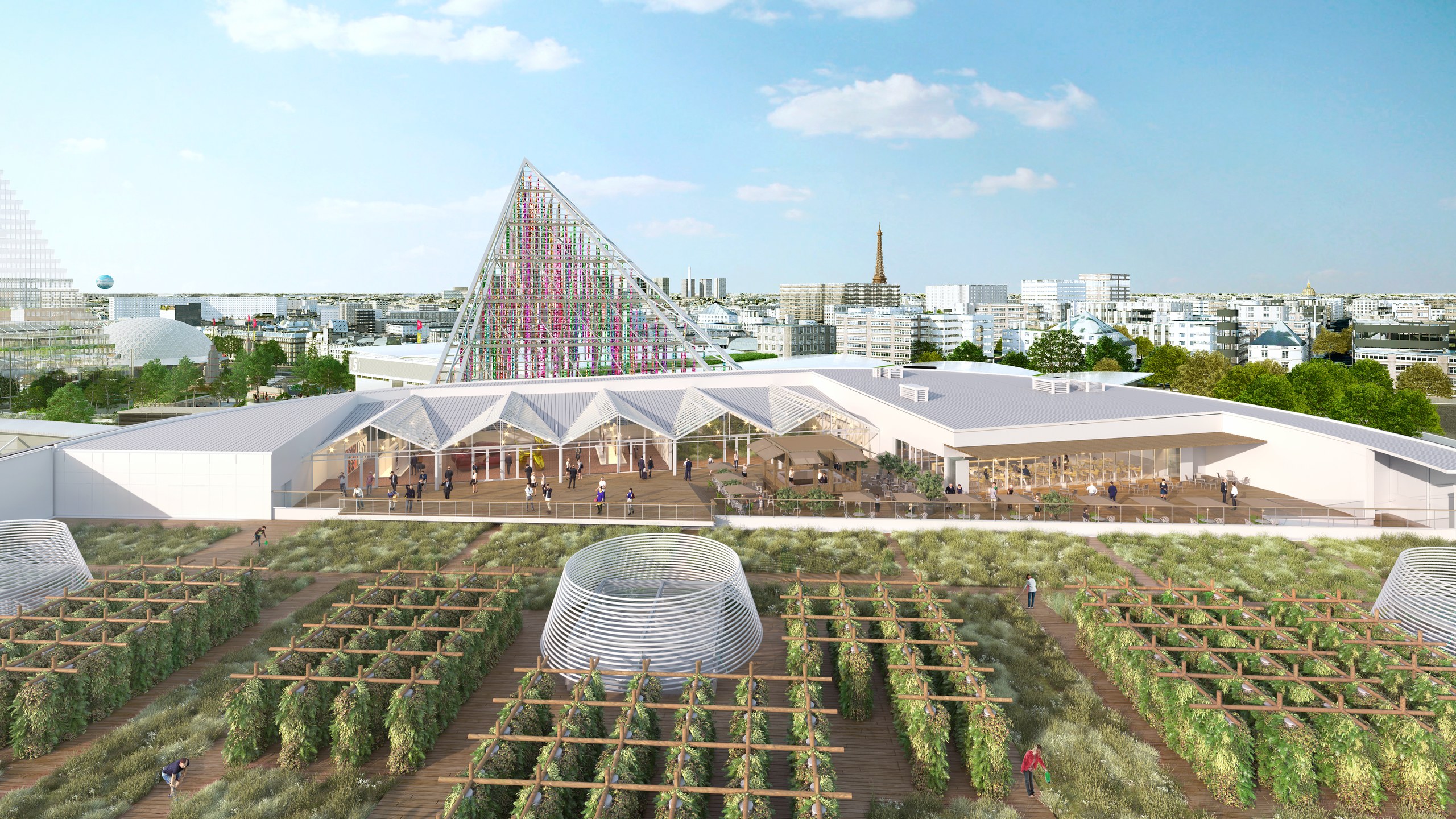
Paris Will Soon Be Home to the World’s Largest Rooftop Urban Farm

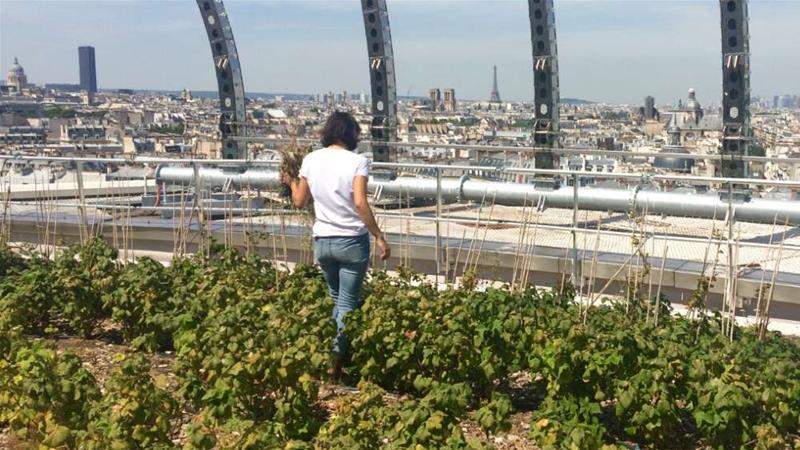
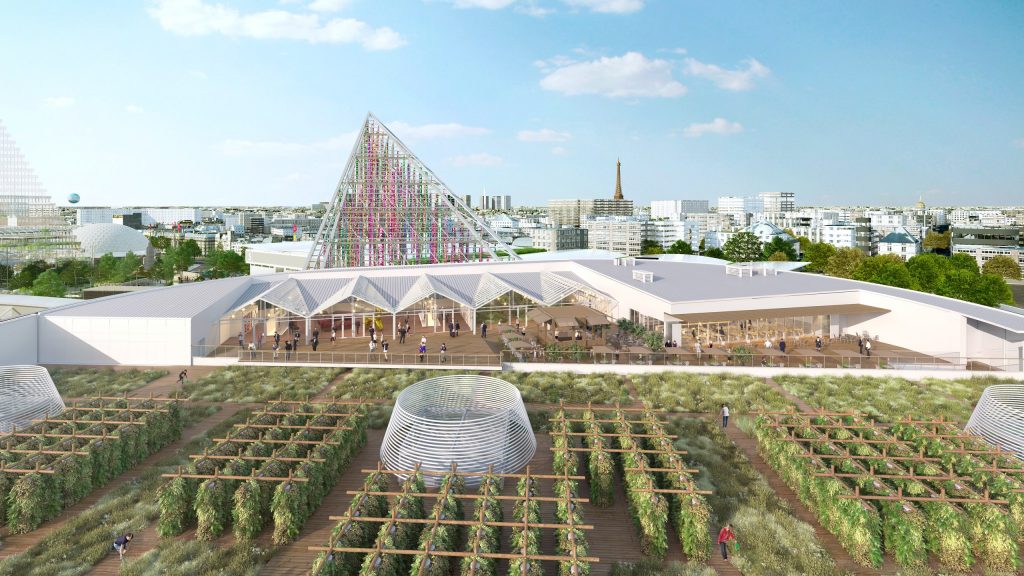
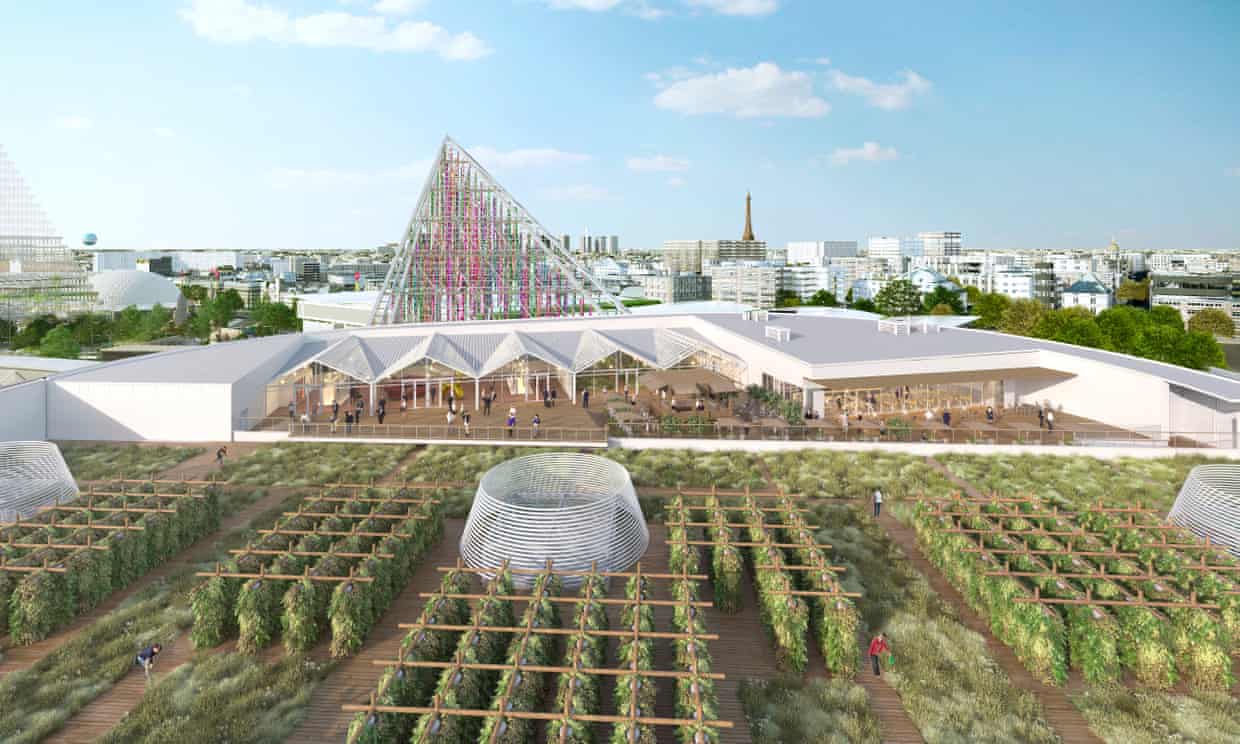
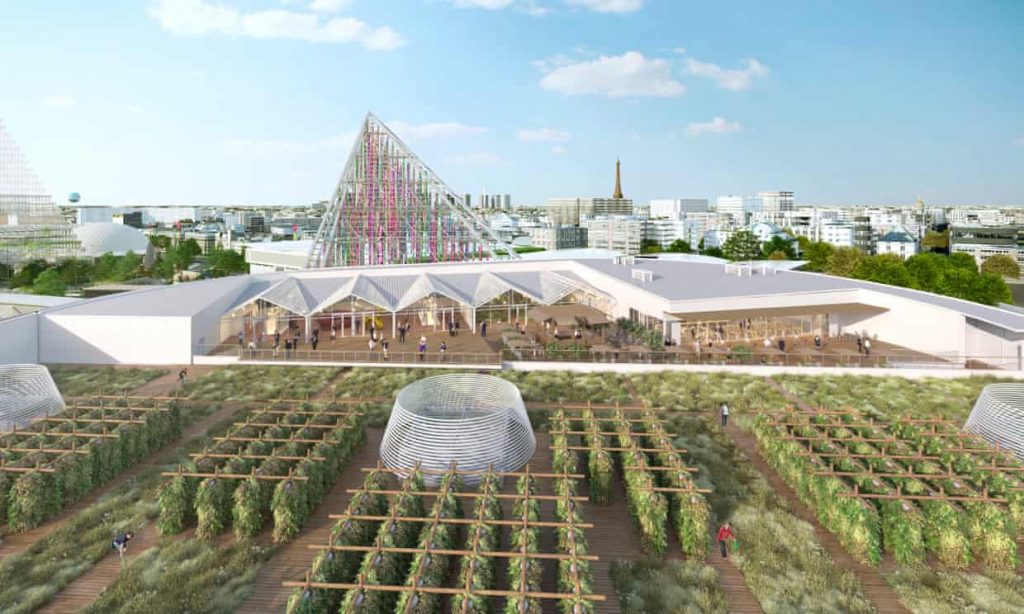
In an Olmstedian effort to bring city dwellers back to nature and to produce a sustainable, local assortment of fruits and vegetables, urban farming company Agripolis is bringing what will be the world’s largest rooftop urban farm to Paris. Situated along the périphérique in the city’s 15th arrondissement, the 150,000-square-foot sprawling green space will sit atop the Exhibition Center at Porte de Versailles when the space opens in 2020. Designed by local French firm Valode & Pistre (who were also responsible for the recent transformation of Gare du Nord), the urban farm is a part of the decade-long renovation project to make the exhibition center a model for sustainable development as the rest of the city follows suit.

“Today, large metropolitan areas are the focal point of a number of ecological issues,” says Clément Lebellé, cofounder of Cultures en Ville, a partner in the project that specializes in urban agricultural development. “These issues include the loss of natural ground cover, pollution, and rainwater management but also societal issues such as the lack of connection between urban dwellers and their food supply.”

READ THE FULL ARTICLE: https://www.architecturaldigest.com/story/paris-will-soon-be-home-to-the-worlds-largest-rooftop-urban-farm

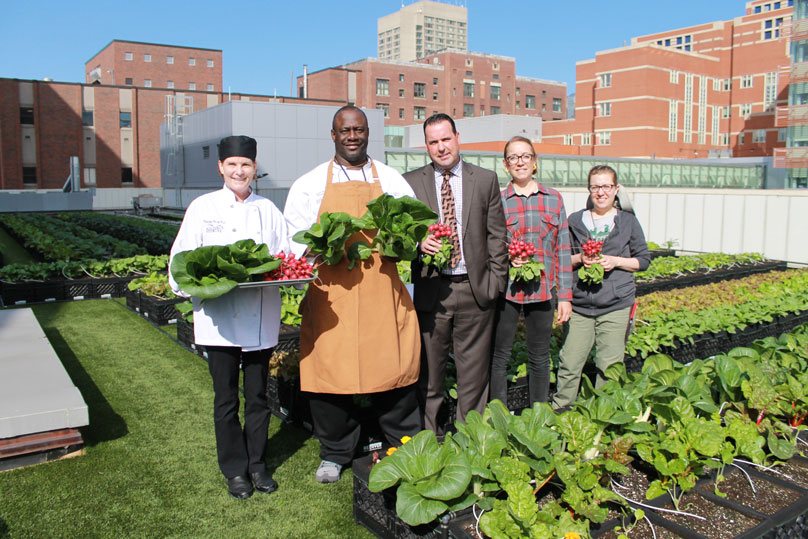
Hospital’s Rooftop Garden Provides 7000 Pounds of Organic Veggies a Year for Patients

High above the Boston Medical Center grows a bountiful organic vegetable garden that feeds patients, staff and the poor.

More than a hundred volunteers tend the garden, which includes kale, collard greens, bok choy, tomatoes, carrots, cucumbers, peppers, eggplant, beans, squash and a wide variety of herbs.

The crops are grown in organic soil in recycled milk crates and are pollinated by two onsite beehives that provide honey as well. The 2500-square-foot farm also provides habitat for bees in an otherwise uninhabitable urban setting.

The eco-farm insulates the building reducing cooling and heating costs and absorbs rainwater that would otherwise contribute to sewage overflow in the city streets below.

But most of all, the rooftop garden provides nutritious food for those who need it most, between 5000 and 7000 pounds of it per year.

“Food is medicine. That’s why we’re doing what we’re doing,” says David Maffeo, the hospital’s senior director of support services.

READ THE FULL ARTICLE: https://returntonow.net

World’s largest urban farm to open – on a Paris rooftop

It’s a warm afternoon in late spring and before us rows of strawberry plants rustle in the breeze as the scent of fragrant herbs wafts across the air. Nearby, a bee buzzes lazily past. Contrary to appearances, however, we are not in an idyllic corner of the countryside but standing on the top of a six-storey building in the heart of the French capital.

Welcome to the future of farming in Paris – where a whole host of rooftop plantations, such as this one on the edge of the Marais, have been springing up of late. Yet this thriving operation is just a drop in the ocean compared to its new sister site. When that one opens, in the spring of 2020, it will be the largest rooftop farm in the world.

Currently under construction in the south-west of the city, this urban oasis will span approximately 14,000 sq metres (150695 sq feet) – also making it the largest urban farm in Europe. With the plan to grow more than 30 different plant species, the site will produce around 1,000kg of fruit and vegetables every day in high season. Tended by around 20 gardeners, they will also be using entirely organic methods.

READ THE FULL STORY: TheGuardian.com

9 of The Best Vegetables to Grow in Small Gardens

Gardening in a small space can be just as rewarding and fun as growing in a large garden area.  These days, urban gardeners are growing more of their own food in sometimes less than 100 square feet.  Balconies, patios, even indoor windowsills are a great place to grow vegetables and herbs.  Almost anything can be grown in a container, and if you’re wanting to know what you should plant to maximize your yield in a small area, here are 9 of the best vegetables/herbs to grow in a small garden.

1. Shallots:

Space shallots approx. 4-6 inches apart with the rows 18 inches apart. Plant the bulb root side down, the top of the bulb 1 inch below the surface. Planting too deep grows elongated bulbs that don’t store well.

2. Carrots:

Sow seeds evenly in a very shallow trench, about 1/4 inch deep. Keep seeds moist so they will germinate. Space rows about 12″ apart and when the first leaves emerge, thin to 1″ apart; when true leaves emerge, thin to 3″ apart.

3. Cherry Tomatoes:

To start tomatoes indoors, sow seeds using expanding seed starting soil pods about 8 weeks before the last frost date for your area. Seedlings will be spindly with less than 12-14 hours of light per day, try to keep them in a warm sunny location. When seedlings have 4 leaves, transfer to a deeper pot (3-4″) and again when 8-10 inches tall. Each time, place the uppermost leaves just above the soil line and remove all lower leaves. Transplant (see: guide to transplanting) into the garden when the stem above the soil has reached 8-10 inches tall. Be sure to harden them off before transplanting them outdoors. Allow up to 10 days for the tomato plants to harden off to the outside temperature fluctuations.

4. Runner Beans:

Set three 6 foot poles in the ground, tepee fashion, and tie together at the top. Leave 3 to 4 feet between the pole groups. Make a hill at the base of each pole, enriched with compost or well-rotted manure, and plant 6-8 seeds in each. After the second pair of true leaves appear, thin to 3 plants per pole. With regular harvesting, the pole beans should bear all summer.

5. Garlic:

Break apart cloves from bulb but keep the papery husk on each individual clove.
Ensure soil is well-drained with plenty of organic matter. Plant in Full Sun.
Plant 4 inches apart & 2 inches deep, in their upright position (the wide end down and pointed end facing up). Come springtime, shoots will begin to emerge.

6. Kale:

Plant Kale in rows 18 inches to 2 feet apart. When the seedlings are 3 or more inches high, thin plants to 10 inches apart (read about thinning) and use the thinnings for salads or as a cooked vegetable.

7. Basil:

Try to space your basil plants about 12 inches apart. As long as you harvest the leaves when they are young, basil plants make a wonderful container crop.

8. Lettuce:

Seed should be sown thinly in rows 1 foot apart; for leaf types, thin plants to 2-3 inches apart, then thin again by pulling every other plant when half grown. This will encourage thickly developed plants. For head, Bibb, and cos types, space rows 18 inches apart, plants 8-10 inches apart. Closer spacing results in smaller heads, which may be preferable for small families.

9. Beets:

Sow seed 1/2 inch deep in rows 12-18 inches apart. The beet seed is a compact ball of many tiny seeds. Many plants germinate where each seed is sown, so seed should be placed sparingly. When seedlings are 4-6 inches high, thin plants to stand 1 1/2 inches apart. (They can be used in salad or cooked like spinach.) Then, as these beets grow to about an inch in diameter, pull every other one to allow larger beets to grow.

READ MORE ABOUT GARDENING IN SMALL SPACES AT www.SeedsNow.com
A LOOK INSIDE RINO’S ROOFTOP URBAN FARM

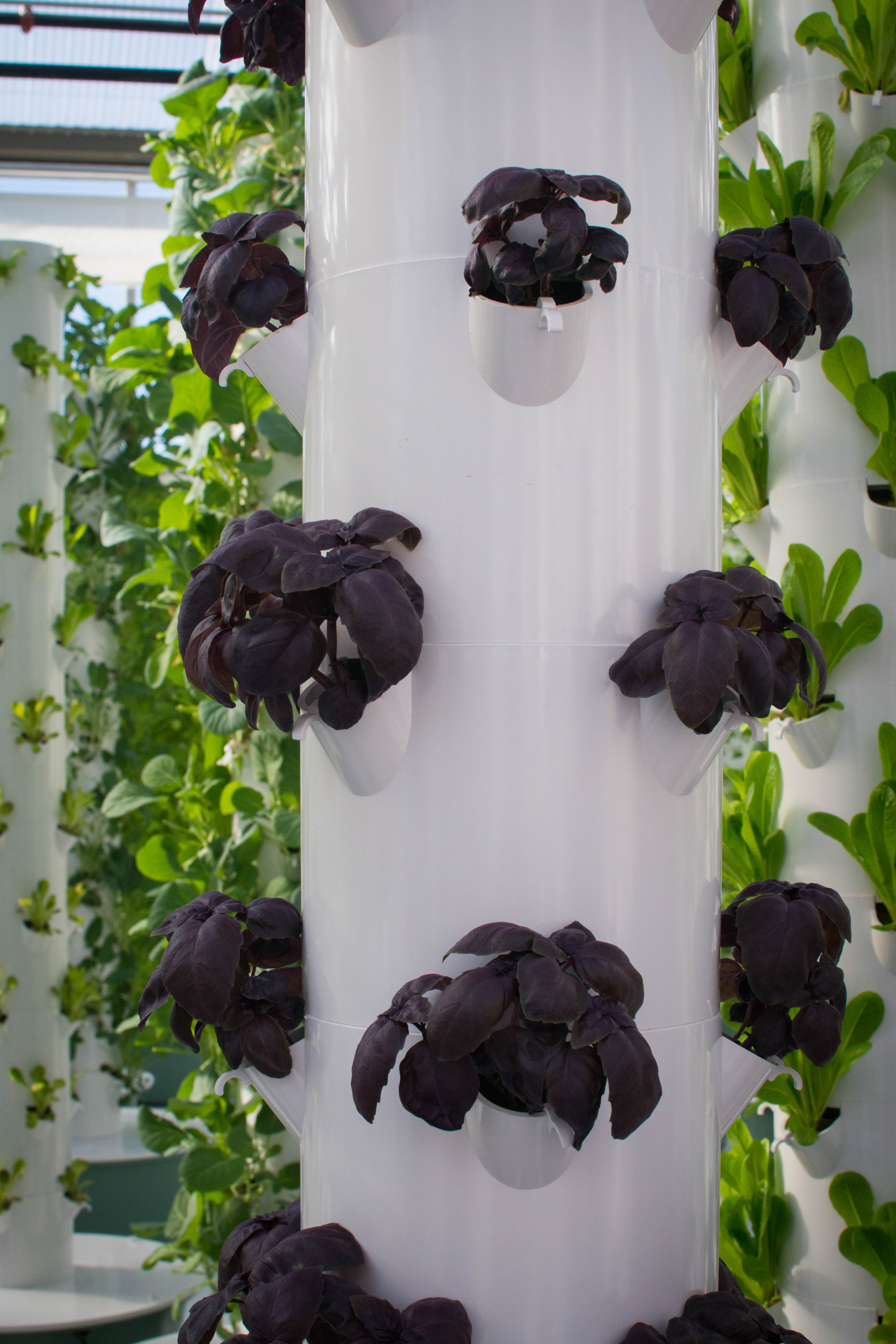
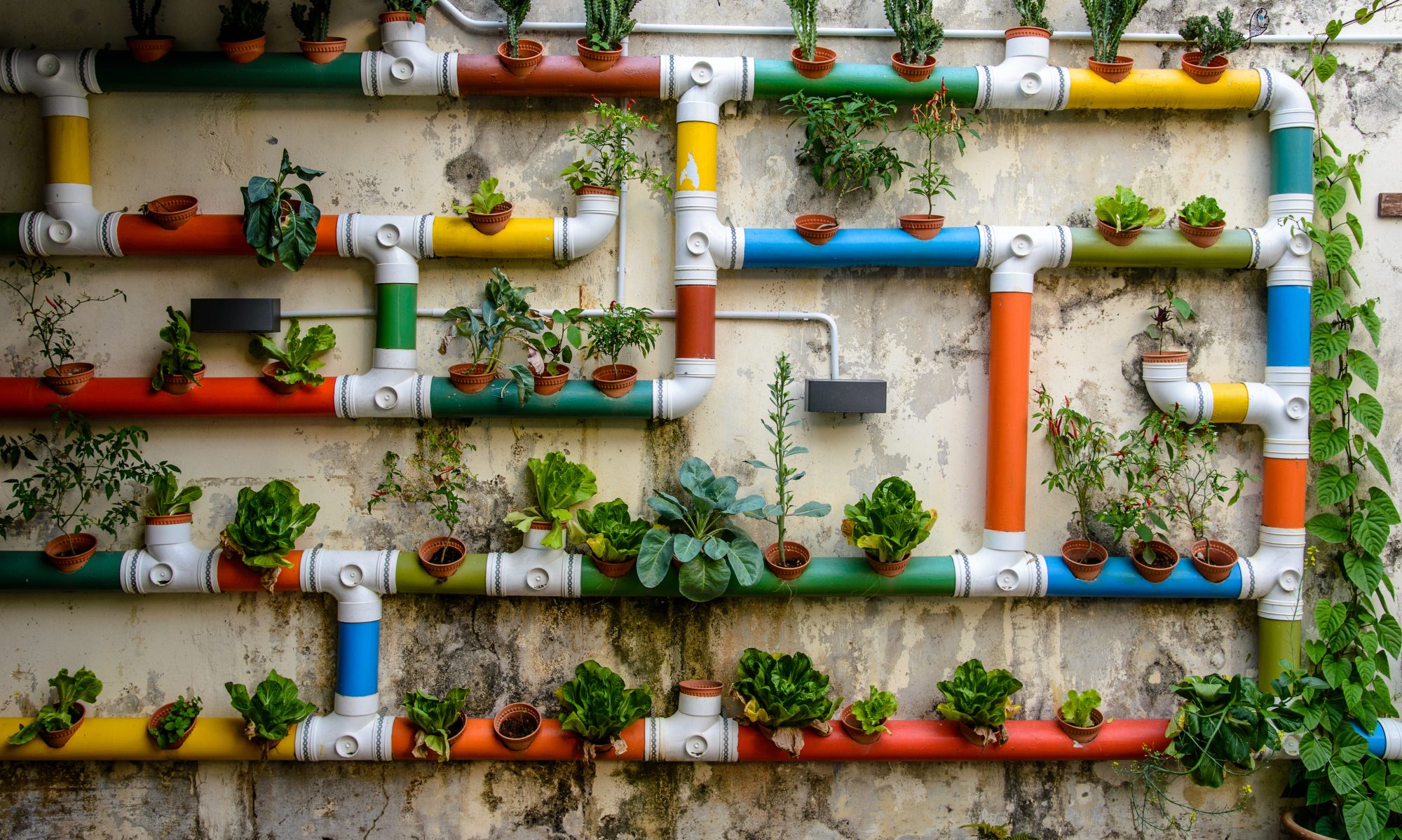
If you’ve recently walked down Lawrence Street in RiNo,  you have probably have been stopped in your tracks by the sight of a rooftop garden. At the very least, you’ve probably wondered what was going on above Uchi. This beautiful greenhouse space is home to Altius Farms. As one of the largest vertical aeroponic rooftop gardens in the country, Altius currently grows varieties of lettuce, herbs and edible flowers galore.

Part of the new S*Park condo community, Altius landed at the RiNo location where the land historically has been farmed since the 1930s. The greenhouse itself offers 8,000 square feet to run operations, and the community garden outside will double the growing space once the spring comes. S*Park and Altius are planning to team up for great farm-to-table events and community dinners come warmer temperatures.

READ THE FULL STORY AT: https://303magazine.com/2019/01/altius-rino-rooftop-farm/

Reviving monastery’s city farm, started a century before urban agriculture was cool

Members of religious orders have always had a need to garden, inspired no doubt by one of the Christian faith’s noted cultivators, Saint Fiacre, a green-fingered holy man who became the patron saint of gardeners.

When monks, friars and nuns established their enclaves, they turned to gardens of herbs, wildflowers and vegetables to feed and heal themselves. Other essential elements: a dairy and a fruit orchard. Apiaries also played a key role, providing honey, mead and beeswax for candles.

The garden, as Westerners know it, survived the Dark Ages because of monasteries. Given these traditions, it was natural for the founders of the Franciscan Monastery of the Holy Land in America to count on a small farm when in 1897 they purchased 100 acres of open land in Northeast Washington.

READ THE ARTICLE: https://www.washingtonpost.com/lifestyle/home/a-city-farm-is-revived-faithfully/2018/07/10/713f1f40-7e23-11e8-b0ef-fffcabeff946_story.html?utm_term=.eaa91050eb78

Win a FREE Seed Club Subscription!

Seed Club GIF

Win a FREE 1 Month Subscription to UOG’s Monthly Seed & Garden Club! https://urbanorganicgardener.cratejoy.com/offer.html

Everything is delivered to you at just the right time of the year. [All based on your grow zone – growing conditions – garden location – preferences – and more!]

Now is the perfect time to join as we are currently getting ready for the upcoming spring planting season!

Let our Garden Guru’s curate a collection of seeds & garden supplies just for you – your grow zone – garden space – location – and more. Includes everything you need to grow 5 new edible plant varieties every month – varieties can include herbs, vegetables, flowers, sprouts, micro-greens, bulbs, and more! Join the rest of the UOG community and get growing now!

ENTER TO WIN: https://urbanorganicgardener.cratejoy.com/offer.html

Discovery of wild truffle on Paris rooftop hailed as boon for urban gardeners

61fbec366fc82003752fc75f99f166a43df272a49276ecbb94aa502166e248c6
“French gourmets were celebrating Friday after a wild truffle was discovered for what experts said was the first time ever in Paris. It’s not exactly the sort of thing you expect to find nestled on a rooftop in the centre of the bustling French capital. In fact, experts believe it to be the first discovery of its kind in Paris. The discovery in a hotel roof garden in the shadow of the Eiffel Tower comes as prices for the aromatic fungus have doubled to more than 5,000 euros ($6,000) a kilo.

Coming just before Christmas, when truffles are used to flavour such seasonal foods as foie gras and chestnut soup, it raises the hope of an undreamt-of windfall for the new wave of urban gardeners colonising city roofs.”

Read the FULL STORY at: “TheLocal.fr.com

We’re on SNAPCHAT! [Let’s Get Snapping]

We want to be where our fans and fellow gardeners are, so we’ve headed over to snapchat and created an account! We hope you’ll share all of your awesome gardening successes/tips/and learning experiences with us over there.

Let’s be friends! Just use the snap code below to quickly and easily add us and see more great content from us, everyday!

SnapChat UOG IG


UOG SnapChat Logo

Washington Business Offers Rooftop Views, Urban Gardening and Yoga

WSJenks001_Web

“For nearly 150 years, many residents in the Washington, D.C., area have turned to W.S. Jenks & Son for their hardware and home improvement needs.

The product selection has shifted from wood-burning stoves, heaters and horseshoes to an array of modern hardware and lawn and garden products, but the business remains a spot for community members to gather.

In 2014, the family-owned and operated business moved to a new location in a unique, older building, says Jerry Siegel, president of W.S. Jenks & Son.”

See MORE Pictures at: “HardwareRetailing.com

Enter to WIN a FREE 1 Month Subscription to UOG’S Monthly Seed & Garden Club!


A Touch of Tuscany Headed to Staten Island

On top of this new 40,000 square foot roof you’ll find a vineyard, with an organic farm and bee keeping program.  They also plan on opening a restaurant on property that will use the organic produce and donate 100% of their profits to charity’s within Staten Island.

“We will grow the grapes, crush them and bottle them — all right here on the property,” he said.

To read more about this project, visit: “Silive.com

WHY URBAN FARMING MAKES SO MUCH SENSE FOR NEW YORK CITY

tmg-article_default_mobile
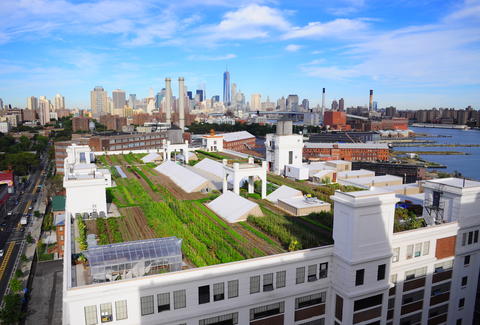
The Brooklyn Grange is an urban farm that sits upon a high-rise in Brooklyn Navy Yard. Teamed with it’s sister farm in Long Island City, Queens, the two farms are producing more than 50,000 lbs. of fresh vegetables and herbs in just 2.5 small acres of space.

“This is truly seed-to-plate agriculture, with no use of fossil fuels,” says Anastasia Cole Plakias, Brooklyn Grange’s vice president and founding partner, of the latter program. “People walk over from where they live, and go home with produce that was picked that morning.”

To read the rest of the article, visit: “Thrillist.com