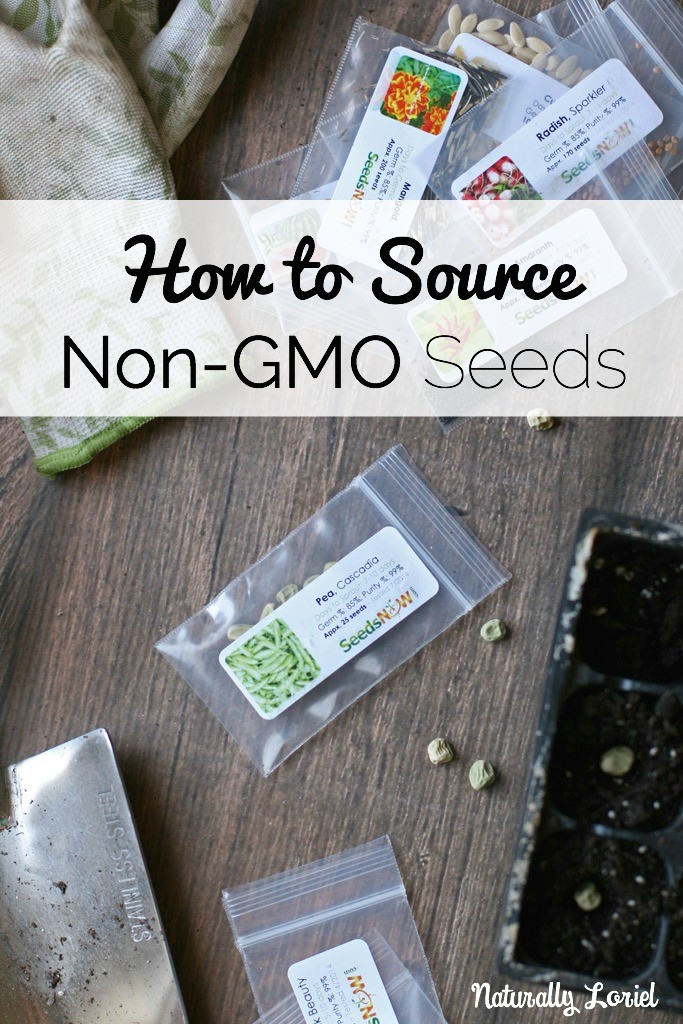
How to Source Non-GMO Seeds

how-to-source-non-gmo-seeds-naturally-loriel-seedsnow-683x1024
Source: NaturallyLoriel.com

Naturally Loriel recently published a blog post on a very important topic:  How to Source Non-GMO Seeds.

She says, “You begin to learn which food companies deserve your support and try to find a local farmer’s market in your area. You realize it’s so important to meet and shake the hands of the farmer that produces your food. Unfortunately though, you’re not as lucky as Lauren is, and the farmer’s markets in your area royally suck. The only other logical solution is to grow your own food.”

Click here to read the original blog post: http://www.naturallyloriel.com/how-to-source-non-gmo-seeds/

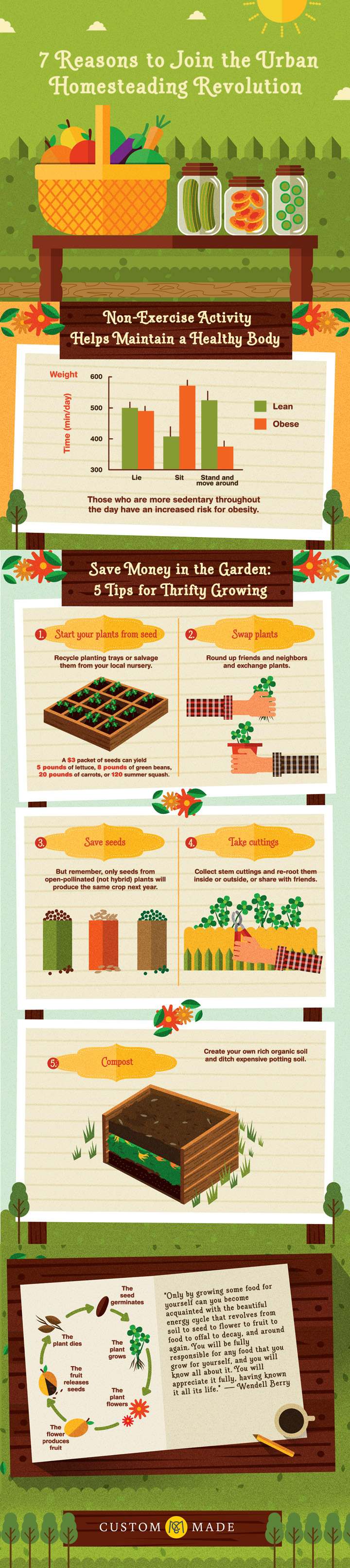
7 Reasons to Join the Urban Homesteading Revolution

Screen Shot 2014-11-06 at 11.27.57 AMby

1. Homegrown food is safer, more nutritious, and tastes better.

When the latest salmonella or e-coli outbreak dominates the headlines, it’s comforting to know exactly where your food comes from and how it’s raised. And because vitamin content is depleted by light, temperature, and time, freshly picked produce grown near your house is more nutritious than conventional produce, which is transported an average of 1,494 miles before it reaches the grocery store.

An even more delicious reason to celebrate homegrown food is the flavor. Gourmet chefs use the freshest ingredients they can find for a reason. The first time I cooked one of the eggs laid by our hens, I couldn’t believe how large and yellow the yolk was or how delectable it tasted. And it’s easy to appreciate novelist Barbara Kingsolver’s zeal for sun-ripened garden tomatoes. “The first tomato brings me to my knees,” she writes. “Its vital stats are recorded in my journal with the care of a birth announcement.”

2. Urban homesteading encourages healthy movement.

When I started gardening and making more things around the house and yard, I noticed a side effect: I felt better. It’s not surprising. Digging the dandelions out of a raised bed, brewing an India Pale Ale, and peeling potatoes fall in line with the sort of daily activities most important for maintaining a healthy body weight, according to research conducted by Dr. James Levine at the Mayo Clinic. In Levine’s study, people were fed an extra thousand calories a day. Those who did the most daily non-exercise activity (as opposed to deliberate exercise for fitness) gained the least weight.

3. Urban homesteading helps families connect with nature and the seasons.

Growing up in Colorado, I was fortunate to spend a lot of time hiking and camping. Gardening has given me an even more intimate connection with the natural world, since now I must work with it as a co-creator. And it has given my two young sons a wonderful relationship with plants and seasonal rhythms. They love the garden and beg to help plant seeds, pull weeds, and harvest. Every time one of them asks me if it’s pea or fig season yet, or recognizes an edible plant in someone’s yard, I smile. Those may seem like simple things, but for me as a kid, produce was something that was shipped across the country and delivered to a refrigerated section of the grocery store.

4. Urban homesteading is thrifty. 

It’s no coincidence the urban homesteading boom coincided with a worldwide economic recession. If you build your soil, save seeds, and tend your garden well, you can save hundreds of dollars on organic produce each season by growing your own. Keeping chickens can also save you money. We estimate that our eggs cost $3.35 a dozen (in organic chicken feed) at the most, compared to $5 to $7 for similar eggs at the health food store. However, we were lucky to inherit our chicken coop, so others may have to include that expense as well.

Cooking from scratch saves us the most money. It’s not just that making stock, microbrews, and bread products from bulk ingredients is cheaper than buying them. As we’ve become better chefs, we’re also not as apt to go to restaurants, which used to be a huge drain on our finances.

5. Turning a lawn into a homestead makes productive use of land and supports healthier ecosystems.

In the memoir Paradise Lot, Eric Toensmeier and Jonathan Bates recount how they transformed their backyard—one-tenth of an acre of compacted soil in Holyoke, Massachusetts—into a permaculture oasis where they grow about 160 edible perennials. What was once a barren lot is now habitat for fish, snails, frogs, salamanders, raccoons, opossums, woodchucks, bugs, and worms. “Imagine what would happen,” Toensmeier writes, “if we as a species paid similar attention to all the degraded and abandoned lands of the world.”

Most of us don’t have the skills or desire to garden on the scale that Toensmeier and Bates do. But by planting a few vegetables, herbs, or fruit trees, we create habitats for birds, butterflies, and pollinators. And by composting kitchen waste, chicken manure, and fallen leaves, we improve the ecosystem that supports all life.

6. Gardening and creating things boosts the spirits.

Author Matthew Crawford traded his job at a Washington think tank for a career fixing motorcycles because working with his hands made him feel more alive. “Seeing a motorcycle about to leave my shop under its own power, several days after arriving in the back of a pickup truck, I don’t feel tired even though I’ve been standing on a concrete floor all day,” Crawford writes.

We’ve all experienced the thrill that comes from making or fixing something. In her book Lifting Depression, neuroscientist Dr. Kelly Lambert explains that association. “When we knit a sweater, prepare a meal, or simply repair a lamp, we’re actually bathing our brain in ‘feel-good’ chemicals,” she explains. Lambert contends that in our drive to do less physical work to acquire what we want and need, we may have lost something vital to our mental well-being—an innate resistance to depression.

I can attest to what Lambert says. Almost nothing is as satisfying as appraising a finished scarf or jar of sauerkraut, or cutting the first slice off a loaf of homemade bread. I have no doubt that creating something with my hands every day—even a meal—is imperative for my mental health.

7. Urban homesteading encourages families to live, work, and buy more intentionally.

These days, before we buy something impulsively, my husband and I are more likely to ask ourselves some simple questions. Can we make, fix, or do this ourselves, and is it worth the time and energy? Sometimes the answer is no. For me, canning and making clothing are not worth the effort. But just asking these questions makes our family more intentional about how we live and work, and what we buy.

As a society, we’re often encouraged to make decisions based on two variables: time and labor. When it comes to household tasks, it’s usually seen as preferable to save both time and labor. While making a stew will take longer and require more physical work than buying a can, the process is enjoyable and good for the body. In addition, the homemade variety is healthier, tastes better, and brings greater satisfaction. Equations look different when you add in all of the variables.

I hardly think of my family as urban homesteaders anymore, because the parts of the lifestyle that once seemed foreign and daunting, such as gardening, composting, and cooking from scratch, are now routine. They help us stay connected and make our lives feel richer. It’s powerful to produce some of what we need to survive, especially food.
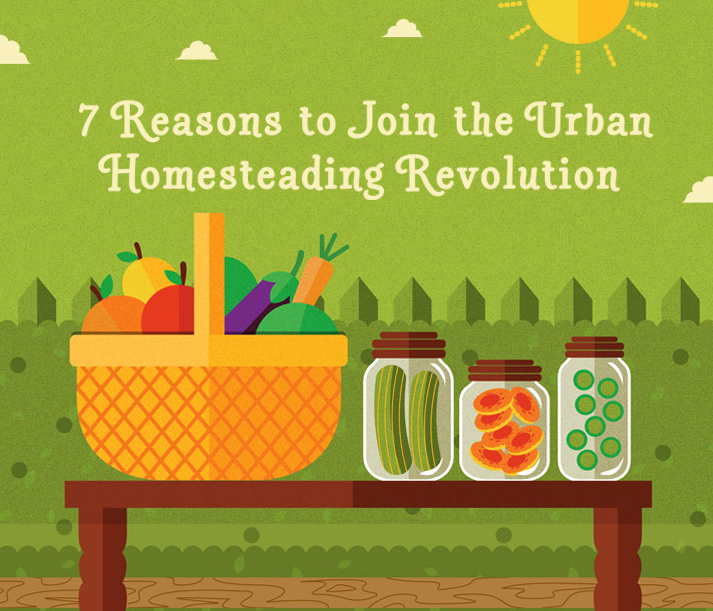
7 Reasons to Join the Urban Homesteading Revolution

7 Reasons to Join the Urban Homesteading Revolution
Infographic by CustomMade
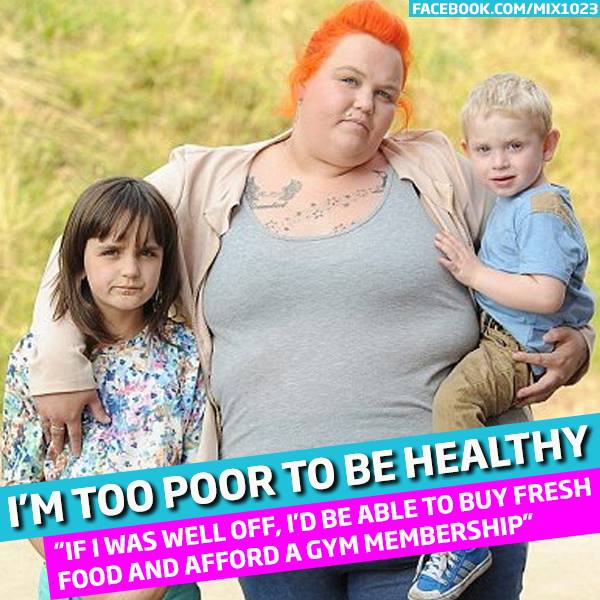
Too Poor to Be Healthy?

obese mom

“An obese mother-of-two who lives on benefits says she needs more of taxpayers’ money to overhaul her unhealthy lifestyle.  Christina Briggs, 26, says she hates being 160 kilos but she can’t do anything about it because she can only afford junk food. Meanwhile, exercise is out of the question because she doesn’t have the funds to join a gym.”

Unemployed Christina gets £20,000 in benefits a year and lives in a council house with her two children by different fathers, Helena, 10, and Robert, two.

She left school as a teenager after falling pregnant with her daughter following a one night stand.

The family feast everyday on takeaways, chocolate and crisps as Christina says they can’t afford low fat foods. As a result, the mother is currently a dress size 26.

She has been warned by her GP that her health is in danger because of her size – medical complications relating to obesity include heart disease and diabetes.

Christina is desperate not to leave her two children without a mother and doesn’t want her size to take her to an early grave.

But she insists ‘it’s not my fault – healthy food is too expensive’.

She feels her only hope is for the government to give her more money so she can afford to buy fruit and vegetables and join a gym.

She also believes she should be paid to lose weight as that would give her the motivation to fight the flab.

She told the magazine: ‘I need more benefits to eat healthily and exercise. It would be good if the government offered a cash incentive for me to lose weight. I’d like to get £1 for every pound I lose, or healthy food vouchers.

‘If the price of healthy food was lowered that would help, too. I need help, but I need it from the government.’

She added that she can’t get a job to gain more money because she’s needed at home to care for her children, especially as her daughter has attention deficit hyperactivity disorder and issues with her kidneys.

She explained: ‘There’s no way I could get a job. I don’t feel bad about the taxpayer funding my life and my child’s medical problems, because I don’t treat myself or buy anything excessive. I just get enough money to live on – the taxpayers should help fund my diet.’

Read more: http://www.dailymail.co.uk/femail/article-2768442/It-s-not-easy-overweight-benefits-says-25-stone-mother-two-wants-MORE-money-government-help-diet.html#ixzz3EPLyvREY

Is she too poor to be healthy?   Comment below.

5 Ways To Grow Organic Food In Small Spaces For Preppers, Survivalists And Every Day Folks

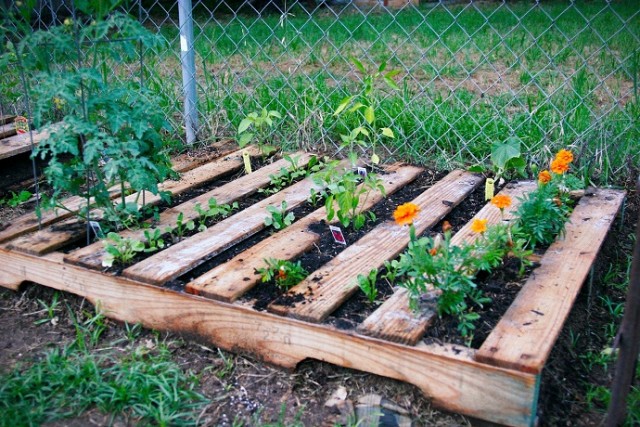
pallet-garden-e1382450563458
Just came across this post over at jbbardot.com I think everyone should read.  You can read the full article here.  With the constant onslaught of GMOs, pesticides, and chemicals making their way into the food supply, growing food in your home garden has become less of a hobby and more of a necessity. Many people have now begun to grow a large portion of the fruits and vegetables they consume at home, and an increasing number do so without the luxury of vast amounts of land. Food can be grown in just about anything, and all it takes is a little knowledge and effort. Even if you only have an apartment balcony, there are techniques that can help you produce your own impressive harvest, and this article looks at 5 different ways to grow food in a limited space.

Vertical Gardening

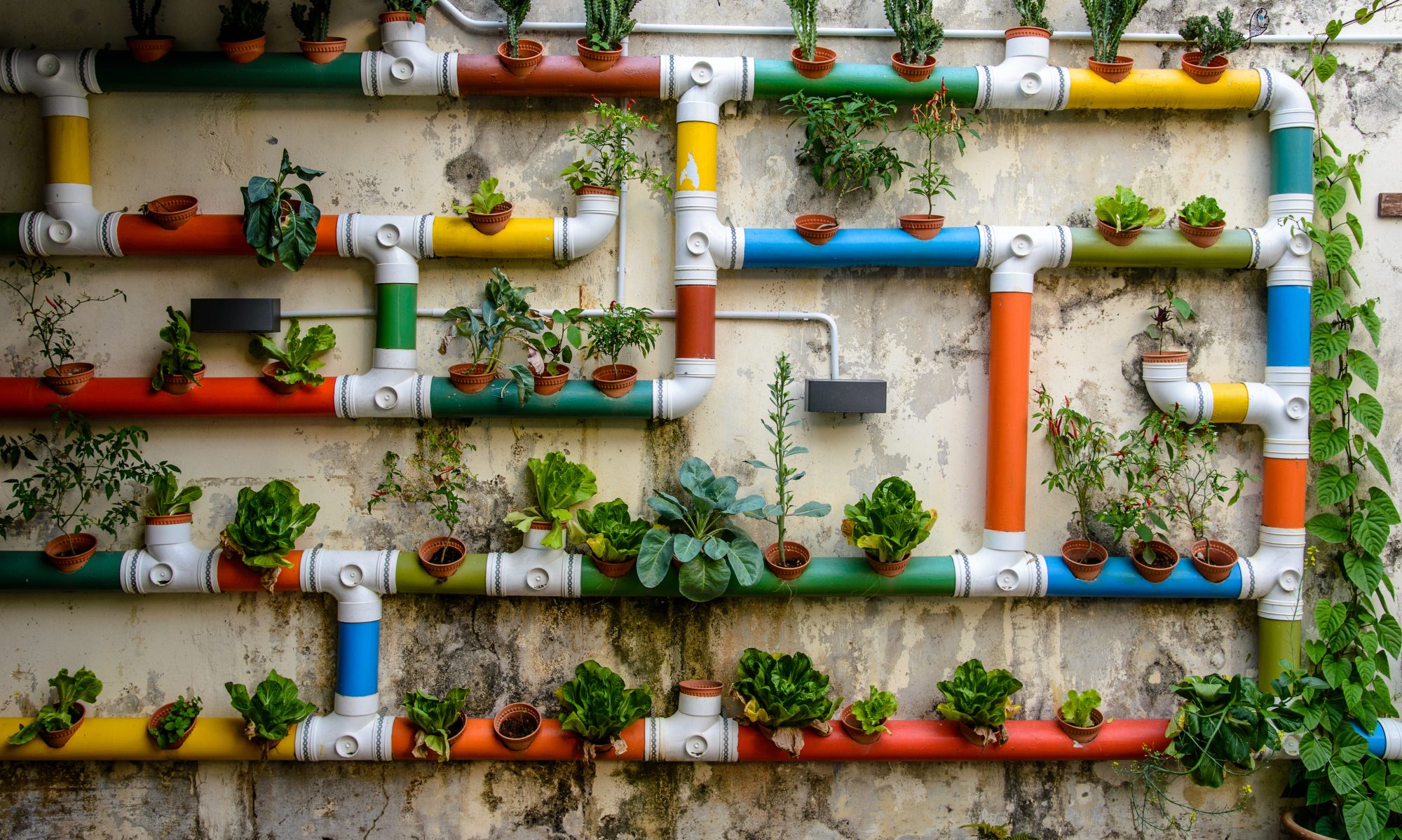
Vertical gardening has become fashionable lately with many interior designers including a ‘green wall’ in office buildings, and they are often used to cover the exterior of museums and galleries to create a ‘living art’ feature. However, their true appeal lies in their effectiveness for growing food, and they are perfect for patio gardens, balconies, or for anyone wishing to maximize their vertical garden space. Most large DIY stores sell container kits that can be attached to a trellis and then attached onto a wall, or you could even make your own containers using 2 litre plastic bottles or empty plastic pots. For those without an outside space, Windowfarms sell a hydroponic indoor vertical gardening kit that feeds and waters itself, and manufacturers claim it can grow everything from herbs to strawberries in just about any climate.

Square Foot Gardening

Square foot gardening found popularity in 1981 when gardener Mel Bartholomew demonstrated how to grow a substantial amount of food in a container or vegetable bed measuring just 4ft x 4ft, and his technique has been emulated in homes all over the world. Square foot gardening involves dividing the space into 16 different squares and planting different seeds in each space. As each crop is harvested a different plant takes its place, and the tallest plants such as tomatoes and leeks are situated at the back. In his book All New Square Foot Gardening, Bartholomew recommends a soil mixture of peat moss, vermiculite, and compost to yield best results, and regular rotation of crops will ensure fertile soil. This method is perfect for new gardeners as it is easy to maintain and needs only a few materials to start up.

Growing Food in Pallets

Shipping pallets can be recycled into just about anything, and an entire culture has evolved around creating spectacular pieces of furniture using pallets and other pieces of wood salvaged from shipping yards. Pallets also make excellent vegetable planters and are perfect for shallow root vegetables and succulents. Once filled with soil, the pallets can be layered on top of each other and different vegetables planted around the sides and along the top to maximize growing space. They are also ideal for vertical gardens and can easily be fixed to a wall or fence.

Growing Food in Containers

Container gardening is the most popular choice for balcony or patio gardeners, but you are not limited to the usual plastic tubs. Attach a wire from one end of your space to the other and hang baskets filled with cherry tomatoes, lettuce, cucumber, and herbs to make the most out of your air space. For a quirky touch, search your local thrift stores for some large size men’s work boots and use them to plant herbs and small veggies, or take an old freestanding bathtub and fill it with carrots, spring onions, lettuce, and kale. Other items that can be recycled to use as growing containers include car tires, laundry baskets, tin cans, and casserole dishes. Container gardens are perfect for those who live in cooler climates as they can easily be brought inside when the winter frosts arrive.

Growing Food Indoors

Even those without an outdoor space can grow their own organic… READ THE FULL ARTICLE HERE: http://www.jbbardot.com/5-ways-to-grow-organic-food-in-small-spaces-for-preppers-survivalists-and-every-day-folks/

What’s the Hardest Part About Starting Your Container Garden?

You want to start container gardening, but there is one thing that’s stopping you?

What is it?

I’ve been asking for your feedback over the last few weeks through surveys and on the Urban Organic Gardener Facebook page.

The reason for asking is because I’m starting to develop an online vegetable container gardening training course for you that will empower you to easily start growing your own food.

Based on what you have told me, the hardest part about starting…is just that. It’s starting.

Reasons why you aren’t starting your container garden

  • It’s too overwhelming.
  • Fear of failure.
  • Not knowing where to start.
  • I have a black thumb and history of killing plants.
  • I have no idea what I’m doing.
  • I want to know exactly what to do.

Any of those sound familiar to you?

[vimeo clip_id=”39600494″ title=”0″ byline=”0″ portrait=”0″ width=”525″ height=”393″]

Your turn

In order to help you start growing your own food without the confusion and provide the best value for you with this this training, in the comments below let me know what else are the hardest parts about starting your container garden?

Photo courtesy of Music2Work2 on Flickr.

Why Not to Use Chemicals in Your Garden

We already know some of the effects of chemical gardening and why organic gardening makes sense, but I posed an open-ended sentence on the Urban Organic Gardener Facebook page that said, “I don’t use chemicals in my garden because ___.”

Over 70 comments were left by people giving their reasons why. All of which were simple and to the point. Most of the responses mentioned not wanting to eat the chemicals and respecting wildlife and the environment.

Here are some of the comments that were left:

Carolyn Madison said…“because I do not want to eat chemicals – Chemicals create toxic food!”

Missy Gullickson said…“if a bug won’t eat it, I won’t either…”

Randy Smith said…“I don’t like to eat stuff that has skull and crossbones on the package.”

Roberta Clay said…“I don’t use chemicals in my garden or on my farm, because it can harm or kill my bees, the wildlife, the earth and anything the land produces!!!”

Matthew Lee said…“‎…they harm my family and ultimately impede the sustainability of my farm.”

Michael Van Varenberg said…“‎ i like pulling weeds.”

Pam Howe said…“…cancer sucks.”

Michele Dangelo said…“My kids eat the food.”

Lynn Johnson said…” i already have more than enough unwanted chemicals in my life–in the air i breathe, the water i drink, the food i eat…”

Urban Hillbilly said…“Really I don’t use chemicals because I almost lost my 2 1/2 yr old baby to appendicitis. Not one doctor could tell me why someone so young got so sick….I fed her good food but it was NOT organic… SO this is how I became the Urban Hillbilly.”

Robin Gwen said…“I like to squish bugs.”

Deanna Rolfe Dunn said…” I don’t want to eat chemicals – there’s enough stress to our bodies without adding to it!”

What are some other reasons not to use chemicals in your garden?

Photo courtesy of andypowe11

Sharing Your Garden Harvest With Neighbors

I was fortunate to have one of the great experiences of growing my own food this past weekend – the experience of sharing the harvest with others.

While on my balcony garden taking care of my mint, I noticed a neighbor across the way harvesting some herbs for their meal. Since my mint container is overflowing, I shouted across the way to ask if he needed any. He came over to get some mint and we bs’d for a few minutes.

Though we have seen each other before, this was the first time that we actually spoke to each other and conversed.

A few hours later, he knocked on my door with some fruit salad that had some of the mint in it. That really brought it all together for me.

I’ve mentioned before that one of the simplest of reasons that we should grow our own food is that because we are human and it’s what we’ve done for hundreds of thousands of years.

Instead of me yapping and talking about it, it was apparent to me that growing your own food does help to bring people together through sharing.

What are some stories that you have about sharing your garden harvests?

From Seed to Table: Food Brings People Together

I’ve said it before that we are humans, therefore we grow food. If you look back at societies, civilizations and communities, you will see that the common factor was growing food.

Over the past 100 or so years, that skill has been lost to chemical agriculture and the ability to transport food long distances. There is so much that goes into food that we don’t get to partake in anymore. We just see it as congregating around a table and eating it. Some of the time it’s not even that, it’s something that’s done en route from one task to another.

Everything about food can bring families, couples, partners, neighbors, whoever it may be together. There is camaraderie and a relationship that is built when going through the process.

Each of the steps in the process are chances to forge deeper relationships with each other and with the food. From the decision of what to grow to planting and tending to, then there is harvesting, preparing and sharing.

You know damned well that if you were to grow some parsley and put it in a dish, you are certainly going to stick your chest out and tell everyone you grew that parsley. There is a sense of pride and accomplishment that comes with growing your own food.

It’s not just about the eating part, which is mad fun, but it goes much deeper than that. You’ll start to get a better appreciation of food that you buy because you know what goes into it. You certainly are less likely to waste food when you grow your own.

This is why I think we should all start to grow some of our own food or source it locally. It helps to bring us together.

What stories do you have to share about growing food and bringing people together?

httpv://www.youtube.com/watch?v=5SZYNckCvS4

Where Does Your Food Come From?

One of the reasons that I started my fire escape garden in 2009 is because I learned that on average our food travels 1,500 miles from farm to plate. That’s about the distance from one coast of the United States to the center of the country.

The next time you are at the grocery store or supermarket (aren’t they the same thing?), pick up some produce and look at the label to see where it’s from. I started to do this when I was living in NYC and saw Chile, Argentina, Mexico, Peru and other far off countries. There wasn’t even anything from my country, nonetheless my state.

It got me thinking about all of the variables that go into getting that food to the store and what it means for me to purchase.

  • Oil is used to transport the food, which has an environmental impact. It also effects the rising food prices.
  • Nutrients are likely lost because it’s been harvested 3-4 weeks before it even made it to the shelf of the store.
  • Local farmers are affected because we are shipping it in from elsewhere instead of a local source.

These are what got me started apartment gardening in New York and why I keep doing it with my balcony garden in LA. When I was in NYC, I got a lot of my produce from a CSA. Now that I’m in LA, I go to the farmers market a few times a week. So I’m fortunate that most of my food is grown pretty close to me.

1,500 miles is a pretty long distance for food to be traveling and it’s not completely necessary. You can start growing some of your own and support your local farmers.

What’s your thoughts on food traveling so far? Were you aware of this?

httpv://www.youtube.com/watch?v=d-3FLLidFDI