Use a Kitchen Compost Pail to Save Your Scraps

You know what you can compost

…But you don’t know where to store it before you compost it.

It’s too much of a hassle to bring it to your compost bin each time. I hear you on that.

This is why it’s important to have a kitchen compost pail readily accessible.

6 Features Your Kitchen Compost Pail Should Have

  • A lid that fits tightly.
  • Enough space to fit your food scraps.
  • Style – which is debatable.
  • Easily washable.
  • Easily transportable. Preferably with a handle.
  • Fits on your kitchen counter or close to your cutting board.

If aesthetics is your thing, there are some stylish kitchen compost pails available.

It’s not necessary to buy one though. The next time you go to the supermarket or deli, ask them if they have any 1-gallon containers with a lid that they were throwing away.

These work perfectly.

[vimeo clip_id=”36808647″ title=”0″ byline=”0″ portrait=”0″ width=”525″ height=”393″]

The pail that I use I picked up for a few dollars at my local health food store.

Every few days you can dump the content of the pail into a larger bucket or into your compost bin.

The main purpose of the kitchen compost pail is to make that it’s as easy as possible for you to store and compile your food scraps.

Your Turn

In the comments below, let me know where you have your kitchen compost pail.

Things You Have Around Your Home That You Can Compost

Can I add meat to my compost pile?

Is stale bread OK to compost?

Or, more importantly, what can you compost?

The answer to that is in your home…

…and to help you get started with indoor composting, I am going to share things that you have in your home that you can compost.

What You Can Compost at Home

This is by no means an exhaustive list of every single thing that you can compost. It’s a practical list of things that you all have.

Let’s go through some quick composting fundamentals first. Compost is made up of two elements – browns and greens.

Think of browns as your dry items such as leaves and shredded newspaper.

Greens are your wet items like veggie scraps and coffee grinds.

When you start your compost, you will need a balance of the two. For right now, I want to share what you can compost and save the rest for later.

Common greens you have at home that can be composted:

  • Fruit and veggie scraps. Avoid onions and citrus. Yes, they can be composted, but for your indoor compost bin it’s best to stay away.
  • Coffee grounds and tea bags
  • Grass clippings. Only if the grass hasn’t been treated with chemical fertilizers.
  • Plain cooked rice or pasta
  • Stale crackers, bread, cereal or pretzels
  • Old herbs and spices
  • Egg shells. Not really a green, but they can be composted

Common browns you have at home that can be composted:

  • Cardboard including boxes and toilet paper rolls
  • Dryer lint
  • Dried leaves
  • Shredded black and white newspaper
  • Hair from your brush. Make sure there is no gel or hairspray in it
  • Shredded bills and documents

Yes, there are other things that can be composted like goat manure, river mud and oat straw, but not many of us have stuff like that available to us.

If you are just getting into indoor composting, then this list should give you a solid start.

Your Turn

Are you starting an indoor compost bin?

Leave a comment and let me know.

How to Select the Best Grow Light for Indoor Growing

Michelle Moore

Not all light is the same.

Plants respond differently to different colors of light.

Light on either end of the spectrum, blue light or red light, have the greatest impact on photosynthesis.

Kinds of Light

Blue light, referred to as cool light, encourages compact bushy growth.

Red light, on the opposite end of the spectrum, triggers a hormone response which creates blooms.

Grow lights producing the orange and reddish light typically produce substantial heat, however, some lights are able to produce full spectrum light without the heat.

Grow lights come in all shapes, sizes and price ranges.

As a general rule, inexpensive lights to purchase tend to be the most expensive to operate and the least effective. While price is not necessarily an indicator of performance, many of the efficient grow lights require ballasts as well as specialized fixtures.

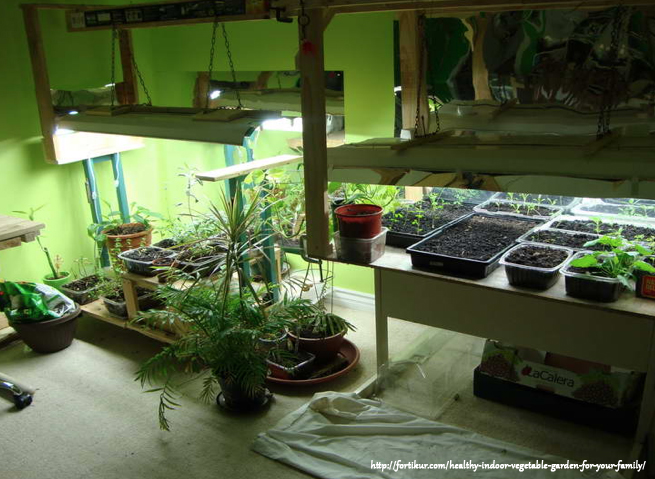
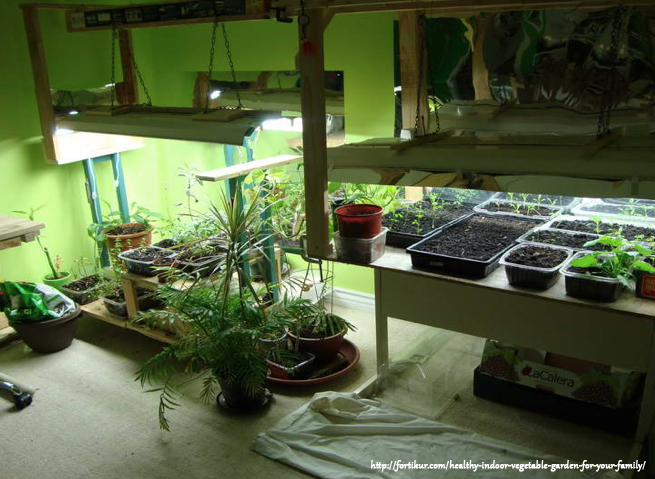
Image of vegetable being grown indoors under artificial light is via fortikur.com.

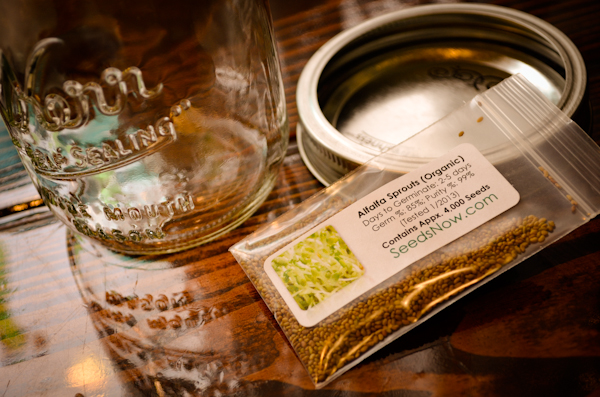
Check out SeedsNow.com if you’re looking to grow organic vegetable and herbs from seed.

Click here to read more about what GMOs are. It’s really easy for you to grow all kinds of vegetables, herbs, and sprouts inside.  All year long!  Invest in a grow light and you’ll be happy.
Basic Types of Grow Lights

These lights run the gamut of performance and price range.

Incandescent Lights.

The least expensive lights to purchase cost around $30. These incandescent lights work well for specific plants where the light is placed a minimum of 24” from the plant. These lights get extremely hot so they must be used with care. Spot grow bulbs, color corrected incandescent lights, install easily and are good for use with a specific plant or a small grouping of plants. Most spot incandescent bulbs last less than 1,000 hours. Some light fixtures come with a clip handle so you can put them exactly where they’re needed.

Fluorescent Grow Lights.

They are a common choice for homeowners. Fluorescent lights are reasonably energy efficient and relatively easy to install. A typical fluorescent bulb will last approximately 20,000 hours. Fluorescent light is typically on the blue end of the spectrum. Blue light encourages bushy compact growth which makes them perfect for seed starting. Blue light is also cool to the touch making it possible to place lights within just a few inches of the seedlings.

New Full-Spectrum Fluorescent Lights.
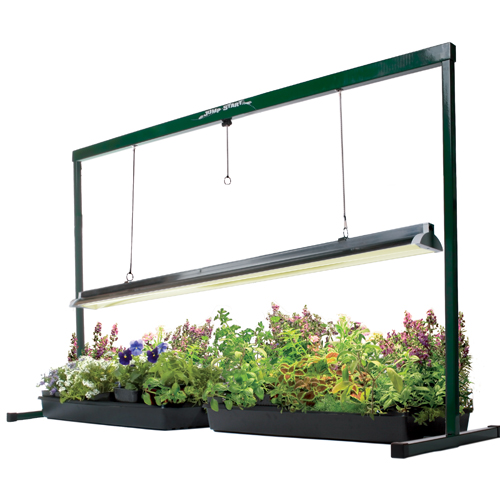
Provide the red spectrum as well to encourage blooming.

Combining the lights in a fixture makes for even, all around growth.

The next generation in fluorescent lighting includes the new T-5 lights.

These new lights have extremely high output but are energy efficient and long lasting.

The T-5 lights triple the light output of normal fluorescent lights without increasing the wattage. Plants absorb a high percentage of T-5 lighting because the fixtures function well very close to plants. High output bulbs require a high output fixture to operate, so the bulbs and normal fluorescent fixtures will not work together.

LED Lights
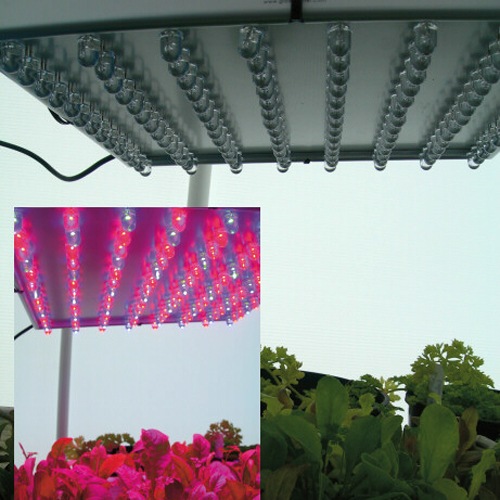
The newest type of grow lights use LED technology.

One major advantage to the LED lights is the small size.

LED lights are only a few inches in diameter and are easy to mount.

In some greenhouses, LED lights may be the only practical light option.

Hanging most grow lights requires a strong greenhouse structure and a place to hang the lights.

LED lights weigh a fraction of other lights and are easy to configure where needed. According to LED manufacturers, LED grow lights maximize blue and red light to provide and excellent balance for plants.

They do not have much green-yellow light. Since humans see green-yellow light best LED grow lights appear dim to our eyes. This is an exciting new technology that will be interesting to watch as it develops.

The Best Grow Light Option

Now that I’ve given you a good rundown on greenhouse lighting options, it’s also important to mention darkness.

Almost all plants benefit from a period of six hours or more of darkness.

It’s a good idea to know how much light your plants need, but unlike commercial growers, hobbyists often have a wide variety of plants so they need to take a broad approach to lighting.

Fluorescent lights offer excellent overall lighting options.

Other Considerations

If you chose to use any type of fluorescent lighting, you will need to account for plant growth.

Fluorescent lights perform best when positioned very close to plants.

As plants grow into the light, it is important to raise the fixture.

Generally only the plants touching the lights will burn, but be prepared because they grow quickly.

Adjustable hangers are a good solution. These hangers move easily allowing you to make quick adjustments.

If you’re looking for non-gmo seeds that grow well using hydroponic systems, click here.

Your Turn

Are you currently using grow lights to grow indoors? What kind? What are you growing?

Do you plan on growing indoors using grow lights?

Let me know in the comments below.
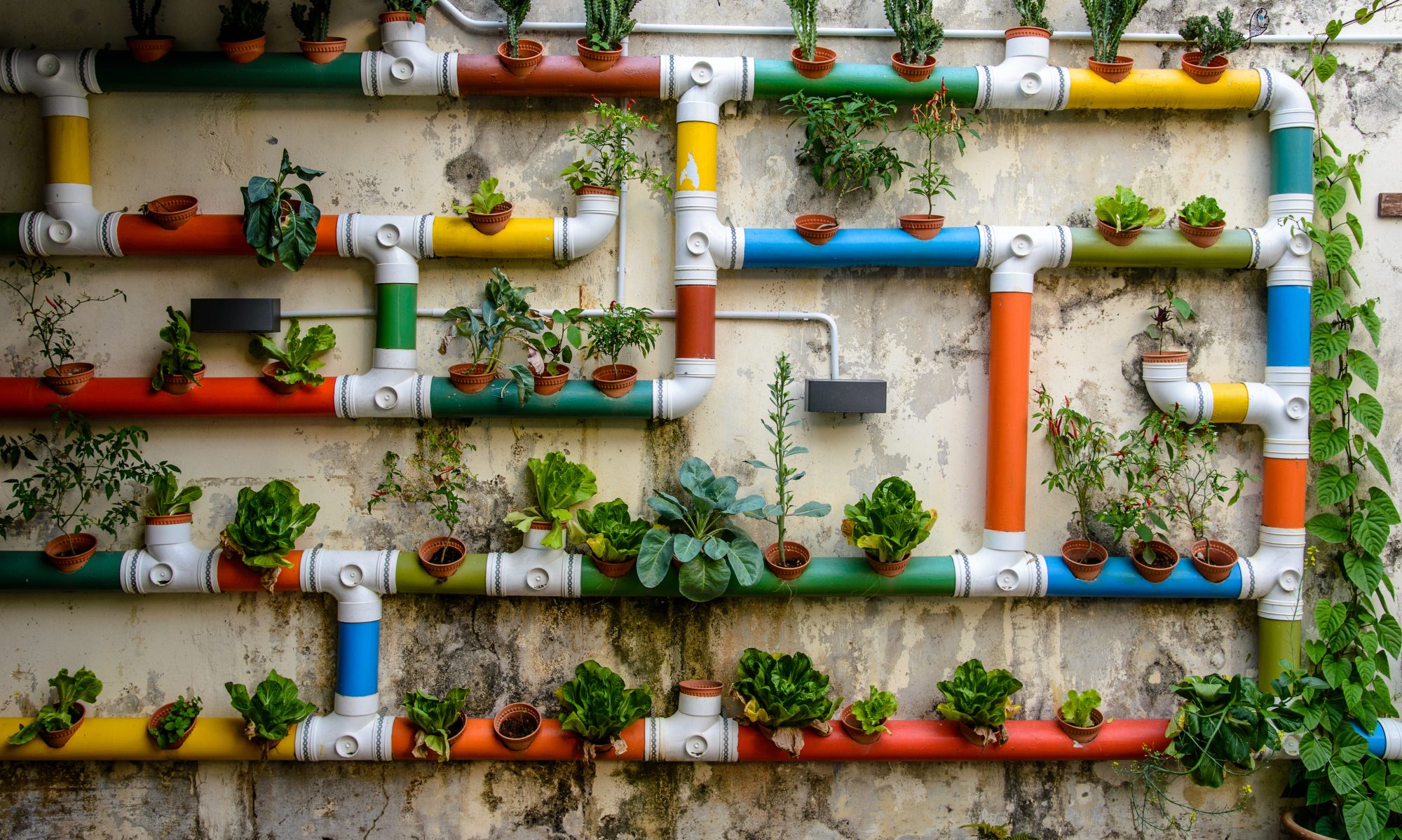
How to Grow Your Own Sprouts Indoors

Today I am going to show you the easiest way that you can start to grow your own food.

And you won’t need any outdoor space…

You just need a spot on your kitchen counter.

I am going to share with you how to grow your own sprouts indoors.

No need to buy fancy gadgets or machines. You can do this on the cheap.

You ready?

Let’s do it!

What you’ll need to grow your sprouts

  • Mason jar
  • Cheescloth or another breathable cloth
  • Canning lid or rubber band
  • Bowl or dish

Steps to grow your own sprouts

  • The first thing to do is to soak the seeds for 8 hours in the mason jar. I prefer to do this right before I go to bed to let them soak overnight.
  • The next morning, put the cheesecloth over the mouth of the jar and secure it with the canning lid. Drain out the water. Refill with water to rinse the seeds and drain again. Place the jar out of direct sunlight at an angle in a bowl. This will allow the rest of the water to drain.
  • Repeat the previous step every 8-12 hours (about 2 times per day).
  • Generally it’ll take 5-7 days for them to be ready to eat. The seeds are ready to eat as soon as they start to sprout. Just rinse and drain them one last time before you store them in the fridge.

Sound off

What is your favorite sprout?

How to Make a Seed Watering Pot

Do you have problems watering your seeds?
Not sure the best way to water them?

I’ve had this problem too.

That’s why I am happy that I came across this DIY project on FunInTheMaking.net that I can share with you.

It’s DIY seed watering pot and it will help you to easily water your seeds without having the impact of the water harming them.

What you’ll need

  • Plastic jug of some kind – I used a milk container, but you can use a maple syrup container or something similar.
  • Drill and a 1/16″ drill bit or whatever size you find appropriate.

Make it in two simple steps by drilling

  • A hole in the cap.
  • Several holes in the bottom of the jug.

[vimeo clip_id=”36255737″ title=”0″ byline=”0″ portrait=”0″ width=”525″ height=”393″]

To use your seed watering pot

  • Fill a bowl or dish with water.
  • Place your thumb over the hole in the cap and submerge it in the water.
  • Remove your thumb and you’ll feel the water being sucked up into the pot.
  • Remove the pot from the water with your thumb over the hole.
  • To water your seeds, put the watering pot over the seeds and remove your thumb.
  • A gentle flow of water should come out from the bottom.
  • To stop the flow, place your thumb back on the cap.

[flickrset id=”72157629149521591″ thumbnail=”square” photos=”” overlay=”true” size=”medium”]

This is a much gentler way to water your seedlings and not damage them.

Sound off

How do you water your seedlings?

Health Benefits and Reasons to Grow Mint

Mint is a commonly grown herb in container gardens…

…but do you know the health benefits of this herb?

Well today, I’ll share some with you some ways that I use it and other ways that it can be used.

Common uses for mint

Soothes aches, pains and stomach problems
You can easily make mint tea by steeping mint leaves in hot water for a few minutes. This has been known to help with:

  • Digestion
  • Hiccups
  • Farting
  • Menstrual cramps
  • Constricted muscles
  • Other minor aches and pains

Antiseptic and antibacterial
“Mint possesses astringent, antiseptic, antibacterial, and antimicrobial properties,” said the Marketing Manager for an online herb company. “Peppermint is great for cleaning abrasions, cuts, burns and wounds. It’s even good for treating acne.- best when steeped with hot water and left to cool, then applied as an external rinse.”

Relieve headaches
If you are suffering from a headache or migraine, you can mash up mint leaves with some oil. Then apply the mixture to where you are feeling the pain.

Decongestant
“It’s also a decongestant and has expectorant and antiviral properties,” said the marketing manager. “Peppermint tea isn’t just a great stress reliever, it’s good for clearing respiratory issues, treating colds and helping to open up nasal and chest passages aided by its mentholated aroma.

I like adding a pouch of it to hot water or to my shower to infuse the steam with peppermint to help me breathe better when sick.”

[vimeo clip_id=”35989867″ title=”0″ byline=”0″ portrait=”0″ width=”525″ height=”393″]

Growing mint

Mint is an herb that you shouldn’t start from seed, and can easily transplant in your container garden.

When you harvest mint a certain way, you can promote even more growth.

You can get a mint transplant from your local nursery or a cutting from a friend.

Sound off

How do you use mint?

5 Herbs You’ll Never Want to Start From Seed

Which herbs should you start from seeds?

You can experiment and find out on your own…

…or you can read the rest of this post and save yourself the hassle.

If you want to save time and energy, continue reading.

Some herbs require too much of your time

There definitely is something fun about starting from seed. You get to take care of the seedling and watch it grow until you finally use. Like a child of yours.

No doubt on that.

But there are some herbs that are too much work and require too much of your precious time to start from seed and you’re better off buying transplants.

This is especially true because we are urban gardening in small spaces like our apartments and in containers. We have to maximize our space.

The herbs that experts say you shouldn’t start from seed

Bay Leaf
“Bay is extremely difficult to germinate because they must be fresh and viable, and must be stratified and kept moist,” said Briscoe White, the owner of an herb company. “That’s one of the reasons bays are in such high demand- they’re hard to find because they’re hard to germinate, have a low germination rate and grow extremely slowly.”

Lavender
“Lavender can be a little tricky because they’re both very slow growing from seed, which can lead to problems with disease or fungus, since the young plants are so susceptible,” said the White. “Lavender also is very finicky with moisture and because of its slow growth can be difficult to keep healthy.”

Flavored Mints
“Many kinds of flavored mints, like chocolate mint or orange mint, can’t be started from seed, only from cuttings,” said Fern from Life on the Balcony. “This is because they’re hybrid varieties that don’t come true to form when grown from seed.”

[vimeo clip_id=”35859819″ title=”0″ byline=”0″ portrait=”0″ width=”525″ height=”393″]

Rosemary
Rosemary is much like lavender and, “It can be frustrating to grow from seed because there are so many varieties,” said the White. “To ensure that you get a true variety, you’re best to take a cutting and propagate from that, rather than seed.”

“Rosemary is so much easier to start from a cutting or from a plant bought at the nursery,” added Fern.

White Sage
“White Sage is also difficult to germinate as it has a 10-15% germination rate and on top of that, just takes a lot of time to get growing,” said the owner. “The viability is so low, that we end up placing 10-12 seeds per cell to try to get enough plants to sprout.”

Where you can buy these herbs

You can get these herbs from

  • Your local nursery
  • A cutting from a friend

Sound off

What herbs are you growing or want to start growing?

Questions to Ask Yourself When Deciding What to Grow

Deciding what to grow is an important decision.

It’s also the question that I get asked most often when people are starting their urban gardens.

To that question, I often respond with a series of questions that you need to ask yourself.

Here they are:

  1. What’s the location that I am growing in?
  2. How much sunlight does my space get?
  3. What am I growing in?

Once you answer those three questions, your choices will automatically be narrowed down.

If you only get three hours of sunlight, your chances of growing cucumbers are small.

Then you can move on to the next set of questions to ask yourself:

  1. What do I use most? If you are using a lot of something, you should consider growing it.
  2. What do I like to eat? This might seem like an obvious question to ask, but it’s an important one. We are working with small spaces and need to get the most out of them. Why grow something that you don’t like to eat?
  3. What makes the most $$$ sense? To me it’s herbs. At the grocery store you always have to buy a big bunch and only need a sprig or two of them.
  4. What season is it? Certain herbs and vegetables will only grow in certain temperatures.

Once you answer those questions, you will have a clearer picker as to what you can grow.

[vimeo clip_id=”35728824″ title=”0″ byline=”0″ portrait=”0″ width=”525″ height=”393″]

How did you answer these questions?

How to Determine the Amount of Sunlight Your Garden Gets

What can I grow?

That’s the most common question that I get asked.

First, you’ll have to decide on the location of your urban garden.

Then you’ll have to determine how much sunlight your garden space gets.

There are four main categories of sunlight:

  • Full sun. 6+ hours of direct sunlight.
  • Partial sun. 4-5 hours of direct sunlight.
  • Partial shade. 2-4 hours of direct sunlight.
  • Shade Less than 1 hour of direct sunlight.

Since we are living in urban environments, we have other structures that we are dealing with as well. Those can be adjacent buildings, over hangs and walls.

I would assume that most of us fall into the partial sun category and below.

Easily figure out how much sunlight you get

A simple way to figure out how much sunlight your space gets is to monitor it throughout the day.

All you have to do is pop outside for less than a minute every few hours and take some quick notes.

Start off with a quick sketch of your garden space. Section it off as the day progresses because the surrounding structures will cast shade in certain areas.

Here is a video of what the process looks like from my balcony garden:

[vimeo clip_id=”35606437″ title=”0″ byline=”0″ portrait=”0″ width=”525″ height=”393″]

Once you know how much sunlight your garden gets, the list of what you can grow has been narrowed down for you.

My balcony gets only three hours of direct sunlight. Based on that my selection is limited down to certain herbs and vegetables. This is why I’m growing a lot of greens.

Now you can repeat the same process and leave a comment below to let me know how much sunlight your urban garden gets.

7 Location Ideas for Apartment and Urban Gardens

When you live in an apartment your space is limited.

That’s especially true when it comes to your garden.

We barely have room for furniture. Forget about tomatoes.

This is why it’s important to consider all options when deciding where to start your apartment vegetable garden.

Since a lot of apartment dwellers are renters as well, we need to take into consideration the costs involved and what our landlord will allow.

It ain’t no thang though because here are seven (7) spaces where you can start your apartment garden:

  1. Fire escape. This is where it all started for me in 2009. You can fit a few containers on the landing, but be sure to leave plenty of space for a footpath.
  2. Hand rails. I used these too on my fire escape to hang 10 soda bottle planters filled with mint, oregano, lettuces and more.
  3. Balcony or patio.This is what I had when I first moved to LA. I had about 10 containers out there. They lined up nicely on both sides allowing for a walkway down the middle.
  4. Walls.There are plenty of vertical garden planters out there right now. The thing with most of them is that you need to secure them to the walls, which might be an issue for some renters or landlords.
  5. Windowsill boxes. These are great to grow shallow rooted herbs and vegetables. Like the vertical planters they do need to be secured to the structure.
  6. Front or backyard.If you are on a lower level, this might be all you have. If you are renting, it’s unlikely that your landlord will allow you to rip up the lawn to start your garden. They might allow you to put some containers out there though.
  7. Along the side of the building. This is usually dead space that isn’t visible from anywhere and not being used. It is worth inquiring to find out if you can put containers out there to start your garden.

Where do you have or can you start your apartment garden?

I’m Moving and Losing My Balcony Garden

I’m going to be moving in the next couple of weeks.

Why does it matter and what’s it have to do with urban gardening?

Even though I’m moving into the apartment next door to mine, I am losing the balcony and the balcony garden.

Why should you care?

It matters because I will be growing in an all new location and using new methods including growing indoors using natural and grow lights and growing hydroponically.

So be sure to hit me up with your indoor and hydroponic questions.

Losing my balcony, but gaining more garden space

I am still going to be container gardening just in an all new location that I never thought of before.

When discussing the move with the landlord, he said that I could use the side of the building to put my containers.

It’s a much larger space and gets more sunlight.

[vimeo clip_id=”35353635″ title=”0″ byline=”0″ portrait=”0″ width=”525″ height=”393″]

Talk to your building manager or landlord

For those of you that don’t have a balcony, ledge or fire escape, ask your building managers or landlords if you can put some containers along the side of the building out of the way.

It will give you space to grow.

I thought I was going to lose space by moving, but I gained a lot more by asking a simple question.

Tell me what’s up

What spaces around your apartment can you ask your landlord to put some containers?

Storing Your Seeds For the Long-Term…in the Freezer

The strangest posts wind up causing some controversy.
It doesn’t make sense to me.

When I wrote about why having an emergency seed bank is important, I didn’t quite get the reaction that I’d expect.

I received emails, Facebook comments and Tweets saying that I couldn’t be more wrong about storing the seeds and that freezing them was a horrible idea.

I’ll admit that I have never frozen seeds before and then used them. It is a recommendation that I’ve seen countless time before.

So I did a bit of research and here’s some excerpts from sites:

Last year we planted a variety of different seeds that we had put in the freezer over 10 years ago and forgotten about and they came up just fine. They were just in ziplock bags. — via Survivalist Boards

Seeds dried to a low moisture content with silica gel and then stored in a freezer can usually retain viability for many years. — via HowToSaveSeeds.com

Freezing seeds will put the embryo into suspended animation reducing its need to consume the sugars that are encased in the seed. This increases it’s storage life immensely… — via Ready Nutrition

Takeaways for Storing Your Seeds in the Freezer

The main takeaways that I got in my research were the following:

  • Make sure the seeds are dry when placed in the freezer. Using a silica gel pack can help with this.
  • Put the seeds in an airtight container. This can be a mason jar or even a ziplock bag. Vacuum sealing works well too.
  • Allow the seeds to thaw before planting. These are for long-term storage, but good to keep this tip in mind.

How do you store your seeds for the short or long-term?

Get 10% Off your Vegetable Seed Purchase Online from SeedsNow.com

All you have to do is click here and use the discount code URBAN10 to get 10% off.

Transitioning from Winter to Spring Worm Composting

Winter is the time of year when many raising red worms will find it difficult.

They find their worms are dying off.

This can easily be avoided if you take precautions when raising your red worms.

Seasonal changes affect the way one raises their red worms. When winter arrives we concentrate on keeping our red worms warm. It is much easier when raising red worms to keep a worm bin warm than trying to keep it cool enough during the warmer months.

Raising red worms and transitioning from winter to spring can be relatively simple if you approach it properly. Here are some tips to help you make that transition:

Make sure your worm bin does not have too much moisture. Moisture and heat do not mix when it comes to keeping a worm bin. A soil moisture meter can be purchased at most hardware, home improvement and even discount stores this time of year. A good year round moisture percentage to maintain is 60% to 70%.

Add less green items and more brown items to reduce the heat in your worm bin. Brown (carbon) products consist of shredded newspaper and cardboard for one. These products will not generate nearly as much heat within your worm bin as green products do.

Avoid certain vegetables. As we start to transition from winter to spring avoid melons and vegetables such as cucumbers for a while.

These tips will save you and your worms some grief as the warmer months start to approach.

Please Note: This post was contributed by one of my sponsors, Rainbow Worms. For additional information on raising red worms, connect with Rainbow Worms on Facebook, Twitter or subscribe to their blog.

Image courtesy of Vancour on Flickr

Why Having an Emergency Heirloom Seed Bank is Important

Some believe that one of the best investments to currently make is in an emergency seed bank.

With everything that is going on with the global economy and food system, it’s hard to argue.

What would happen if our food supply was cut-off? or the price of food sky rockets too high?

Yes, it is important to have the canned goods and non-perishables, but what happens when they run out and the supermarket shelves are dry?

That’s where having an emergency seed bank helps out. I’m not getting all sensationalistic and saying it’s going to happen today or in the near future, but like any other emergency kit, it’s best to be prepared.

How to use your emergency seed bank

There are two ways that you can use your bank:

  • Keeping it in storage for emergencies. One of the best places to store them is in the freezer.
  • Start your garden. This way you can start to grow your food and build up the seed bank by saving your seeds.

Where to buy a seed bank?

It’s really important you buy a quality seed bank from a place that sells good seed.  SeedsNow.com has a huge selection of seed banks and best of all their seeds are all 100% NON-GMO and Heirloom varieties.  If you don’t know what NON-GMO or heirloom is – don’t worry – that’s the good stuff you’re looking for in a seed bank.

Here’s a couple options worth checking out:

Have you thought about getting an emergency seed bank?