



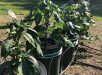

One of the questions that people frequently ask me is revolved around the health concerns of growing in the plastic containers.
Is it safe to grow in plastic containers? Is it leaching harmful toxins into the soil, water, plants and eventually my body. I honestly have no clue, nor do I claim to. I think there is a valid concern in those beliefs and generally avoid plastic, but I rationalize doing so in a few ways.
- The containers are being saved from the landfill. While this doesn’t directly effect my health. It does effect the health and well being of the planet, which in turn effects my health. None of the containers were purchased. All of them were already used.
- I’m growing organically. The soil, plants, compost, manure tea and even the water is filtered. Does that counter balance any potential leaching? I dunno, but in my mind in kind of does.
- Since I don’t have land, what am I going to use if I don’t use plastic containers? I’d have to buy pots of some sort which would increase the amount of money being spent and resources used in the production of the pots.
I don’t know the exact health effects and carbon footprint of everything (I don’t believe that anyone really does). For the reasons mentioned above, I can rationalize growing my own food in plastic containers simply because I know how the plants are being taken care of and am cutting down severely on the transportation costs of the food.
What are your thoughts on this?



Mike,
I also use plastic containers. From what I've read, they're fine as long as they're food grade (number 2 or 5 plastics). You should avoid no. 3 and no. 6 plastics, and probably no. 1, since the latter starts breaking down faster in the heat. My hope is to eventually move somewhere with dirt in the ground, but for now, I have no choice but to stick with containers, and I can't afford a bunch of terracotta ones.
Thanks for the info. There is so much info out there about plastic and I get it. But am with you about it being to expensive about terrcotta. I can afford the used plastic ones and use organic methods.
One day, I too would like some land with actual soil to grow in.
Tough one! I use old plastic milk jugs to start plants.
The type of plastic you are using will determine if there's a chance of leaching. If you are using PVC you will likely leach lead. It's also possible you could leach out BPA if you are using #7 plastics. This is also compounded by the fact that the containers are usually in the sun, so the heat helps the leaching process.
However, you also have the same potential if you are using ceramic pots that aren't intended for food. It could very well have lead in the glaze. So, it is a valid question and worth looking in to.
Good topic.
I did a little research into the types of plastics commonly used and how safe they are. If you need to grow food in plastic looks like types 1 and 2 are best http://www.care2.com/greenliving/which-plastics… , and 4 and 5 technically ok but some production process issues on those. Of course that's all on data of currently known carcinogens, etc. and we may discover something negative later… for that reason my guy is steadfast against growing in plastic. I'm on the wall.
So for the beginning of the year I tried to keep all my edibles growing in ceramic and terra cotta pots, and put ornamentals in plastic. Due to the need to expandy my growing area I'm planting in some recycled 5 gal. nursery pots that are #2 plastic. I'm going to try to keep the plastic edible growing to a minimum, and to keep those containers in more shaded, cooler areas to help prevent anything from leaching out of them.
I am really considering just going for #2, then I could find some of those 5gal. buckets from local eateries to build some self-watering containers like you have….
If you ever do wanna splurge on a little terra cotta they have some discounts at pottermfg.com it's a warehouse in Gardena, just got a cylindrical 14″ pot for $9.
That's the conundrum (I just wanted to use that word). Do I grow my food in 20 5-gallon containers that I got for free or do I invest $180 in terra cotta? That's a huge difference.
It's also likely a deal breaker for most people (myself included).
These are #2 containers. It's either this or nothing. I think this is a good enough solution for me.
Do the Aussies do it that way too?
I'd say that as long as food came in it your fine, there's no official food safe plastic out there anyway. They just use plastics not likely to leach a chemical out. Do what works I guess.
I'm feelin that.
I've had a lot of good luck finding Terra Cotta pots at yard sales or thrift stores – and occasionally left outside to be thrown away. My boyfriend is also a carpenter and has built me some planter boxes out of wood, but then you need to be careful to use the appropriate type of wood….
Exactly. I'll stick with the plastic for now until I gets me some land.
I take a “I'm going to do the best I can” approach, and try not to worry about anything else. I have grown and continue to grow food in plastic pots. It doesn't keep me up at night. What about scavenging untreated wood and making a planter box? Also, I have a bunch of extra Smart Pots (breathable fabric pots, your edibles will love them) that you can have if we can ever arrange to meet in person. 🙂
I'm with you. I wouldn't buy plastic containers, so I justify it because they are reclaimed. The fact that I use plastic are likely the biggest hate comments that I get next to being an asshole for blocking up my fire escape.
You, Adriana and I will definitely meet up soon. My transportation situation is still the same. I'm setting the goal of before Halloween. Best believe that.
I get nearly all of my buckets from the local grocery stores bakery or deli depts. That means they are all “food-grade”. What that means, and how it translates to what leaches out of them in the sun? I have NO idea……and I don't plan on getting a degree in chemistry anytime soon. We're doing the best we can….and at least we're doing SOMETHING.
BTW…….by next summer I will be moving to a place out in the boonies. Nearly THREE acres! We just got the place and will be spending the next year clearing the lot, which has been used as an old trailer/auto graveyard. I've already got plans for the chicken coop, the sheep corral and the pig pen.Still considering whether goats will be worth the effort. I'm also studying up on how to plan and care for an orchard!
I'm gonna be a REAL farmer! (insert happy old hippie dance here)
Brag much 😉 Hhahaha. Congrats!
I'll send you a bushel of home-grown apples — It ain't braggin' if it's true! ; )
BTW — my husband blames YOU for me actually getting off my butt and DOING something about wanting a farm. Lucky for you I married a short, teddy-bear looking, hippie…….hahahhaha!
I will gladly accept your brag then. Tell your husband that I said you're welcome 😉
Yes, I believe #2 is one of the safer plastics.
Yes, and avoid #7 because of the chance of BPA or lead. #2 & #5 are considered to be non-leaching plastics and should be perfectly safe.
Can you direct me to how many plants I can plant in a 5 gallon bucket? I saw guidelines on this somewhere. Like 1 tomato plant, 4 swiss chard, 2 pepper etc..
i appreciate that rationalization. we're always having to put the line in the sand somewhere and it isn't easy.
Not sure on the exacts. I use the rule of thumb of anything that vines or can be trellised like tomatoes and cukes to one per container. Everything else, I do by trial and error.
Exactly. Def not easy and people want to be perfect. Not for me.
I have use old aquariams that were being thrown out for cracked seals etc. I had a 50 gallon and used cardboard to section off for different herbs. Worked great, I sat it in my bay window. Never tried it with being outside but you can experiment with ways to cut back on the weight of the soil. I dont know maybe you could still figure out a drainage technique, I'm sure you could cut a hole in the bottom or something. could still line the glass with newspaper or something to protect the roots. A way to keep any chemicals from leaking into your soil for people who are looking for alternative and green ways to grow. Just a thought.
Great idea. Love it. Thanks for sharing.
I think the question of using the plastic buckets might be detrimental to your health or the environment is silly to say the least. Did you not say Mike that these are buckets were from Deli's, Supermarkets, Farmers Markets answers that question. What were in the buckets to start with if it was not some kind of Food Material in the first place. Well Duhhh! Restaraunts have Pickle Buckets, Vegetable Oil buckets etc, etc. The same thing
Using these buckets a second time for growing food is helping the environment Double.
GrandBob
http://GrandBobsGarden.blogspot.com
Yes the buckets previously held food in them, but there are reports and information out there saying that they are still toxic. I think that is the issue for some.
Thanks. It’s about finding a balance. Your daughter can def grow something. She can at least grow some sprouts.
Thanks for the comment and the kind words.
You can get five-gallon buckets from a deli, bakery, or the bakery/deli in a grocery store that are food-grade. I figure if I am going to go to the trouble of trying to grow food safely, then getting a container that will not leach toxins into the soil and plants is part of the process. However, if you feel safe, how can anyone argue with you? Maybe, over time you can get rid of any iffy container. Good job! My daughter lives in NYC and has nowhere to grow any food. SAD! I have plenty of room in my yard but live too far away to give her food! I just found your post and have it as an icon on my desktop. That means I like it and want to come back.
She is newly-single, two children, and swears she cannot grown herbs and does not have the time. So, I am not there to help out by getting anything started. Since she has the whole top story of a house, it seems that herbs in the windows should be possible in at least one room!
I have offered to come from the Deep South and dumpster dive for her. She thinks i would get killed.
Just because a bucket came from a food establishment does not mean that the bucket held food. It could have held cleaning liquid or powder of some kind. The buckets that originally held food should be the safest, the least harmful. So, they may be leaching something, just less toxins than a paint bucket.
That’s nice of you to offer to go help your daughter. Def don’t use the containers if paint has been in them.
If there are a lot of old cars on the place, you might want to have your soil tested, just a thought. Old cars had lots of contaminants in them, like asbestos, lead, petroleum, plastics, antifreeze, etc.
And if you have any old cars still out there, you can often make a surprisingly good amount on junkers, selling to people who restore vintage autos. Congratulations on your land acquisition – I hope to do the same one day!
Word. Thanks for sharing the info.
I’d love to find an affordable alternative, but can’t right now.
In Mel Bartholomew’s very organic ‘Square Foot Gardening’ you’ll find just how many plants you can plant in a square foot. 100% of the garden at 50% of the cost in 20% of the space, 10% of the water, using 5% of the seeds and 2% of the work. I done it, it works like magic.
There is a difference between using a container to hold food and using it in your garden for 10 years, exposed to sun and rain, to grow food. We’ve all read that plastic photodegrades and releases PCB’s in the ocean (for example, the Pacific Trash Vortex). I am not satisfied with the answers I’ve been seeing here myself. I’d like links to real research that proves that exposed plastic bins do not release toxins into soil over years of exposure. I think wood, ceramic and the good old fashioned ground are the way to go for long term container farming.
I’m not concerned with 10 years from now right now. Ideally I won’t be using the same containers.
When using wood, you need to make sure that it’s not pressure treated lumber.
I’d love to use an alternative, but haven’t found anything that’s affordable and reasonable yet.
A similar
question has been nagging me the last couple weeks. Ive been wanting to make
some drip irrigation containers out of recycled plastic and got to wondering
about the chemical laden water feeding the tomatoes and such. After a bit of
research, I’ve decided against using plastics in the garden whenever possible.
I’ve made an effort to be as chemical free as possible and may be getting a bit
carried with it, oh well. I say if your choices are grow in plastic or don’t grow
at all, grow in plastic. Maybe someday soon someone will do the appropriate
studies and put an end to all of these questions. Anyhow, Happy Gardening!
Absolutely. If I had my choice, I’d go no plastic and the like. I’ve yet to find an affordable and suitable alternative…
I grow organic vegetables in containers. I am slowly switching over to fabric pots such as Smart Pots or Hydrofarm Dirt Bags. I have red potatoes and sweet potatoes growing in them this year and so far they are doing great. Not only are they safer than plastic but also allow the roots to breathe. I’ve found that Amazon.com is the least expensive (I can’t find them locally). Most plastic planters are made of #2 plastic. I don’t use 5 gallon buckets because too much soil is needed which gets very expensive (especially for organic soils and fertilizers). I just began a compost bin this spring so hopefully that will cut down on the cost next year.
I bought most of my plastic planters at yard sales (recycling) for around 50 cents or on clearance for 75% off.
By the way, the fabric pots are reusable and fold up so they take up very little space when storing them for the winter.
Interesting. Thanks for the tips. Will have to look into those containers.
Smartpots are made from woven polypropylene. They are plastic.
Smart Pot is made of inert fabric (polypropylene) which claims to be completely safe for edible plants. Inert means there is no chemical reaction and so it does not leach. It’s possible that what is now considered safe will eventually found not to be, but currently, the following plastics have no KNOWN health hazards:Code 1: Polyethylene Terephthalate, or PET / PETE
Code 2: High Density Polyethylene, or HDPE
Code 4: Low Density Polyethylene, or LDPE
Code 5: Polypropylene, or PP
You should never heat up food in a microwave or put hot/boiling liquid in these containers.
I will expand on that and say that you should never use a microwave…period.
I would recommend purchasing plastic “food grade” containers from a restaurant supply source. The containers come in alot of sizes to give you some choices. The most important part is that they are “food grade” meaning that they are made to contain food and not leach out. I know this does not solve the land fill issue – but those buckets we buy at paint stores and big box stores are mass produced and cheaply made… who knows what the impact on your food is.
Good points.
Hey Mike! Love your posts and tweets! I pick up food grade plastic buckets from my local health food store. They put them out for the taking once they’ve been emptied of whatever was originally in them. I’ve used them for composting, growing tomatoes and as a catch-all when I’m weeding. I figure it’s a win-win situation!
Nice. Good stuff!
Hey Mike
Hmm, still figuring that one out. The way that I see it is that I can’t control everything, so by growing without chemicals and all that crap, it’s better than store bought stuff.
Everything isn’t going to be perfect. There is the contaminated water, polluted air, etc. We can’t drive ourselves crazy over that stuff because that’s toxic for ourselves. Just do the best that we can given our circumstances. Na mean?
I suppose if you wanted to be super worried about it then you could use old shipping pallets to make (probably very time consuming) boxes of varying sizes that would fit together with the same ideas in place. however, problem one, the bottom of planting box would eventually weaken from the continual exposure to the water underneath. problem two, not sure what chemicals are already on the shipping pallets. so, i’m with mike in that nothing is perfect so we just have to do the best we can.
Exactly. Most shipping pallets are treated with chemicals too.
If one drinks the soda from the bottle – why would it then prove harmful???
BPAs in the plastic leaching into the liquid.
No time to research the question? Here’s a website with information about plastics at http://healthychild.org/5steps/5_steps_5/
Awesome. Thanks for sharing.
Pretty hard to avoid plastic. My olive oil, milk, fruit juice, yogurt, pasta, bread, mustard, mayo all come in some form of plastic. I would consider a food drum safe to plant in. They warn against heating plastic up which can change the molecular structure of the plastic making it unsafe. I think that using it as a planter is a great idea for recycling.
It’s crazy. Ain’t it!?!
I just planted organic lettuce in organic soil in large plastic pots on my deck. Initially, I didn’t think about using plastic pots. Not to mention, the seedlings I purchased are grown in plastic pots. Although I haven’t found conclusive data, i would think when it gets HOT outside it will leak bpa’s into the soil when watered. I would think it would leak into the vegetables. UGH! I am researching alternatives before I plant more.
Plastics with the number 5 are not known to leach BPAs.
Nice. THanks for the info.
I’ll be using the same food grade buckets as this will be my first vegetable garden. I’ll be using Larry Hall’s rain gutter system for the reservoir, with aluminum gutters. I’m NOT crazy about the idea of using the buckets but for now it’s what I’ll be using. In future, I’m going to make cloth bags and use cloth wicks and try and get away from the plastic as much as I possibly can. Plastic is every freaking where. I even saw individually Saran wrapped potatoes at the supermaket. My God, I couldn’t believe it! That’s just insane. But to get back on track, to get away from the plastic, I’m going to try cloth bags and research what cloth will hold up to being damp and not rot away. I’m thinking hemp would be ideal. I wish we could grow it cos I’d be spinning it into yarn and weaving my own bags out of it. >:|
T-shirts and socks work well to wick.
Thanks Mike. It doesn’t have a number on it. I purchased them at Home depot. They are large” terra cotta look” planters. Meanwhile, I’m enjoying my organic lettuce. Next year, plan b. lol
Thanks so much for the information. I’ll def look into it.
Interestingly enough…I have a garden plot at the famous Rodale Organic Experimental Farm in PA. Guess who is using those big plastic tubs to grow veggies in? You guessed…Rodale’s. Perhaps just because they are plastic does not mean they have BPA…not all plastics do. So, Mike et al, maybe they are not harmful. Thought I’d pass it on.
All good.
Anyone who gets pizza hut pizza, the dough they use comes in 5 gallon PLASTIC buckets. Frosting at most bakeries is in PLASTIC buckets. We drink liquids in PLASTIC containers.
Under no circumstances is it ok to ever eat Pizza Hut 😉
We don’t eat Pizza Hut, or any baked goods that aren’t made by myself or the Amish. I just happen to know about the plastic buckets because my brother-in-law works at a Pizza Hut.
Phew.
hemp cloth will last a few years, and is generally grown with few pesticides. a double layer of burlap will last a year or two. many synthetic fabrics last for years, but nylon, polyester etc are just other ways of saying plastic. consider making bags of old, large size jeans. just sew the legs shut and cut them off. buy at a thrift store. this is conventional cotton, which has been heavily sprayed before it was made into pants. most likely the residue now resides with the first owner of the pants.
bpa is often found in flexible plastic, like squeeze bottles of condiments, baby pacifiers. it could be in buckets, but less likely.
sterlite totes are food safe.
Good to know.
Great discussion! One could worry oneself to death. I prefer to get started and make adjustments as needed. I avoid pesticides and use organic methods. I have a variety of planting containers and just do what I can. Organic food from the backyard (patio) is the most important part for me. I like your site, Mike. Thanks for your time and effort!
Great idea. I was going to buy burlap, but the jeans will be even better. Phytopod (I’m not sure how you spell it) had an interesting system using burlap, but it’s kind of pricy.
Also, just a side note… If environmentalist use plants are used to clean up polluted lakes and ponds because they take in and capture the toxins, why would it work any different with our edible plants and plastic pots? If plants capture the toxins released from the pots, and then we consume them, aren’t we just inadvertently consuming the toxins we are trying to avoid by growing things our selves?? Yes, nursery plants come in plastic, but transplanting should minimize it, and growing from seed would get rid of it all together.
I’m glad I am not the only one concerned with this. Locally, it’s been hard to find any one even thinking about this issue.
Thoughts??
What about hoop houses using PVC and sheet plastic? That seems like it could be problematic as well, as you have the off gassing of the plastic that’s making the little greenhouse type room, and then the rain running off the top and down into your soil if directly on the ground. Your thoughts?
Several safe alternatives to plastics are:
> Glass
> Untreated Wood, like the kind you cut down yourself
> Bamboo
> Old Wine casks (untreated wood)
> Cheesecloth
> Burlap
Hydroponics, you can use natural cork to float the cheesecloth. Not to expensive but very clean from any chemicals.
Do not use any old Terra Cotta pot, they generally contain lots of dangerous chemicals and toxins that will leach into your food. These are in most cases only to be use as flower pots.
linen holds up to water pretty well–remember the original way to prepare, or rett, flax plants to obtain the fibers was to bundle them and place in a stream for several weeks so that the non-usable parts rotted away, leaving you with strick and tow, which you could then prepare and spin. you can buy heavy hemp cloth. just google it. not cheap, but it is avail.
Has anyone had any experience growing in glass containers with holes drilled in the bottom? I’m wanting to start growing but have been hung up on the issue of what is safe to grow in. From a safety standpoint, glass seems safest to me of all available options. I can’t find much online about growing in glass, though, so I’m thinking that may be because it doesn’t work? Any tips are appreciated!
Really no reason to buy them when they are widely available used for free or close to it. Check with any place that sells food. Donut shops get a lot of them with filling creamin them. Restaurants, fast food joints, delis get pickles, mayo, potato salad and other foods in them.
Most of these places just set them by their dumpsters or throw them away. A few sell them. Many will save them for you if you ask.
Besides using them in gardening, they are a good way to store food staples in bulk. In college we had one for bags of pasta, another for rice, a third for beans.
Great idea I had not thought of using. You could use course gravel (or maybe something else that wasn’t too heavy) for several inches in the bottom so if you water too much the roots aren’t in it. Glass marbles might work. Or small stones. Maybe even something like course vermiculite.
I realize your post is rather old, but I was wondering what store you pick those buckets up.
Mike, it looks like you are using Food Grade plastic buckets. A way to tell is to check the recycling symbol on the bottom and look for the numbers 1, 2, or 5. The number 5 indicates food safe plastic. The numbers 1 and 2 are for one time use plastics that are used for things like soda, milk, and juice. Avoid the numbers 3, 6, and 7… they are NOT SAFE. I have been searching for larger storage size containers that are safe. So, far I’m waiting for Rubbermaid to answer my email. Also, I would use BAMBOO for the water filling tube, or copper. PVC pipe is not safe. Another idea I had was to line the larger containers with a food grade plastic…. now to find it! Thank You for taking the time to share your interest with the computer world and gardeners like me. I wish you well (and toxic free) ~
I am doing this very thing and was wondering too about the toxins seeping into the soil/food then me and my family. I wanted to line my containers with something to at “help” it not be bad. I was given a few ideas about rocks on the very bottom and parchment paper up the sides, I think I am actually going to give it a whirl like this. I think it is better than nothing.. and especially the whole experience in starting something organic from basically nothing… Thanks for insight..
Hey Mike!
I am just curious, how are you filtering the water you are using to water all of your plants with?
I know this conversation is old but I am about to start my very first garden and all of this is so intimidating…which potting mix (peat moss vs. coconut coir), which containers (plastic or the hydrofarm dirt bags), etc., etc., etc. Who knew attempting to start an organic, environmentally conscious garden would be such a daunting task. Can anyone tell me if you can use the hydrofarm bags on concrete? Would proper drainage be an issue? Will the water stain my concrete patio (I’m renting)? Thanks Mike for all of the great information you provide.
Oh and I forgot to ask – I’m also considering the City Pickers planters vs. the Earthbox but can’t find any information about food safe status of the City Pickers ones. Anyone know about this?
Hi Mike!
So what exactly is wrong with Pizza Hut pizza? I hadn’t heard and I would like to know because my son eats there occasionally.
Thanks!
Donnell:)
Hey man good on you and I appreciate that their are people willing to use plastic and recycle etc..I worry that plastic could contaminate your efforts to remain organic,as plastic isn’t exactly and naturally(nature made substance).However the real question is does plastic leech into soil and then into plants,and further on into humans.
I am guessing that is because it is hard to find glass with holes. also, glass has two distinct disadvantages, 1) it is easy to break and 2) it is heavy. Glass is generally the best way to store food, so it would make sense to use it to grow food also!
you mean aside from how terrible it tastes? what a travesty it is to the good name of Pizza? or because it’s full of GMOs, processed refined flour and who knows what’s in that sauce?
one should also reconsider drinking soda…because the fizzy carbonation leaches calcium from your bones.
I like to use old wine bottles there fairly light and I can hang them easy!
Get food grade plastics and grow where there is not direct sunlight.
Plastics are best used for indoor use. Heating plastics DO leach chemicals into the soil, thus the plants and into your body if you eat them.
It’s best to always use natural products containers. If you’re trying to save money, wood palettes work great.
If you have no choice but to grow in plastic, keep it out of direct heat and try to get food grade quality.
I guess if you get BPA free containers it wouldn’t be better. Idk if you can find BPA free containers that big, though.
* Instead of polycarbonate and PVC plastics, consider using alternatives such as polyethylene plastic — also labeled as PETE or recycling code #1, #2 (HDPE) and #4 (LDPE). Polypropylene (recycling code #5, or PP) is also considered a safe choice. Recycling code #7 may mean the product contains BPA.
* Do not wash polycarbonate plastic containers in the dishwasher with harsh detergents.
Hi, glass would be great but you need to paint or cover the exterior so light can’t get in. The light can promote algae which will compete with the plant for nutrients.
Why not use food grade containers. You can usually pick them up for free at any fast food restaurant that gets their pickles by the bucket. Food grade containers are designed to be good safe so they should be safe for growing food.
You should all read the article posted on Mother Jones Plastics. BPA free pacifiers, zippy cups, cooking utensils & supplies, our packaged foods, our packaged meds, our eye drops, Whole Foods produce bins . . . are all joke-you might want to check out all of the other chemicals that are also being leached out of the plastic food containers- that are even more genetically harmful that BPA.
We are gullible consumers who should trust no CEO’s, testing studies, judicial system, or our government. When money is involved, one can pay a scientist to test & write the conclusion one wants. Simple as that. So continue using all plastics just as you have been doing & pretend they are safe the next time your grandson is sipping from a plastic straw from his sippy cup that says “BPA free”. Any comments??
petro-based plastics–they’re all potentially bad. so, what to do? we can’t all own and operate organic farms. and we don’t–any of us–know all we need to know. even those of us who know a lot don’t know everything and , gasp, sometimes make mistakes. and both mainstream and alternative news sometimes use scare tactics. just do the best you can, keep learning, and be responsible for your own choices.
I recommend making containers with redwood fencing ( untreated), don’t paint or stain it! Just natural. Best to avoid plastic all together and ceramic and terracotta often contain Lead….. Redwood or glass is all that I will grow in . Good luck and Happy Health ♡
Great info and tips! 🙂