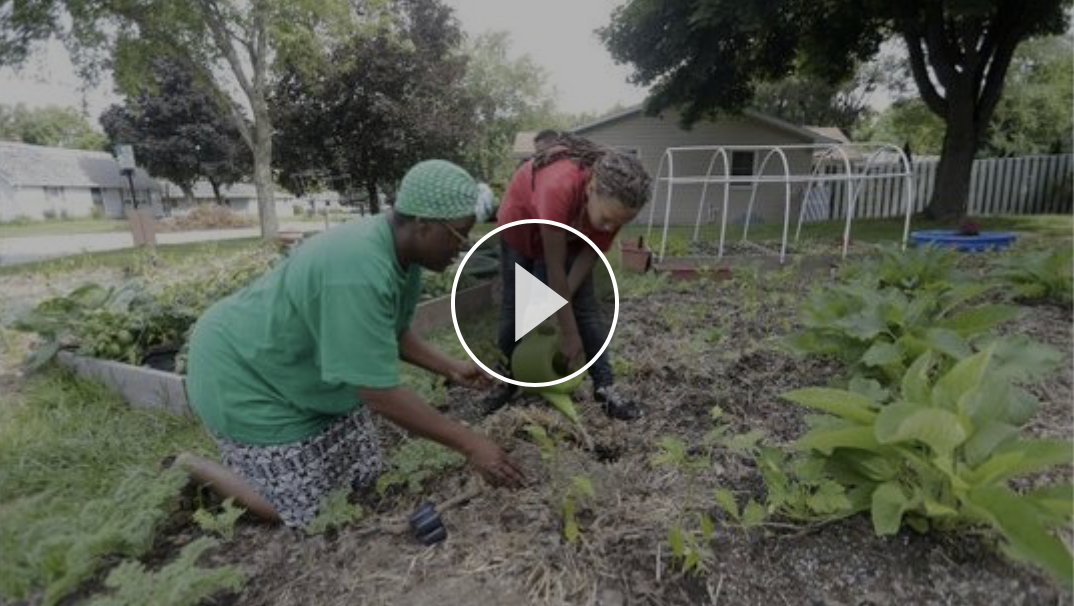

Urban Farming 2.0: From Plow Beams to Leafy Green Machines

1043253_1_0725-URBANFARM2.0_standard

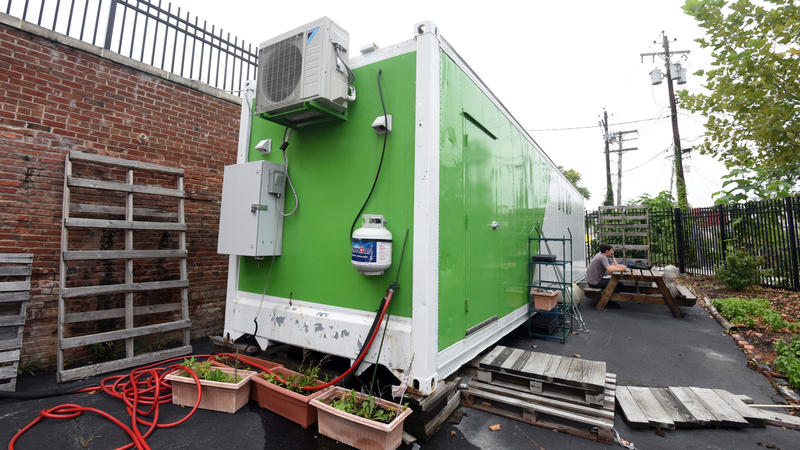
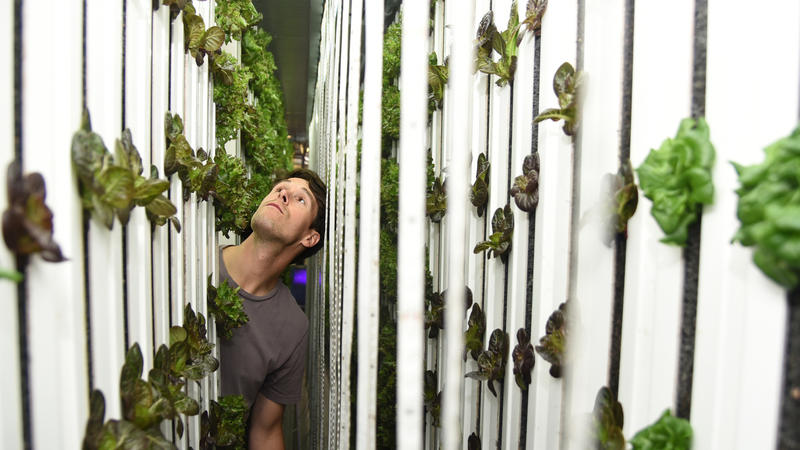
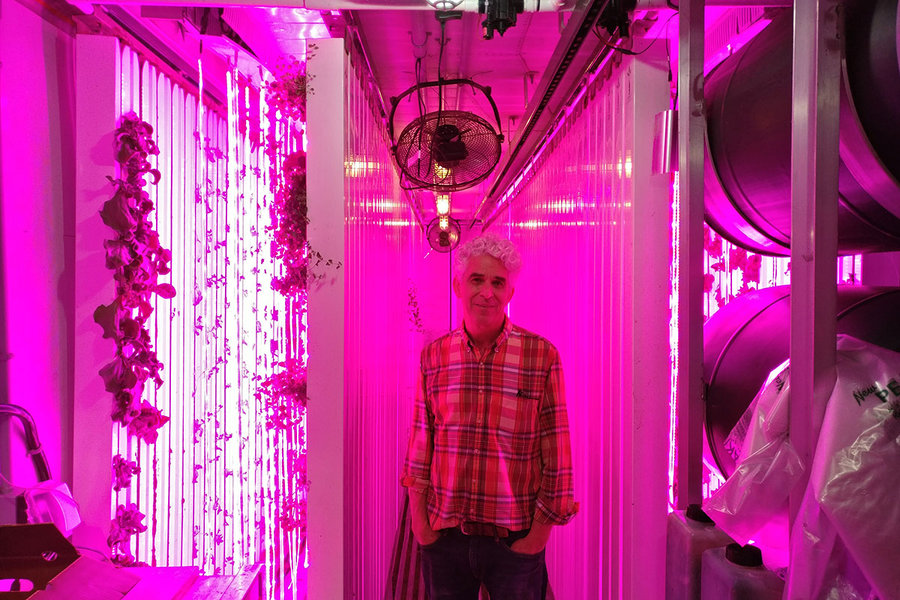
Shawn Cooney swings open the door of a 320-square-foot industrial shipping container to reveal a futuristic setting: hundreds of edible plants growing in vertical columns, fed by the energy from strings of neon red and blue LED lights. Nutrient-infused water cascades from ceiling spigots down through artificial root systems in the growing towers. The temperature inside feels like a comfortable spring day – about 70 degrees F., with a touch of humidity. There isn’t a speck of dirt anywhere.

Welcome to the new urban farm.

This shipping container is one of four that comprise Corner Stalk Farm run by Mr. Cooney and his wife in the heart of Boston. Once the cargo holds for exhaust-spewing 18-wheelers, these discarded freight vessels have been transformed into units known as Leafy Green Machines outfitted with state-of-the-art growing technology by a company called Freight Farms. Now they help farmers turn out crops of lettuce and herbs at a rapid pace.

Read the FULL Article CSMonitor.comat: “CSMonitor.com”
Urban Garden Addresses Food Insecurity

DSC_0014-768x512

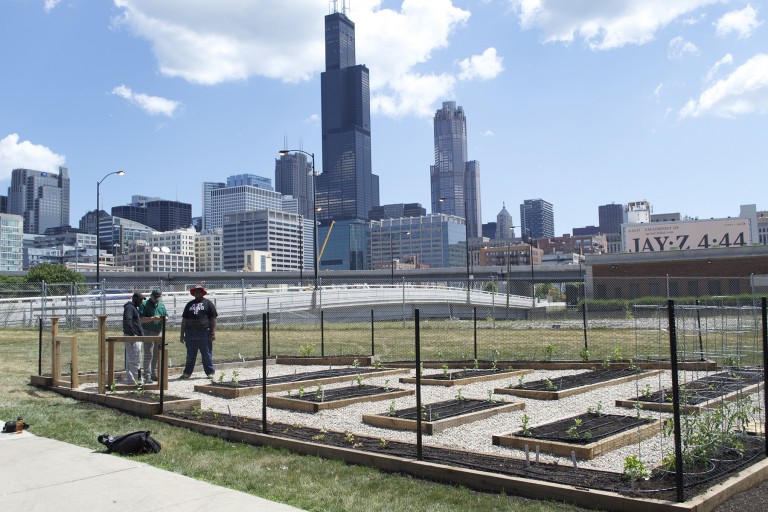
The corner of Harrison and Halsted streets doesn’t feel very rural, with traffic buzzing by the busy intersection and the Willis Tower looming in the background. But that will soon change.

Students Dorrian Neeley and Lashawn Evans, both in the undergraduate Human Development and Learning program in the College of Education, have developed UIC’s first urban garden at the intersection, aiming to address issues of sustainability and food security in low-income Chicago communities.

“Growing up in Chicago, we both know what living off the corner store can do for you,” Neeley said. “We think we can influence the community starting with this garden and hopefully expanding, so people can have the ability to feed themselves.”

Their idea blossomed in the Child and Youth Policies in Urban America course (ED 135), taught by Chris Miller, assistant clinical professor of educational policy studies. Neeley and Evans sought to study sustainable food systems as an independent project, a plan embraced by Miller and Alfred Tatum, dean of the College of Education.

READ THE FULL ARTICLE AT: “News.uic.edu”

How a Small Urban Farm in Virginia Beach Yields Enough Produce to Supply 2 Local Markets

596ceab11231d.image

“Amanda Gerber never meant for this to happen. But there she was one day last week, dressed in a straw hat, jeans and fancy, dirt-caked cowboy boots, tromping out of a raised bed where she had been tearing out spent green bean plants.

“It’s a little overwhelming,” said Gerber, a mother of two and co-owner of Nottalotta Acres, a patchwork farm of 10 parcels totaling about 3 acres scattered around two neighborhoods in the Bayside section of Virginia Beach.

Not a lot of acres. Get it?”

Read the Original Article at: “PilotOnline.com

Ant Space: The Enlightened Ant Farm – Kickstarter Campaign

bc45e16e859fe68c41a0ddbcdc9387c9_original

“Each Ant Space is an ecosystem. Play with the life inside. The narrow habitat makes the game one of subtle manipulation. Sculpt the scene only from above. Drop in seeds and water, add more ants and colored sand. Intelligently design a complex balance of creatures and plants. The Ant Space will evolve over years as a co-creation between the life within and the hand that placed it there.”

f48a1f3b9b094aeb8e079a07512fefa3_original

Learn how you can support Ant Space on Kickstarter!

f6da1b4a29e2c27f5df691fd0f2121d1_original

Baltimore Farm-In-a-Box a Potential Catalyst in Urban Revitalization

bal-urban-pastoral-bs0056115130-20170808

This retrofitted ex-shipping container in a parking lot in Broadway East is hardly your grandfather’s farm. And in his skinny jeans, black sneakers and recycled-materials T-shirt, J.J. Reidy will remind no one of the guy with the pitchfork and overalls in Grant Wood’s “American Gothic.”

Reidy, 29, is the founder and CEO of Urban Pastoral Collective, a two-year-old business with a dual mission: to produce and sell fresh, whole foods in an urban setting and to help leverage the value of such foods into a movement that transforms the way Americans live and interact in cities.

Read the rest of this article at: “BaltimoreSun.com

New Program Promotes Urban Gardening, Neighborhoods in Spokane

2017-07-18_16-1.47.14Autumn and Christian are two of the urban gardening volunteers working in northwest Spokane plots for the group Growing Neighbors.
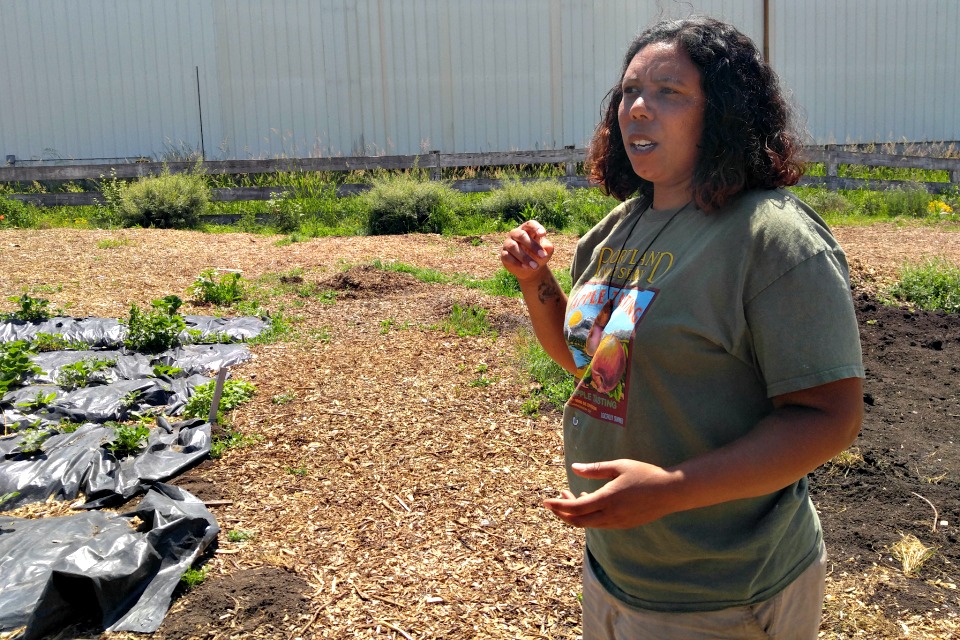


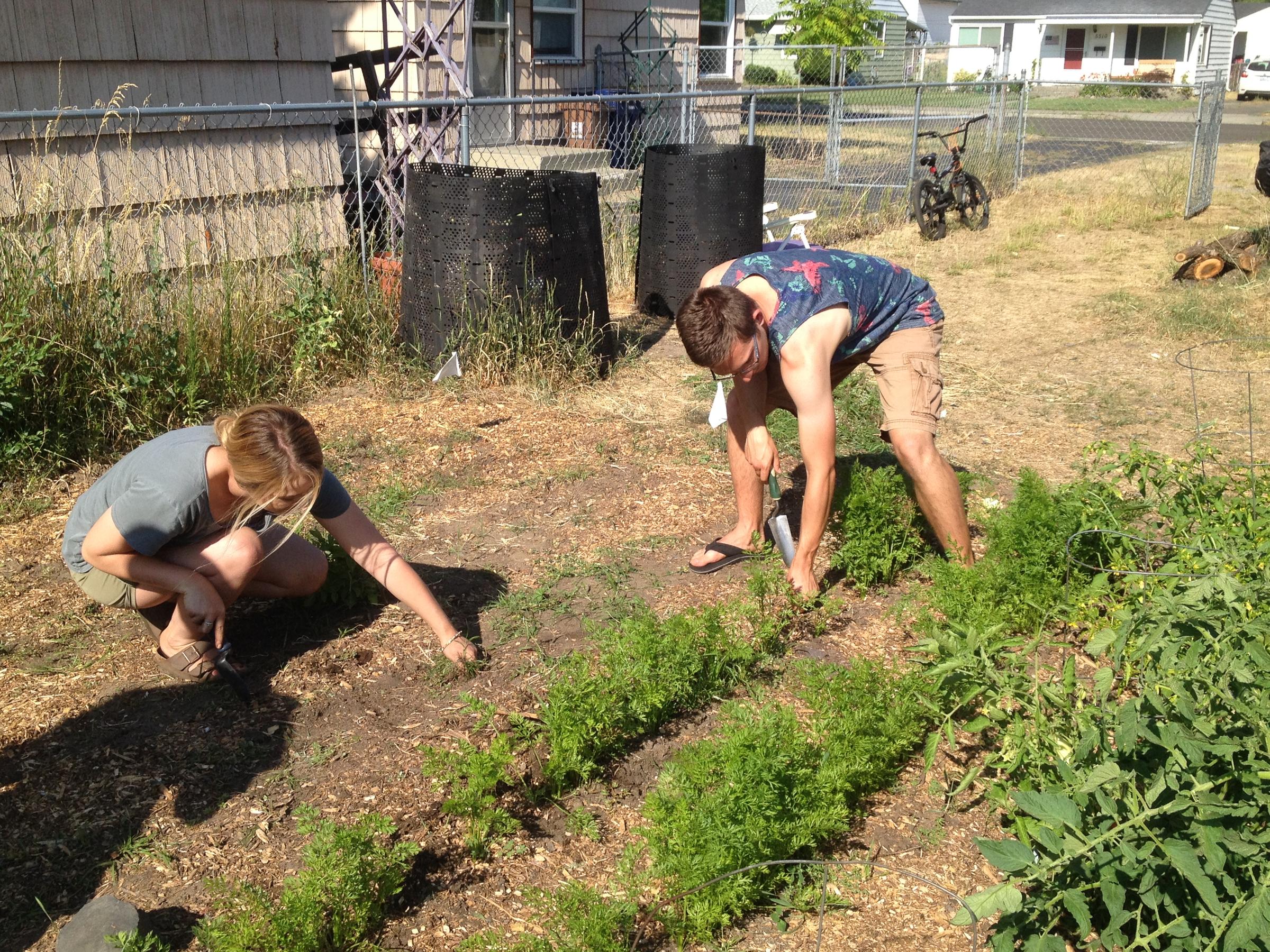
They’ve gone to property owners and asked to borrow little bits of private land in their northwest Spokane neighborhood to grow food. The organization is run by John Edmondson, who invited us to see what Growing Neighbors is doing.

To listen to the story, visit: “SpokanePublicRadio.org

Urban Farming for Everybody

Mudbone-Grown-full-

“Shantae Johnson and Arthur Shavers both grew up in Portland and both grew up gardening.

Johnson’s great-grandmother grew berries for the J.M. Smucker company, and her family grew much of its own food. Shavers helped his grandmother in the garden when he was young. After they met they kept a garden wherever they could – in community garden plots or in the back yard of a condo – but dreamed of having their own farm.

Now they’ve launched MudBone Grown, a company focused on promoting farming, education and community outreach – and a culturally specific urban food systems project at the Oregon Food Bank’s 33rd Avenue farm.

Prior to the company’s launch, Johnson worked for Multnomah County as a community health worker and breastfeeding peer counselor. Shavers had worked as a leather smith, firefighter and emergency medical technician.”

Read the FULL ARTICLE at: “TheSkanner.com

Gardening and Mental Health

capture-20170801-101205

Dozens of people gathered at an urban garden on Whyte Avenue Sunday to celebrate the grand opening of the Youth Empowerment and Social Services (YESS) Urban Roots garden.

The initiative had been in the works for a few years, said associate executive director Margo Long. The project was accelerated when the group got permission to borrow the land from the City of Edmonton and built the garden in six weeks.

Long said the garden, which is located across the street from the YESS building, is a project in sustainable food growing and urban agriculture, however she said it is also about more than just vegetables.

Read more at: “GlobalNews.ca

Student Garden Offers Dirty Hands-On Lessons

597e8f2e286ed.imageThe all-natural, organic, non-GMO plant based diet — often the butt of a joke among Midwestern tables spread with comfort foods — has taken magazine covers and chic cafes by storm.
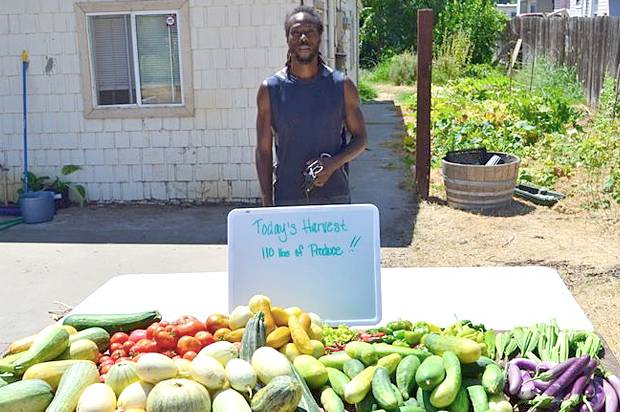
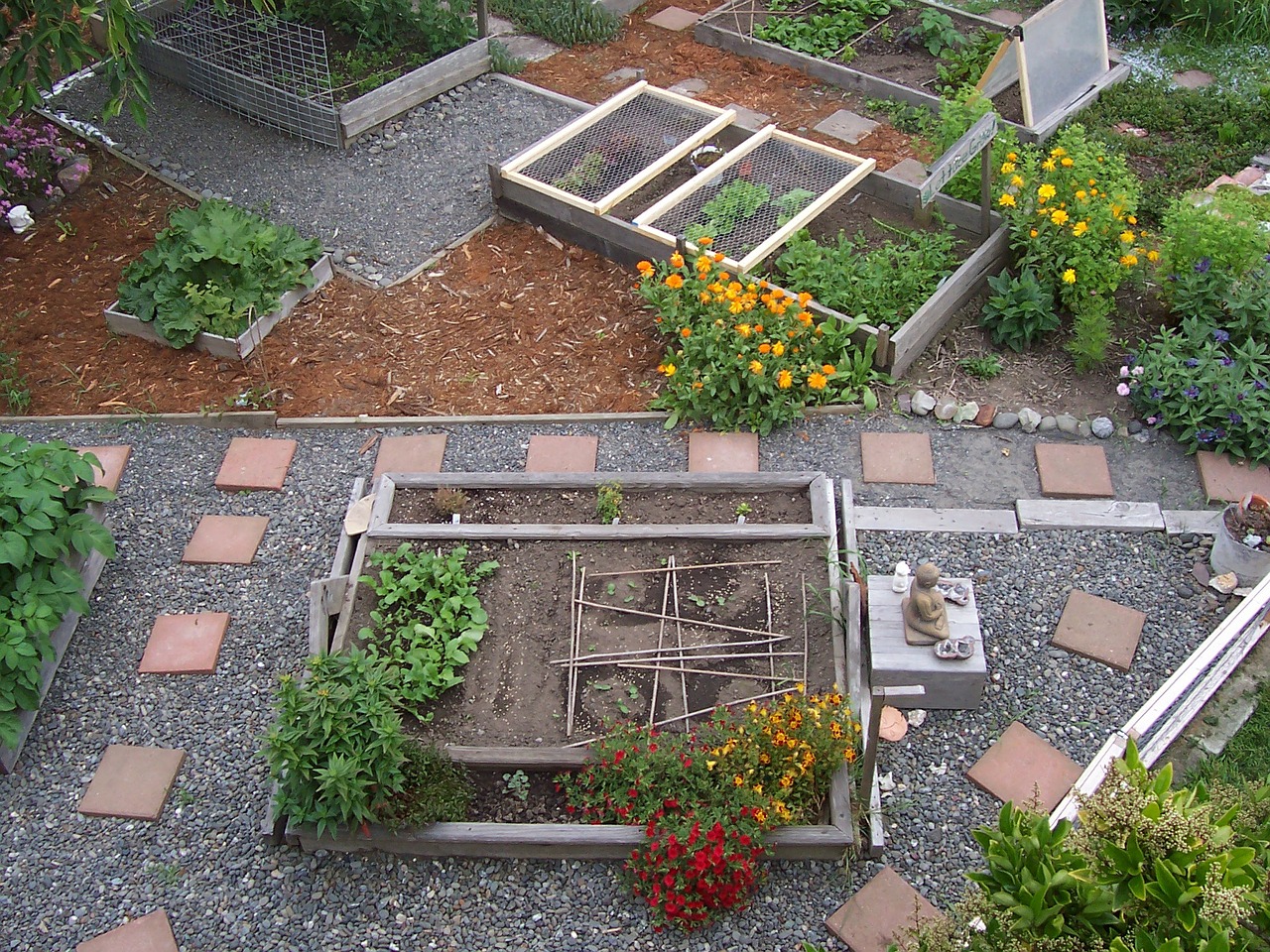

Chad and Nieko Summers are hoping to change that negative mentality locally and help return people’s food choices to their roots, all starting with school children.

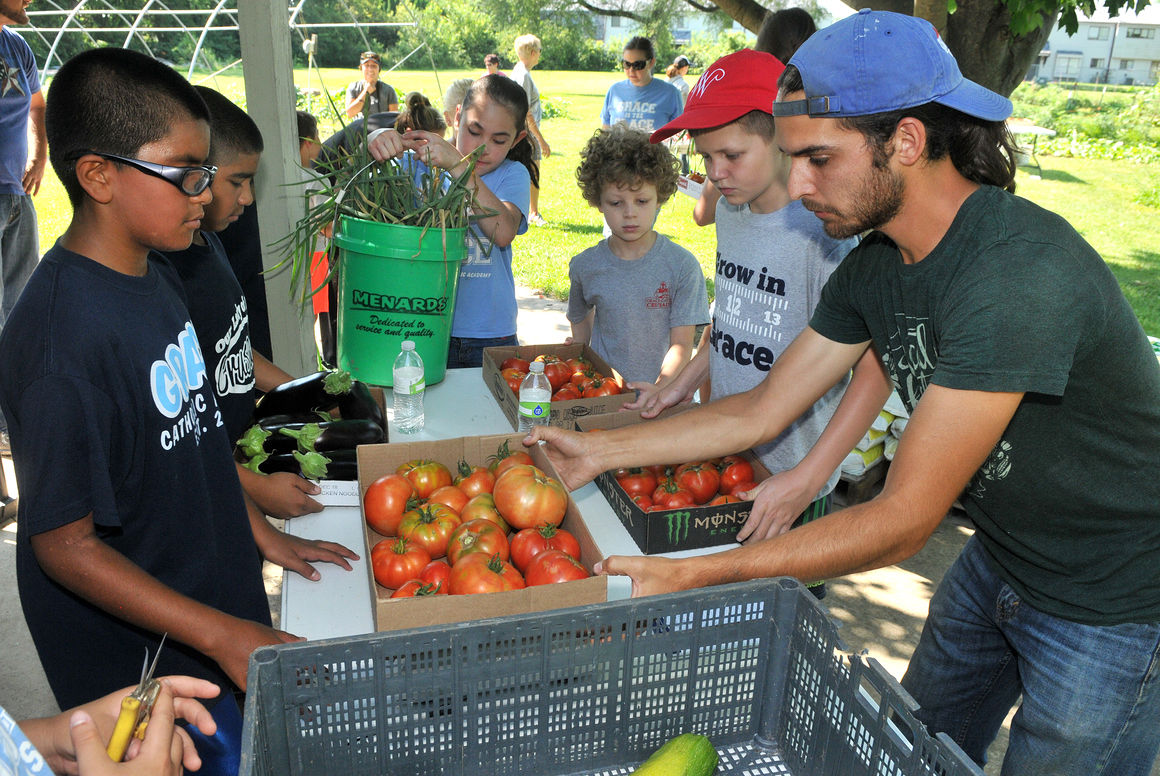
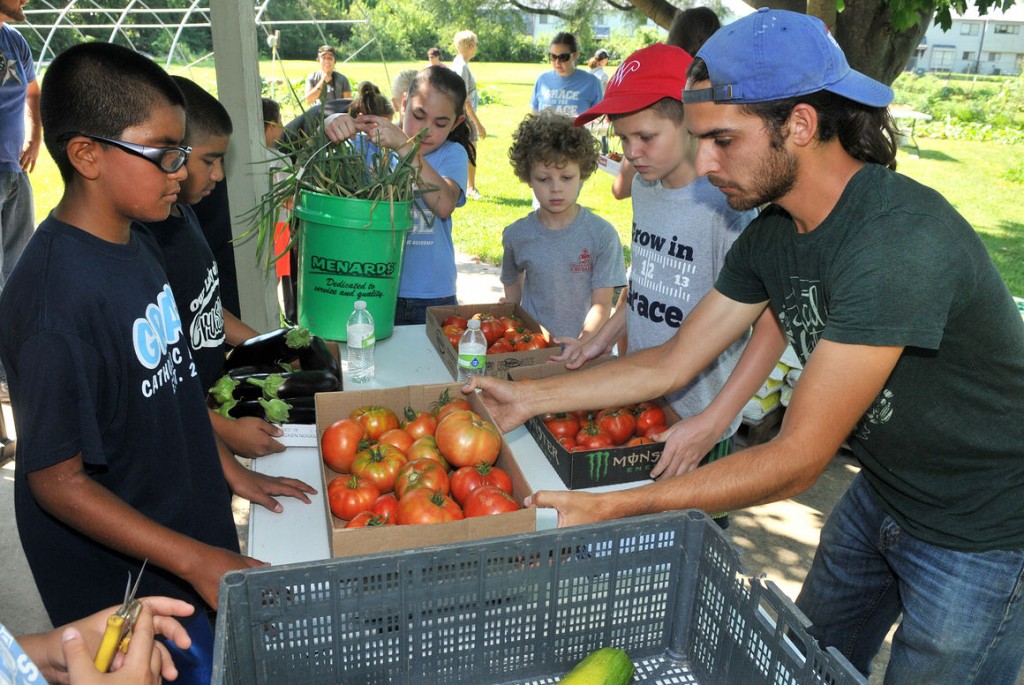
In 2013, the father-son team started Healthy Harvest Urban Farms at 3900 Archer Drive, East Moline. They recently paired up with Our Lady of Grace Catholic Academy in East Moline to pilot “Sprouting Minds,” a food and farming educational program.

In early May, fifth- and sixth-grade students started gardens at Healthy Harvest Urban Farms. They held their first harvest July 25, with students picking and donating 130 pounds of food for St. Mary’s food pantry.

Read the FULL article at: “QCOnline.com

“When you used to say ‘farmer,’ you wouldn’t have me as the picture.” – Sacramento

urban-farm-620x412

“Chanowk Yisrael runs next door to surprise his neighbors with a bowl of cherries he just harvested with the help of 48 other members of the community. The harvest came from the school across the street, with which he has a Memorandum of Understanding agreement for the use of the garden. Yisrael, his wife Judith and her family, and their nine children are not new to urban farming. They’ve been doing it in their own backyard since 2007.

Yisrael, a skinny but muscular man in his early 40s, tells me that for some of the folks (even into their 30s), this was the first time they’d experienced the joy of pulling a piece of fruit off the vine and biting into it right then and there. It’s a life-changing experience, he says, that he provides for people year-round in his backyard garden.”

Read more of this story at: “Salon.com

L.A.’s New Urban Farm Initiative Struggles to Sow its Seeds

manhattanbeach2

Los Angeles is offering landowners financial incentives to turn their urban property into green spaces. Unfortunately, nobody has applied yet.

The program is part of the Urban Agriculture Incentive Zone Act (AB 551), which offers tax cuts to landowners who promise to use their property for urban gardens and agriculture for at least five years. San Francisco was the first city to sign on when the bill was passed in 2014 and Los Angeles County followed earlier this year. The City of Los Angeles will be taking applications in August.

garden-509550_1280

While the thought of luscious greenery and locally grown food sounds great, the program has had a slow start.

“We haven’t had a single contract come through,” says Bruce Durbin, Supervising Planner at Los Angeles County Department of Regional Planning.

Read the FULL Article at: “KCET.org

Loveland Couples Open Their Sustainable Yards in NoCo Urban Homestead Tour

20170722__23RHAHOMESTEADSw~1

“The fourth annual NoCo Urban Homestead Tour on Saturday allowed visitors to learn more about urban farming and gardening by offering an afternoon of self-guided fun through community member’s homes.

“This isn’t your grandma’s garden tour,” said volunteer, Connie Myers. “We are going beyond just perennials and flowers; we are showing people bees, chickens, goats, fruits and vegetables in an urban setting.”

Myer has served on the tour’s committee since it began and also runs a blog called Urban Overalls that focuses on self-sustainability and gardening in an urban setting. Each home was selected through nominations and approached by the committee.”

Follow the REST OF THIS STORY, here: “ReporterHerald.com

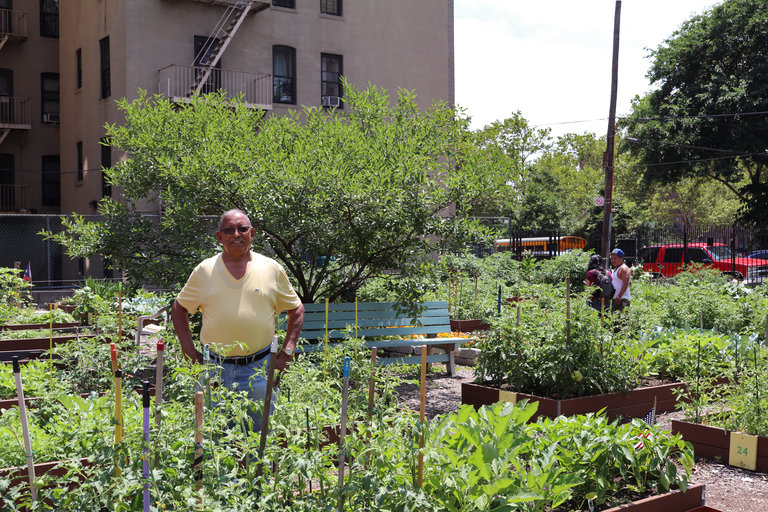
Food From Around the World, Homegrown in New York

00garden1-master768
Efrain Estrada grows so many peppers, eggplants, okra and squash that he sends the extras to his relatives in Puerto Rico.

Though Mr. Estrada calls himself a farmer, his bounty sprouts from the unlikeliest of settings: a patch of green wedged among the bodegas and public housing projects of the South Bronx. There, in a community garden where Mr. Estrada is one of dozens of urban farmers, he fills a box of soil no larger than a child’s sandbox with the things he used to grow with his father on a farm in Puerto Rico.

“If I knew what I know now, I would have helped my father a lot more,” said Mr. Estrada, 74, a retired cook. “There would have been more food.”

Mr. Estrada is able to carry on his family’s agrarian tradition in a teeming metropolis as a result of New York City’s thriving network of community gardens, which is being expanded at a time when an onslaught of development has made these public green spaces more valuable than ever. The community gardens are a refuge for immigrants and those without farms or country houses to escape to in the summer as well as a homegrown source of fruits and vegetables in food deserts like the South Bronx.

Read the FULL ARTICLE at: “NYTimes.com

How an Urban School’s Gardening Project Healed a Community

greenschool_rawpixel_sstock

“After years of working with adolescents who had to be coaxed and cajoled into learning, in this new setting I was surrounded by little children who got excited if you offered them a smile and a handshake. They practically ran into class to find out what Mr. Farmer Steve was up to each day. They expected excitement. Equally exciting for me, I got to be the oldest sixth grader in the Bronx in a school that only went up to the fifth grade. I may have acted like a big kid, but I could do long division in my head. I had a driver’s license. And now I had my own master key to the building.

Our first task: Build our classroom farm. “This is a big project,” I explained to the wide-eyed students. “I’m going to need everyone’s help to put all these pieces together.” Just as I had seen with older students at JVL, these little guys quickly found ways to contribute. Some sorted pieces, some assembled, and together we managed to get six Tower Gardens ready to plant.”

Read the REST of the ARTICLE at: “GreenBiz.com

Big Tex Urban Farms is the Backbone of a Budding Southern Dallas Food System

1501511032-BigTexFarms01

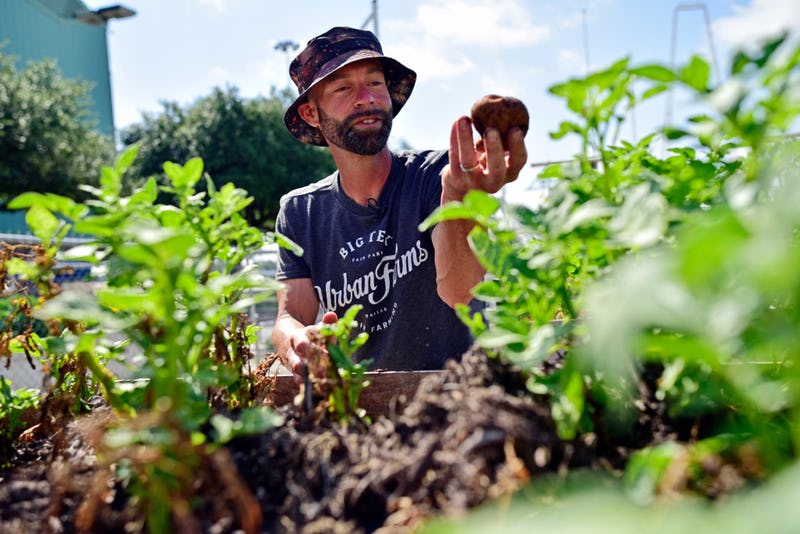
Drew Demler is digging in a box of dirt in the middle of Fair Park. He is harvesting potatoes — big, small, misshapen, one that even looks like a snowman — in a hotter-than-deep-fried parking lot just outside the Cotton Bowl.

“I think potatoes and onions are two of the most important crops that we grow,” Demler, farm manager at Big Tex Urban Farms, says as he uses his bare hands to search for the tubers. “They’re hearty and prolific, and their storage life is long.”

Demler and landscape supervisor Barron Horton take about an hour to harvest potatoes from four raised wooden containers on one side of the farm. There are more than 500 other planting beds around them, full of vegetables in various stages of promise — peppers, black-eyed peas, okra, squash, zucchini.

Read more over at “DallasNews.com

Award-Winning Urban Gardener Butts Heads With City of Green Bay

capture-20170801-100443

GREEN BAY – To Kim Fruin, it was the heavy-handed city trying to shut down her garden.

To the city of Green Bay, it was a mostly a miscommunication between Fruin and its inspectors, maybe fueled by overzealousness on the part of some of Fruin’s friends.

In any case, what Fruin sowed this planting season, the city hopes to harvest as a whole new set of guidelines for urban gardeners.

It started in late June, when someone in Fruin’s east-side neighborhood — she thinks she knows who it was — complained about her yard. Fruin rents on Berwyn Street, and she’s at the end of a cul-de-sac, where traffic can’t pass.

See the FULL Article at: “GreenBayPressGazette.com

Urban Agriculture Efforts Growing in Cincinnati Communities

winton_terrace-_turner_farm_1

An innovative inter-departmental collaboration, Urban AgricultureStat, launched in June with a motion passed by Cincinnati City Council. The goal is to expand Cincinnati’s urban agriculture footprint and invest in ways to develop blighted properties for the purpose of urban farming.

“Many cities, including Cincinnati, have highly successful urban agriculture programs, and many of those programs are expanding,” says Larry Falkin, director of the Office of Environment and Sustainability. “Currently, gardening is occurring on approximately 40 city-owned parcels.”

OES, working with other City departments including law, health, economic development, planning and water, is developing a pilot project to convert publicly owned vacant land or buildings into urban farms.

“Next step will be presenting a report to the City Council,” says Falkin. “OES always tries to learn from both the successes and failures in our own programs and those in peer cities.”

Read the full article at: “SoapBoxMedia.com

Enter to WIN a FREE 1 Month Subscription to UOG’S Monthly Seed & Garden Club!


Urban Farming, Bolstered By Zoning Law Changes, Blossoms in NYC

image

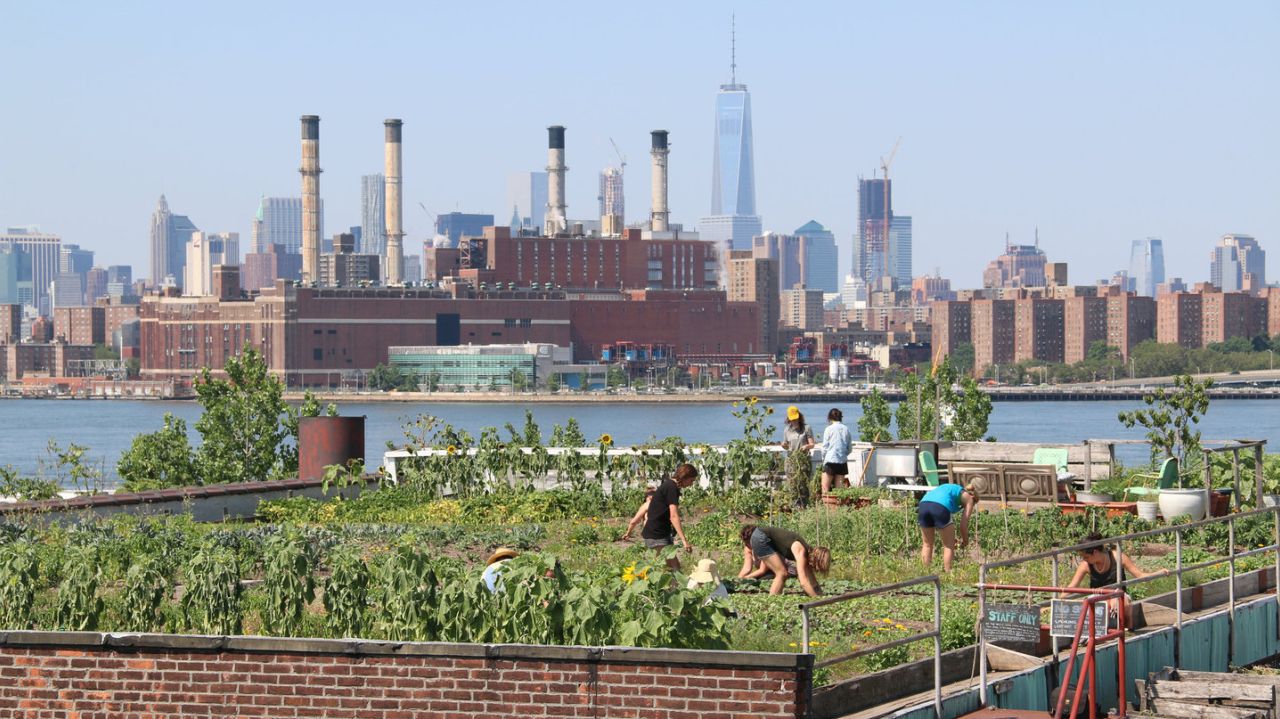
“These large-scale greenhouses are advanced and expensive, but more and more consumers and businesses are supporting them,” said Nicole Baum, spokeswoman for Gotham Greens, a rooftop farm operator in Brooklyn.

The city changed its zoning laws in 2012 to allow rooftop greenhouses certain exemptions from limits on height and floor size on commercial and industrial properties. As a consequence, landlords have come to view them as a potential amenity and opportunity for profit.

“The landlords now see a way to use their space wisely,” said Annie Novak, a farmer who helped create the Eagle Street Rooftop Farm in Greenpoint in 2009. “Now there is a positive shift from the community who want to see these spaces.”

READ THE FULL ARTICLE AT: “AMNY.com

How To Start a Garden That Yields The Crops You Want!

gardening-2448134_1920“People garden with different objectives in mind. Some are seeking a serene oasis, a time they can spend alone in nature, even if it is just a tiny plot on their urban lot. Many do not know of the serenity gardening brings until they have one. Some simply want an ornamental garden, pretty landscaping to admire. Some people just want tomatoes and basil for spaghetti sauce.”

Whatever your desired results from gardening are, here JenReviews shares a wealth of knowledge when it comes to starting a vegetable garden of your own!

Table of Contents

  • Garden with Nature
    The first rule is to garden with nature, not against it. What type of soil do you have? Is it sandy or is it clay or is it a mix? What is the acidic level? How long is your growing season? How hot does it get? How cold does it get? How much rain do you get?
  • Follow the Sun
    Go out to your proposed site and take a look at where the sun is in the morning, in the afternoon and in the evening. Bear in mind that if it is winter, the arc of the sun is going to be a bit different than in the summer.
  • Don’t Try to Keep Out what you Can’t Keep Out
    There are gadgets and gizmos and wives tales of many a fix to deter animals, but save your money and just nod kindly at the neighbor telling his tall tales. The scarecrow with the banging pans, the sensor flood lights, the hose blasting shots of cold water, the fox urine, the Irish Spring soap, the locks of cut hair… these things may cause a deer or groundhog to hesitate once, but the second time they will simply ignore it.
  • It’s All in the Soil
    By-products from growing roots and plant debris feed soil organisms. Soil organisms help plants by decomposing organic matter, cycling nutrients to make them more available to the plant, enhancing soil structure and porosity and controlling the populations of soil organisms, including crop pests. Healthy soil means healthy plants.
  • Organizing the Garden
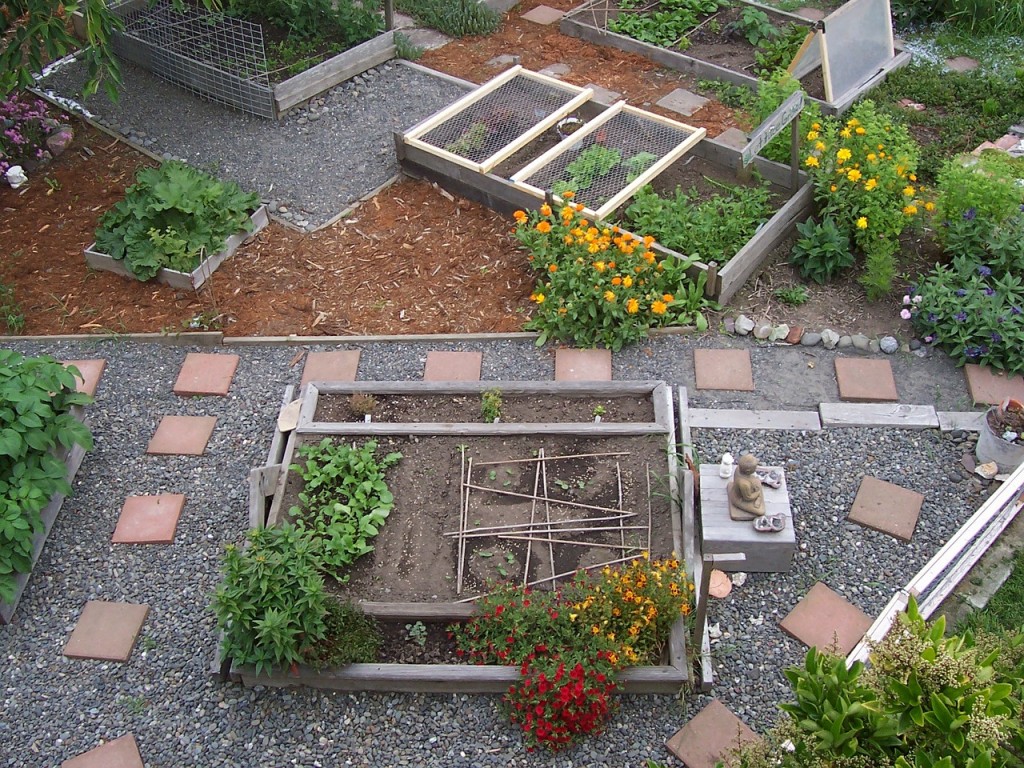
    I would recommend a garden no larger than 25 x 30 feet to begin.
  • Buying Seeds, Starters, Bulbs and Seedlings
  • Companion Planting
    It is based upon observations of plants that grow better together, due to the nutrients their root systems exchange and because the pests they naturally attract are pests that control the population of pests of their companion.
  • Supplies
    Take good care of your tools and make sure they are always clean. Be sensitive to what you are doing. If you cut off a diseased leaf, clean the shears with soap before you use them on another plant or you are likely to spread the disease. Keep them sharp so that your cuts are clean, not sloppy and tearing, thus weakening the plant.