
Nearly all of my urban gardens have self-watering containers in them. They work great on a balcony, fire escape or any other space that doesn’t have soil.
If you’re still trying to figure out what you can grow in small/medium sized container, check out this site for a list of plants and seeds that grow well in containers.
Self-watering containers are different from regular containers that you’d plant in. The main reason is that the water is sucked up by the roots from the bottom of the container.
They made up of two containers of the same size called a reservoir and planting container. I usually use two food-grade 5 gallon containers.
Inside of the reservoir container, you place a wicking basket with small holes in it. For that I use a 1/2 pound deli-container. There is also an overflow hole drilled into the side of the container to allow for drainage.
The planting container has a 3 1/2″ hole drilled into the bottom in the middle and a 1 1/4″ hole drilled along the edge. It’s placed inside of the reservoir container with the deli container centered. The pipe is then put through the smaller hole down to the reservoir container.
You fill the wicking basket with wet soil and continue to add moist soil to the planting container along with the plant. You water the self-watering container by pouring water into the pipe, which will allow the water to get down to the reservoir container. When the water reaches the top of the reservoir, it will begin to come out of the overflow hole.
Since there are holes in the wicking basket with the soil, it will soak up the water and allow the plants roots to drink up the water as needed. This is a more natural way for the plants to soak up water as opposed to watering them from the top.
It also makes it easier to never over or under water the plant because you can tell by the overflow hole.
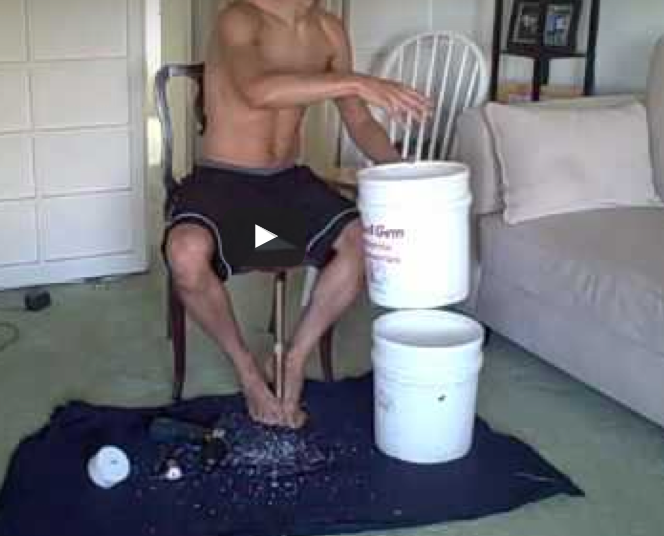
httpv://www.youtube.com/watch?v=zu-ZF0MaWzA
Welcome home!
wow, you're brave dude. I don't think I could have left my green children that long unattended! Glad the self-watering worked out so well! I've been thinking about adapting a couple of my 5 gal nursery pots in one since I've got them laying around….
Thanks bro.
Yea I was surprised that they did so well. They were a bit beat up, but survived.
I see a few companies sell “Self-Watering Potting Mix” what are you thoughts? is this something we need, or will regular garden soil work?
I’ve never seen that. I just using regular organic potting mix.
Hi Mike – I’m interested in starting my first container garden. Can you explain please how your containers are an improvement upon the traditional ceramic pot with saucers? The traditional ceramic design would seem to work pretty much the same way as your containers, in terms of watering (you put water in the saucers) and wicking (through the hole in the bottom of the pot) and therefore self-watering. Plus leeching plastic is a non issue. Thank you!
The reservoir in a self-watering container holds more water. Depending on the season and the vegetable, you can go a week or more without watering it again.
If you use a food grade container with a 5 at the bottom, it’s not known to leach chemicals.
Thanks Mike. 🙂
Is it ok to put these in places where they are gonna get rained on in addition to the watering you give them?
Yes because the excess water will get out from the overflow hole.
This is so awesome. Would you consider selling one of those self-watering containers that you have made, so we can use it as a prototype to make our own?
Your site is so awesome! Great job!
Thanks Lucy. You can make your own by following these instrucitions https://www.urbanorganicgardener.com/2010/06/how-to-make-self-watering-container/
I did double plastic pots for an indoor houseplant, only no holes in the reservoir and a bed of rocks for drainage in case I over-watered. I made it up, have never seen anyone do anything like this before, but I wanted to keep the plant alive, and not get water on the floor. Your idea is better for outdoors -self watering, overflow drain. But what do you think about my idea? Okay for plant? Improvements?
You tell me…did it work all right?
Zak, Gravity always wins. Any excess water will drain out of the overflow hole. Rainwater is actually prefered over tap water for several reasons:
1) Chlorine kills germs.Great for public safety but not so good for the beneficial microbes in your soil. Try to let your tap water sit 24 hours to dissipate the chlorine.
2) Fluoride interfers with dozens of plant enzymes.
3) Thermal shock. Water that is a different temp than the plant and soil stresses the plant. Again, keep a bucket of water alongside your plants. Use “yesterday’s” tap water then refill the bucket and save it to use on another day. The temps will match and the chlorine will bubble out but you’re stuck with the fluoride’s effects. Using collected rain water as often as possible is ideal.
Great points.
Do you think this would work well with citrus plants that are really picky about the amount of water in the soil?
Not sure. Never grew citrus. Ask the grower that you buy the plant from.
Thank you so much for your site as a gardening resource. I farmed last summer, and now for the first time, am trying to embark on a porch gardening expedition, and came across your site (from a friend recommendation). I love the idea of the self-watering containers – about how long do the pipes have to be? I’m assuming long enough to fit the length of your container? Thanks!
Nice. Generally about 15-18″
Thanks. I noticed after doing more reading, that you actually recommend not using the pipe now…That being said, I have two more questions (for now) – how did you make your saw horses to drill your larger holes? And do you have any recommendations where you were able to find food grade containers inexpensively?
Check here https://www.urbanorganicgardener.com/2010/06/how-to-make-self-watering-container/
and here https://www.urbanorganicgardener.com/2011/04/where-to-get-containers-for-your-container-garden/
hi! i love using self watering containers for all my summer veggies. I wanted to know what type of soil mix do you use in these containers? the ones on the market are so expensive and need to be changed yearly because they get so clogged up with the plants roots and then i just compost it.
I’ve been using Fox Farm’s Ocean Forest.
I first saw your YouTube videos when I was searching on how to make self watering containers for gardening; they were definitley very helpful. I guess PVC pipe would work just as good? I live in South Philadelphia, PA so I really don’t get too many pest around my garden area (touch wood). I currently have about 6 Lowes buckets (not self-watering) filled with various things. Peppers (hot & sweet) basil, tomatoes and I am trying corn (started from seed) for the first time in a 20 gallon or so container. It’s about 3 feet tall at the moment…
nice bro. way to hold it down in the 215. I went to school at Drexel and lived in Manayunk for a few years.
Love the site and the videos… I’m building my own containers based on your video but the wicking basket, I’m assuming that there are holes in the plastic wicking basket for the water to get in. How many and where do they go? Also do you put a barrier like weed membrane in the basket to stop poting mix get into the water?
No set number and put them all around the wicking basket. No barrier needed.
so, so, cool! i am really grateful for the video. thanks so much for what you do
I have 10 containers built using your design with the following modifications: I found square buckets at shipleys donuts for $1 each when stacked together they leave about 4 inches for a reservoir, and I used a small terra cotta pot for the wicking pot. It works great, healthy jalopeno, huge tomato, squash, cucumber, and bean vines. I wasnt proactive enough pruning the tomato and it has tried to take over but still getting decent yields from the other veggies. You have a great website and the virgin guides are perfect for finding what to plant when. Great work man.
Hi there, Mike. I read a bit but I still have a doubt as to how does the water circulates to the plants. I’ve thought of 2 routes:
1) Soil goes all the way down into the reservoir pot, but is contained by the deli pot. This way, the water can go up by capilarity through the soil and excess water gets to the reservoir.
PROBLEM: won’t the soil escape to the reservoir? Won’t the plant roots try to get directly into the reservoir as they grow after water?
2) Water gets up to the soil by evaporation, condensating in the soil itself.
PROBLEM: this seems to be a very slow process for feeding water intensive plants like tomatoes.
Did I miss the point? How does it work?
Also, how long can your pots usually go without manually getting the hose and watering them?
Cheers!
If I have made my self watering container but haven filled it with dirt yet because my seedlings haven’t arrived. Is it ok to go ahead and fill the container with soil and the reservoir with water without having a plant in it? Will the soil become water-logged or something ?
Hi there –
I’m a novice gardener. Thank you for this explanation of how a self-watering planter works – seems quite logical. However, I just purchased a “Harmony Self-watering Planter” (made by DCN plastics) that does not seem to be built to function in the way you mention.
First, there is no watering tube into which water can be poured to reach the bottom water chamber. Second, there is no other outlet on the base of the planter where water might also be poured – the whole planter is one solid piece of plastic (from the outside, it just looks like any regular planter). However there are drainage holes so that the water reservoir, which is accessible only on the INSIDE and BEFORE any soil is put into it, will drain out when the water reaches a certain level.
I’m presuming I’m not supposed to pour water through the top surface of the soil? This would defeat the purpose of the self-watering feature that tries to prevent over-watering by top and bottom, correct?
How the heck do I use this thing? Do I need to find some kind of tube to insert on my own to transport water directly into the water chamber at the bottom in order to bypass the soil?
Very confused. Thanks anyone who can help me out.
Hi Carol,
I’ve several DCN Harmony Self-Watering planters too, and like you I was confused. I’ve ask directly the company how we should use the planters and It is like you though, by pouring the water from the top until we see water going out from the drainage hole.
I was sceptical, but I’ve read somewhere else ( can’t remember where) that self- watering isn’t against pouring water from the top, but to loose your water at all from the bottom. With their design they keep the bottom moist but still need to pour from the top.
Is this good?Enough? bad?
I cannot said, but it is definetly better than old pot where all your water gone away with the nutrients.
I look forward to test that this summer: one planter as is, and a another with a home made tubing connected to the bottom.
JF
Sorry for my english 😉
P.S.: people at DCN are really kind don’t hesitat to ask them.
what is a wicking basket?
By far the most useful and easy-to-understand explanation of how a self-watering container works that I’ve come across. Thank you.
Your series of articles about Container gardening is one of the most comprehensive guides I’ve seen so far, and I don’t care that they are from 2010-11. – they’re evergreen.
When I started gardening 4 years ago I started with containers. Since then I moved to the real garden, but I continue to plant some veggies in containers because of simplicity. Plus, it makes it more simple and accessible for my kids who garden with me! Anyway, just wanted to say “thank you” for your articles, although I’m gardening for couple of years now, I can still learn a lot from them!