
23 Easiest Vegetables, Fruits, and Herbs to Grow

From Visually by WebpageFX.


#1.  LETTUCE

Lettuce can be grown practically anywhere. Lettuce it is a cool-season vegetable, with an ideal temperature of 50-60 degrees. It does poorly in hot weather, and is tolerant to some frost and light freezes. The leafy types mature quickly and are more suited for warm climates. Cos is also more heat tolerant. It will prefer a little shade during the warmer part of the season. It can be grown year round with proper varieties, and some additional winter protection. Lettuce will generally grow best in the spring and fall seasons.

How to Grow Organic Lettuce from Seed

#2.  CARROTS

Carrots grow quickly at first, sending down a tiny orange root that expands and develops more quickly toward the end of its growing period. As with all root crops, rapid, steady development produces the best results. Keep the row weed free with light shallow cultivation or heavy mulching. The seedlings must have steady moisture to develop well, with less moisture as the roots mature. Too much moisture at the end of maturing will cause the roots to crack. To prevent greening the shoulders, hill up dirt around the greens.

How to Grow Organic Carrots from Seed

#3.  GREEN ONIONS & CHIVES

Chives are grown best in cooler weather, are cold hardy and usually are planted early in the spring.  Chives can quickly take over your garden if you allow the plant to go to seed. Chives are also very easily transplanted in case you wanted to dig up the plants and move them to another area. Sow your chive seeds directly into the soil as soon as it is workable and at least 60 degrees F.   Choose an area that is well drained, and add several inches of compost or organic matter around the plants to help fertilize the soil and to help cut down on weeds.

How to Grow Organic Chives (AKA Garlic Chives) from Seed

#4.  SPROUTS

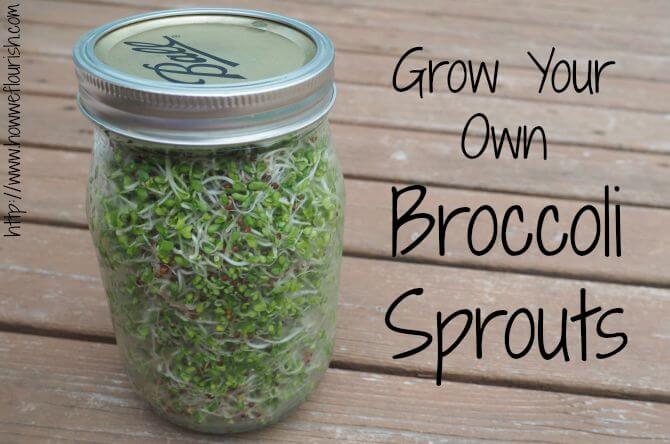
The easiest method of growing sprouts is to use a Mason jar. The key is to provide plenty of fresh air to enter the jar and only cover the top with a mesh screen. Step 1: Soaking — For a quart-sized jar, put 1 ½ to 2 tablespoons of small seeds (up to 1 cup if using larger seeds like green peas or garbanzo) in the sprouting jar. Cover top of jar with cloth or sprouting lid and rinse the seeds in warm (not hot) water. Drain and refill so that water is about an inch above the seeds. Let the seeds soak 8-12 hours (overnight). Protect from light by covering with a dish towel or placing in a cupboard. Step 2: Rinsing — Rinse 2 to 3 times per day for 2 to 3 days. After thoroughly draining the rinse water, lay the jar on its side to spread out the seeds. Do not expose to light. After 2 to 3 days the sprouts should be filling up the jar.

Order Organic Sprout Seeds Online

#5.  GARLIC

Garlic can be planted in the spring as soon as the ground can be worked, but fall planting is recommended. Bulbs will grow bigger and more flavorful when you plant them in the fall.  Plant 6 to 8 weeks before your first hard frost.  In southern areas, February or March can be a better time to plant.

Guide to Growing Organic Garlic

#6.  ONIONS

Onions are easy to grow, have a fairly short growing period and take up little space in the garden. If you don’t have a vegetable garden, plant a few onions in your flower garden or in a pot or box and set them on your patio or in a sunny window.

Onions are a cool-season crop, hardy to frost and light freezes, although certain varieties are exceptions. They can be grown practically everywhere, and prefer a cool- season start. Onions are as hardy as they come. Frosts, freezing temperatures and snow will not kill them. They should have steadily moist soil and even growing weather to mature at a steady pace. Otherwise they bolt to seed or do not form good bulbs. High temperatures and low humidity are advantageous during bulbing and curing.

How to Grow Organic Onions from Seed

#7.  BROCCOLI

Broccoli is an annual cool-season crop hardy to frosts and light freezing, often overlooked and overcooked. Broccoli is sensitive to the heat, if the weather is too hot, it will flower quickly and won’t produce an edible head, it tends to grow best in the fall due to the more predictable cool weather. To prevent spreading clubroot and other soil-borne diseases, don’t compost brassica roots. Some gardeners won’t compost any part of the plant. Also, rotate the placement of brassica plants in your garden so they aren’t in the same 10-foot radius for at least 3 consecutive years. Some experts recommend a rotation of 7 years. Headed broccoli is the most common form in the United States, with big central heads closely packed with buds.

How to Grow Organic Broccoli from Seed

#8.  BELL PEPPERS

Peppers are easily second only to tomatoes as a home gardeners favorite. Try spot planting them around the garden for bursts of beautiful color too. Pepper roots don’t like to be disturbed, so plant them indoors in seed starting pellets two months before your last frost date, usually three or four seeds to a pellet.

How to Grow Organic Sweet Bell Peppers from Seed

#9.  THYME

Thyme can be grown in many climates.  It makes for an attractive and fragrant ground cover, and has fragrant, tiny flowers that the bees love. Grow thyme to attract pollinators for your garden.  Try using fresh thyme in meat dishes, incorporated into sausage, stuffing or your favorite soup recipe.  It also does very well in containers, both inside and outdoors. Plant seeds when the ground temperature has warmed to at least 70 degrees. Loosen soil and then sprinkle seeds on top.  Mist lightly, being careful not to allow the soil to become soggy.

How to Grow Organic Thyme from Seed

#10.  STRAWBERRY

#11.  ARTICHOKES

Artichokes have a preference for a long, frost-free season. They do not grow well when there is heavy frost or snow. The temperature should not be under 55°F at night. For best results, plant them on the average date of last frost for your area. Artichokes need rich, well-drained soil that will hold moisture. They also need as much sun as possible. 8 hours of sunlight is ideal.

How to Grow Organic Artichoke from Seed

#12.  RHUBARB

#13.  BEETS

Beets are an annual cool-season crop, half-hardy to frost and light freezes. They thrive in all parts of the country. Beets are closely related to spinach and chard, and once called “blood turnips” because of their bright red juice. Growing beets will provide delicious colorful roots and nutritious greens. Most beets are open-pollinated and multi-germ, where one seed yields a clump of 4-5 plants that need to be thinned.

How to Grow Organic Beets from Seed

#14.  BASIL

Basil is planted in the spring and dies at the first fall frost. It can be grown year-round indoors or in frost-free climate. Basil also needs daytime temperatures over 70° F and nighttime temps over 50° F. Basil thrives in warmer temperatures.  Sow your seeds outdoors in spring, after all danger of frost has passed. Basil needs at least 6-8 hours of full sun each day, so keep that in mind when choosing a location to start your seeds. Try to space your basil plants about 12 inches apart.

How to Grow Organic Basil from Seed

#15.  ZUCCHINI & SQUASH

Squash is a warm-season crop, very tender to frost and light freezes. Plan an average of 2 winter plants per person and two summer plants per 4-6 people. Summer squash can be grown almost anywhere, as the vines develop quickly. Harvest begins in 2 months. Winter squash requires a longer growing season and more garden space for sprawling plants. They generally do not tend to thrive in hot, dry regions where there is a limited water supply.

How to Grow Organic Squash & Zucchini from Seed

#16.  CUCUMBER

Cucumbers self regulate how many fruits they can carry at one time. In order to maximize production, harvest fruits as soon as they reach picking size. Pick daily, because under ideal conditions, cucumber fruits can double in size in just one day. Grow cucumbers where a long, warm growing season, minimum 65 days, can be assured. Cucumbers are a warm-season crop, very tender to frost and light freezing.

 How to Grow Organic Cucumbers from Seed »

#17.  GREEN BEANS

Beans can be grown in average soil, almost anywhere in the United States. They grow best if the soil is well drained and the summer is consistently warm. Seeds will rot in the ground in cold, damp weather. Plant seeds 2 inches apart, 1 1/2 inches deep in rows 2 feet apart. Thin to about 6-8 plants per foot of row. Bean plants produce the bulk of their crop for a 2 week period. Rather than plant the entire row, sections should be planted at 2 week intervals until mid-July or 8 weeks before the first killing frost. This will assure a steady crop all summer.

How to Grow Organic Green Beans from a Seed  »

#18.  MINT

Mint is said to be the easiest to grow out of all herbs. It’s great for beginning gardeners and grows best in zones 4-9.  Use Mint leaves to add flavoring to a wide array of food and beverages. It also serves as a natural pest deterrent around other vegetables.  Chewing on the leaves will freshen your breath and can calm an upset stomach. Mint is a hardy perennial that can really be started anytime as long as you’re about 2 months before your first Fall frost.  It also grows well indoors, year-round.  Start them inside in late winter, for your Spring planting, or wait until the soil warms up and sow the seeds directly outside in your garden.

How to Grow Organic Mint from Seed 

#19.  RADISH

Radishes are a fast growing, cool-season crop that can be harvested in as little as twenty days.  Eaten raw they can be whole, sliced, diced, or grated. You can also cook and pickle them. Most of them are typically eaten fresh, and make a good addition to salad or a substitute to pepper on a sandwich.

How to Grow Organic Radish from Seed »

#20.  TOMATO

The tomato is a warm-weather vegetable, it is very tender to frost and light freezes. Never plant near walnut family trees. The walnut trees excrete an acid that inhibits growth of nearby plants. Sow seeds using expanding seed starting soil pods about 8 weeks before the last frost date for your area. Seedlings will be spindly with less than 12-14 hours of light per day, try to keep them in a warm sunny location.

How to Plant, Grow, Harvest, and Save Organic Heirloom Tomato Seeds »

#21.  POTATOES

The ideal potato soil is deep, light and loose, a well-drained but moisture retentive loam. Most potato varieties are very aggressive rooting plants, and are able to take full advantage of such soil. In ideal soil, potatoes can make incredible yields. Fortunately, the potato is also very adaptable and will usually produce quite well even where soil conditions are less than perfect.

How to Plant, Grow, and Harvest 
 Organic Potatoes from Seed »

#22.  KALE

Kale is a very easy vegetable to grow. It is generally more disease and pest resistant than other brassicas. Kale also occupies less space than other brassicas. Use it as a spinach substitute in a wide variety of dishes. Kale maintains body and crunch which makes it a good substitute in dishes where spinach might not be suitable; its especially delicious in stir-fry dishes. It is recommended to cook over high heat to bring out the best flavor and prevent bitterness.

Many specialty growers are planting kale in wide beds only 1/2 to 12 inches apart and harvesting kale small as salad greens. In England, close plantings of kale have been shown to prevent aphid infestations through visual masking.

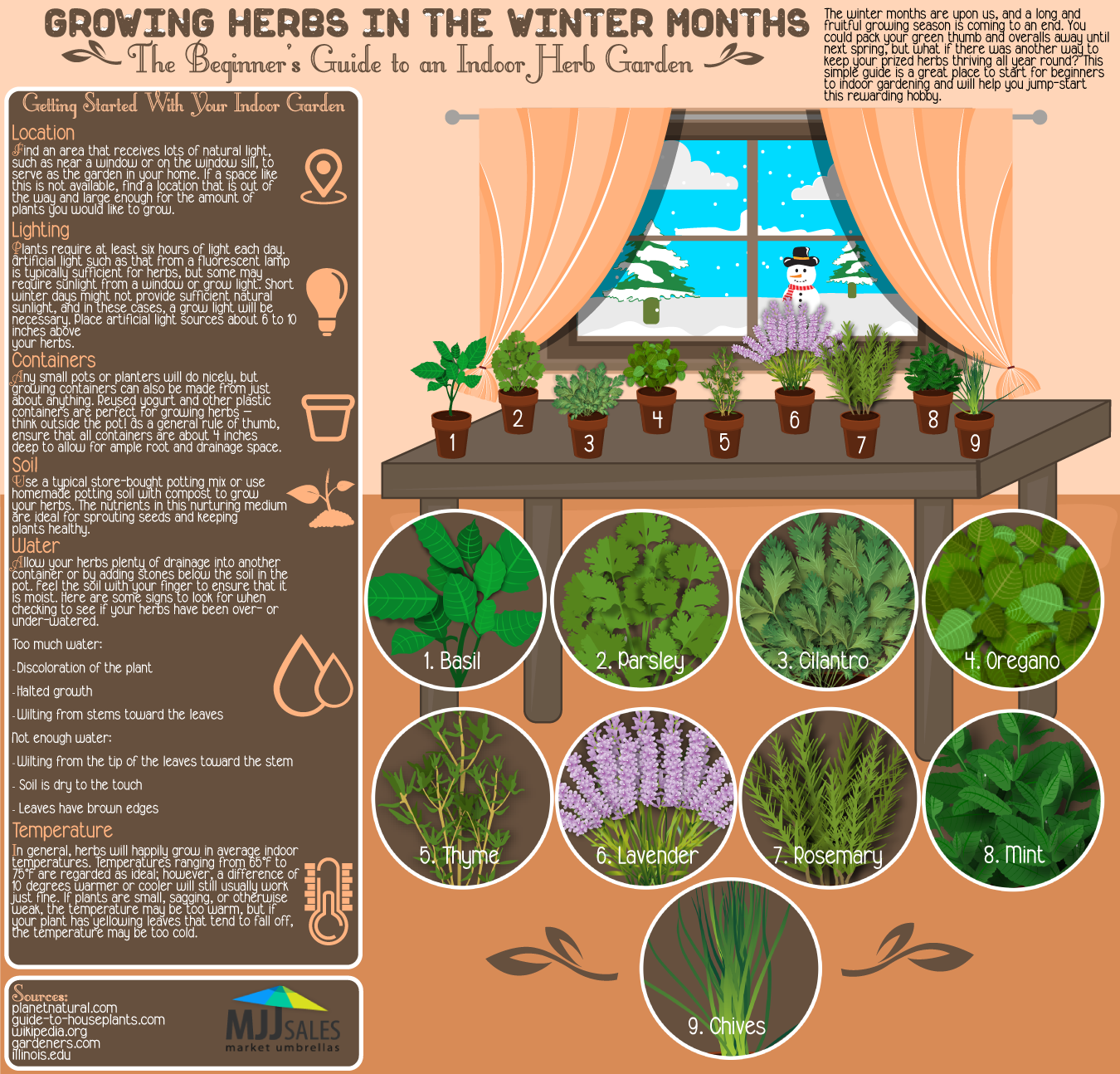
#23.  MICRO-GREENS

Each and every living seed will grow into a plant. It’s when that seed begins to grow (germinate) that we call the beginning growth stage of the plant a “sprout”. They are a convenient way to have fresh vegetables for salads, or otherwise, in any season and can be germinated at home or produced industrially. Sprouts are said to be rich in digestible energy, vitamins, minerals, amino acids, proteins, and phytochemicals!
Order Organic Sprout Seeds Online

Farm in a Box. The ‘Swiss-Army knife’ of sustainable farming.

It’s pretty cool how people can use shipping containers.  We’ve seen people use shipping containers and transform them into homes, hotels, business.  In fact, here is an amazing collection photos of how people have used shipping containers.  People sure are creative!  And best of all, the containers aren’t all that expensive.  The possibilities are truly endless.

In fact, now a company has gone so far as to use them to create: MICRO-FARMS!

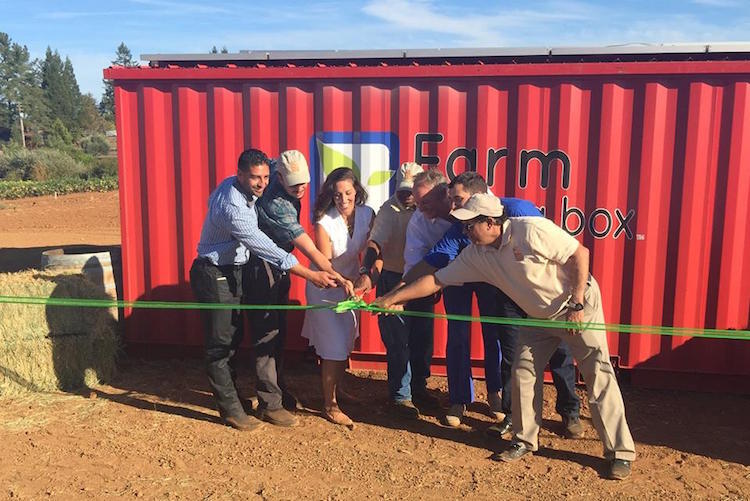
Ecowatch.com says, “Shipping containers already make great micro-homes, but one California-based company is using shipping containers to create micro-farms. Farm from a Box is a complete, small-scale farming toolkit that includes everything you might need to produce your own food. Each box comes in 10-, 20- and 40-foot units and is pre-installed with a photovoltaic system comprising of 10 high-efficiency solar modules, off-grid inverters, a transformer and distribution box and deep-cycle batteries for energy storage. The array is backed up by a 3,000-watt generator.”

Farm-from-a-Box
Farm from a Box is a modified shipping container with a built-in WiFi, irrigation system, solar panels, weather tracking devices, batteries and more. It also contains seedlings, farming equipment and a training program to provide communities with the tools the need to feed themselves. Photo credit: Farm from a Box


Ecowatch.com goes on to say, “…It’s also equipped with high-efficiency LED lighting, secured storage, a mobile charging area, Wi-Fi and a remote monitoring solution. Oh, and seeds and farming tools of course. Each unit is capable of producing crops for one hectare of land (2.47 acres), the company says.”

Click here to read the full article: www.ecowatch.com/2015/12/02/farm-from-a-box/


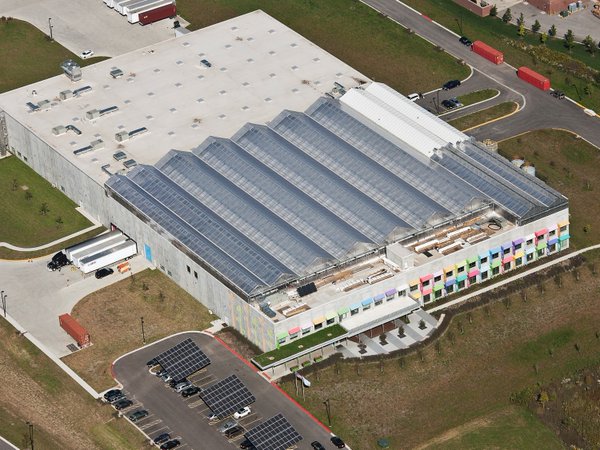
World’s Largest Organic Rooftop Farm Powered 100% by Renewables Opens in Chicago

News from ecowatch.com:  Brooklyn-based urban farming company Gotham Greens opened the world’s largest rooftop farm in Chicago, the company announced Thursday.

CUQ6t6_XIAAaxk_
Gotham Greens ‏@gothamgreens #Chicago is now home to the World’s Largest Rooftop Farm! Check out our largest project yet http://prn.to/1Qx6Pot @gothamgreens

Click here to read more about the World’s Largest Organic Rooftop Farm Powered 100% by Renewables in Chicago

How to Grow Broccoli Sprouts at Home! SUPER HEALTHY!!!

Original source of this post: www.howweflourish.com

Growing Broccoli Sprouts at Home

There is a great blog we recently came across, howweflourish.com.  She recently wrote about why and how everyone should be growing and eating broccoli sprouts.  The results are overwhelmingly positive.

DID YOU KNOW?  Broccoli sprouts are 10x – 100x higher in some cancer fighting compounds than the actual mature vegetable!

She mentions in her article,  …”this past spring, we purchased the seeds for our garden from SeedsNow. I love this company because all their seeds are non-GMO as well as being raw, untreated, pure heirloom, non-hybridized varieties. This means you can save all your seeds from the plants you grow for next season!

But anyway, while I was there, I noticed that they also sell seeds for growing sprouts. I had just finished reading The Elimination Diet, where the praise the benefits of broccoli sprouts, so I thought I would check it out. I picked up a bag of the sprouts and anxiously awaited my delivery. Remember, I was waiting for my garden seeds AND the broccoli sprouts! It was an exciting day at the mailbox.”

Click here to read the full article about why and how to grow organic broccoli sprouts:

Instructions for Growing Broccoli sprouts:

  1. Add 2 tablespoons of broccoli sprouting seeds to a widemouthed quart jar.
  2. Cover with a few inches of filtered water and cap with the sprouting lid.
  3. Store in a warm, dark place overnight. I use a kitchen cabinet for this.
  4. The next morning, drain the liquid off and rinse with fresh water. Be sure to drain all the water off.
  5. Repeat this 3-4 times a day. Continue to store your seeds in a warm, dark place. After a few days, the seeds will start to break open and grow. The biology major in me is absolutely enamored with this process!

  6. Eventually, the sprouts will be an inch or so long and have yellow leaves. Now you can move the sprouts out into the sunlight.
  7. Continue to rinse them 3-4 times a day until the leaves are dark green. Now they are ready to eat!
  8. This whole process will take about a week. Patience is key!
  9. Once they are ready, replace the sprouting lid with a standard mason jar lid and store in the refrigerator.
  10. Serve on top of salads, stirred into soups, or however strikes your fancy.
Schema/Recipe SEO Data Markup by Yummly Rich Recipes

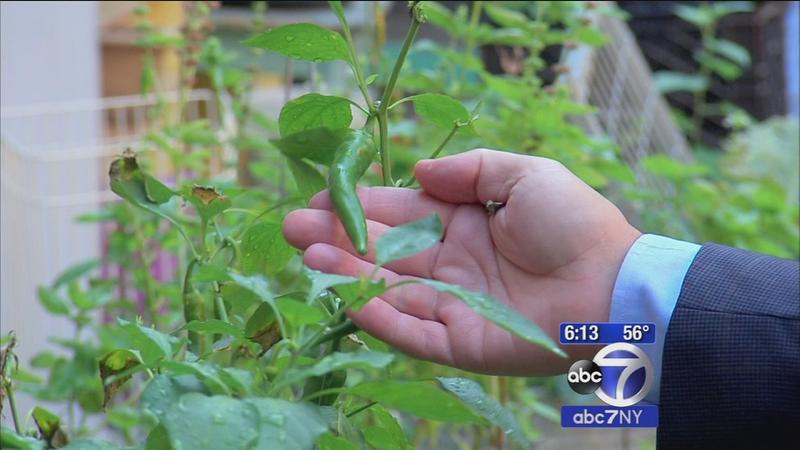
Teens Cultivate Urban Farm In Hamilton Heights, Manhatten

“All of our food here is grown by the kids but the community comes in and takes it for free,” said Rodriguez. “We don’t charge. There is no membership. They come in, take what they want, measure, and then we know how much we’ve grown throughout the year.” – Nando Rodriguez

Read the full news article on ABC 7 NY here:  http://abc7ny.com/food/teens-cultivate-urban-farm-in-hamilton-heights/1101080/


Local gardener transforms vacant lot into thriving urban farm

Original post can be found at: “richmondconfidential.org/

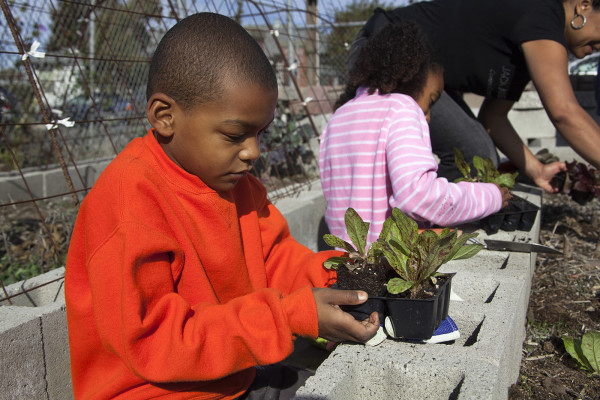
Copeland Cormier is learning the basics of planting seedlings during November’s volunteer day on the farm. (Photo by Brittany Murphy)Cole Dunford (center) and Copeland Cormier (right) enjoy a day on the Happy Lot Farm during November’s volunteer day. (Photo by Brittany Murphy)
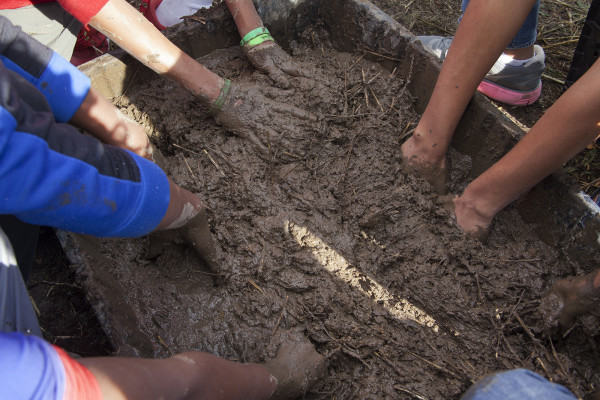
A trough of adobe clay is getting mixed by eight young hands at the Happy Lot Farm and Garden. (Photo by Brittany Murphy)
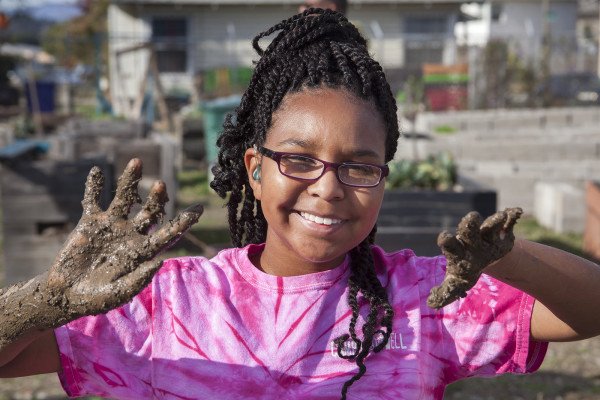
Georgie Fields shows off her mud-clad hands after mixing the adobe clay. (Photo by Brittany Murphy)
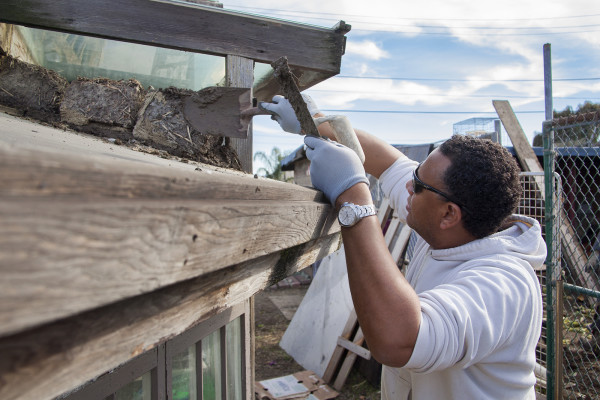
Terry Goode works to patch a weakening section of the greenhouse with the clay mixture that was just made that morning. (Photo by Brittany Murphy)
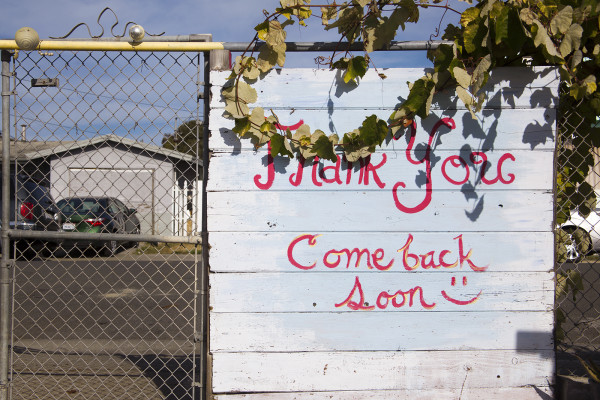
A hand painted sign stands next to the front gate of the Happy Lot Farm and Garden. (Photo by Brittany Murphy)
Andromeda Brooks is changing the way we look at vacant lots.

Tired of staring at the litter outside her window, Brooks decided to turn a blighted lot at Chanslor Avenue and First Street into an experiment in urban agriculture.

“I’m gonna put food on the corner instead of drugs,” Brooks said.

Starting the project solely on her own, Brooks turned a 14,000-square-foot lot full of weeds and debris into a thriving farm growing two dozen varieties of fruits and vegetables, a multitude of chickens and ducks, three rabbits, and even a quail.

She calls it the “Happy Lot Farm and Garden.” The enterprise has continued to grow and with it so has the surrounding neighborhood.

Brooks’ farm transformed a space previously used for loitering and illegal dumping into a source of healthy food for the neighborhood. Brooks gives away most of the produce to community volunteers, random passersby—and even the occasional driver who leaves a car door unlocked.

Community members help during monthly volunteer days. People have dug holes, planted seedlings, mucked out the chicken coop and built a pergola for the grapevines.

Karen Earby, a veteran Happy Lot volunteer, has been coming out to the farm for nearly three years.

“I don’t normally work with my hands,” she said. “I’m in finance. So to come out here and do something with my hands, it’s rewarding. It just makes you feel good.”

Nonprofit groups are reaching out to Brooks, offering volunteers and services. Most recently, a mothers’ organization, Jack and Jill of America, came out for volunteer day in November.

“We’ve had a great time—the kids are really enjoying the hands-on opportunity to be in the garden or actually working with the farm animals,” said Karla Fields, a member of the Jack and Jill group.

Nearly 30 moms, dads and children converged on the farm for the latest volunteer day. After a brief introduction and rundown of the farm rules, Brooks split everyone into groups and sent them off to their tasks.

Easily the most enjoyable task of the day was mixing new adobe clay to repair a section of the garden’s greenhouse. Children sat around a large trough filled with a mixture of mud, hay and water. Eight kids got to throw dirt-free standards to the wind and dug in for some good old-fashioned mud-pie-making. By the time they had finished, each one of them came away with mud splattered up to their elbows and smiles plastered across their faces.

It all sprouted from a plan Brooks started drawing up five years ago. Every detail of the future garden went into her early sketches, which showed where each planter bed would go, the placement of a driveway, even the heights of plants, so she would be able to see all the way across the garden from her house.

“Growing has always been a part of me,” Brooks said. “I guess in hindsight, working on that piece of paper, it’s always been in me.”

She recalled hours as a child running barefoot through her parents’ gardens growing up in San Bruno. Some of her earliest memories are of chickens. After her family moved to Vallejo, she had a whole backyard lined with fruit trees.

Now, her lifelong love of playing in the dirt has begun to change her neighborhood.
Not much dumping and loitering happens when Brooks is outside in her garden. If she suspects someone might be up to no good she may well enlist their help to work in the garden.

She dreams of expanding.

“It would be nice if it could be like a community-supported grocery store,” Brooks said, “where anybody and everybody can come and buy our food.”

Brooks wants the farm to sustain itself someday on its own resources. Already, she is part way there, using the greens from the garden to feed her rabbits and chickens, and in turn using their waste for fertilizer.

Nearly everything that went into building Happy Lot Farm was donated or built with reclaimed materials. Even the dirt for the driveway was donated by a Richmond supporter.

Her adobe greenhouse was built by Massey Bourke, a professor at the University of California at San Francisco. The 12-foot structure is made entirely out of recycled and reclaimed materials, even down to the clay soil that makes up its walls.

The greenhouse started from a piece of glass Brooks’ parents had given her from a sliding door.

Soil from her parents’ backyard in Solano County make up the walls. The roof panels are made from reclaimed shower door panels. The wooden structure of the roof is made of leftover deck material. Hundred-year-old handmade glass windows comprise part of the back wall, obtained from a family home in Oakland that was being demolished.

The striking chevron-patterned shed door, made from former fencing material, was designed and constructed by a group of students from Marin College. Colorful glass reclaimed bottles, stacked in the curving pattern of a leaf, are embedded in the walls on either side of the greenhouse. Rays of blue, green and yellow light beam through the bottles.

“The greenhouse has been essential here on the farm,” Brooks said. Having the ability to germinate her own seedlings and work year-round allows her to give more plants away while still maintaining a supply for the garden.

Brooks doesn’t worry about end-of-year produce tallies, or how many hours of work she puts in each week. Her big concern, she said, is to educate people about their food.

A Guide to Encinitas’ (Sub)Urban Farming Fight

State of the Farm

Current rules were taken from the county’s ordinance when Encinitas was incorporated in 1986 and on the verge of becoming a high-demand coastal city.

The rules allow a homeowner in a single-family area to have up to 10 chickens and 10 goats, and require coops and pens to be more than 35 feet from neighboring homes.

Additionally, homeowner associations can put their own rules in place to further restrict agriculture.

Residents are also allowed to have two bee hives in rural residential areas – places that are one house on one acre – 600 feet from the nearest property line. The county passed new rules in September lowering the setback distance significantly – only 35 feet from neighboring homes and 25 feet from roads. The Council will take up the question of accepting those lower standards at a later date.

Larger setbacks for livestock remain in place and often mean that only residents in Encinitas’ least dense areas can legally own chickens and goats – and those places are only becoming fewer in number.

The city has an agricultural heritage, including the largest poinsettia farm in the world, but a lot has changed in 30 years. Encinitas covers 20 square miles and has added roughly 100 housing units per square mile since 2000, according to census figures, most of those as single-family homes.

Kranz said there was no doubt urbanization has been limiting small livestock and agriculture in the city.

Click here to read the full article: www.voiceofsandiego.org/topics/government/a-guide-to-encinitas-suburban-farming-fight

This Rooftop Garden Is Feeding Atlanta’s Homeless

Original post can be found at: “Munchies.vice.com“”

It’s no surprise that rooftop farms have the potential to impact a local community.  The amount of food that can be grown on the top of a building is quite surpirsing.  In fact, Munchies.vice.com recently wrote an article about how a rooftop garden in Atlanta is directly benefiting its local homeless population.

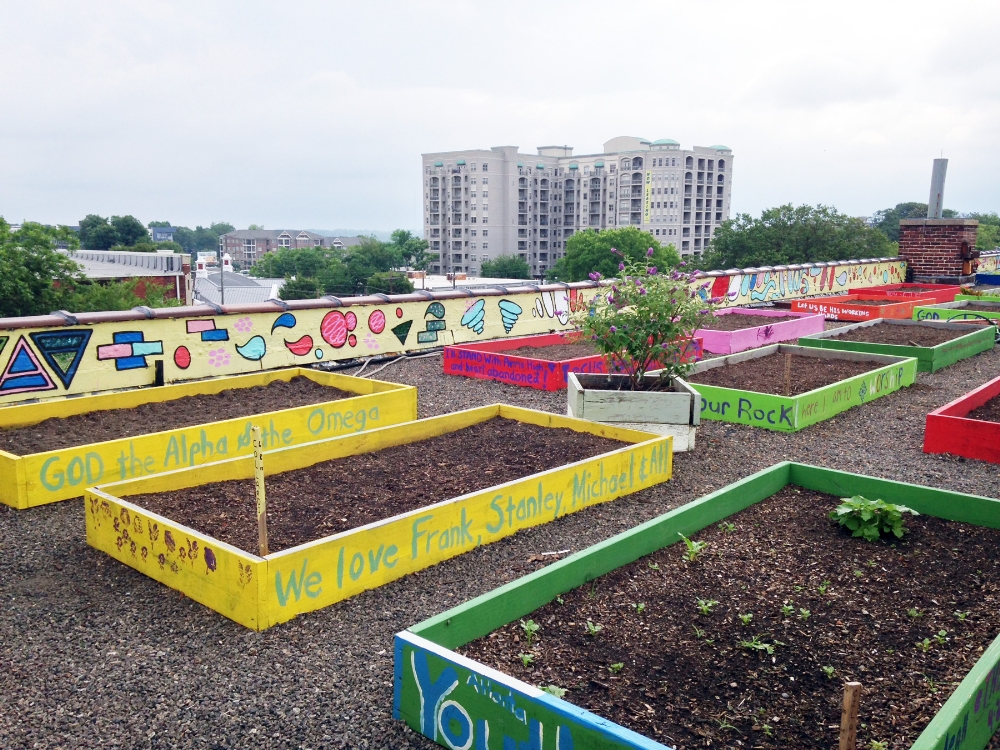
Munchies.vice.com wrote,  “Most residents of Atlanta are familiar with the city’s largest homeless shelter, the Metro Atlanta Task Force for the Homeless. Situated along the border of the affluent downtown and midtown business districts, the shelter has a controversial and beleaguered reputation, as well as a troublesome relationship with the city. While local politics is rife with talk of gentrification and displacement, the rooftop of the shelter has quietly blossomed into an oasis of organic food and practical life experience for its residents.”

rooftopgardenatlanta_IMG_1707
Source/Munchies.vice.com“

Munchies.vice.com also goes on to say that, “with 95,000 square feet, the Metro Atlanta Task Force for the Homeless is the largest shelter space in the southeastern United States. The garden of 80 colorfully painted raised beds atop the four-story concrete building at the corner of Peachtree and Pine streets provides rich work experience (including urban farming certification and licensing), therapy, and fresh, healthy food for the more than 400 men, women, and children who reside there. These beds, built and maintained by residents, have already raised what reads like a Whole Foods shopping list: small crops of organic tender lettuces, collard greens, kale, chard, carrots, strawberries, radishes, squash, watermelon, zucchini, bell peppers, tomatoes, green beans, and more.”

rooftopgardenatlanta_IMG_1637
Source/Munchies.vice.com“

Click here to read the full article: https://www.urbanorganicgardener.com/2015/11/this-rooftop-garden-is-feeding-atlantas-homeless/

Berlin eats its greens – urban gardening

Original Post Can Be Found At: dw.com

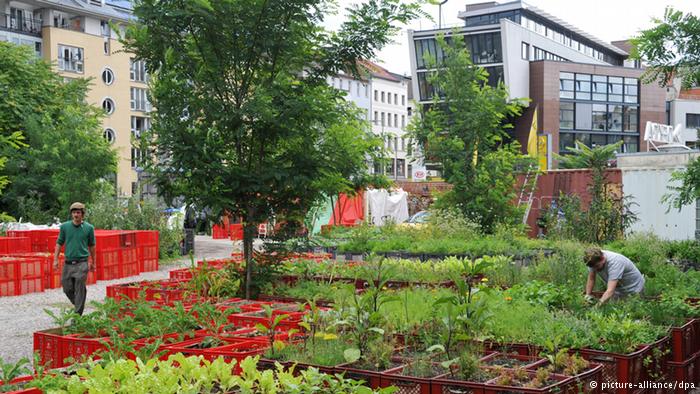
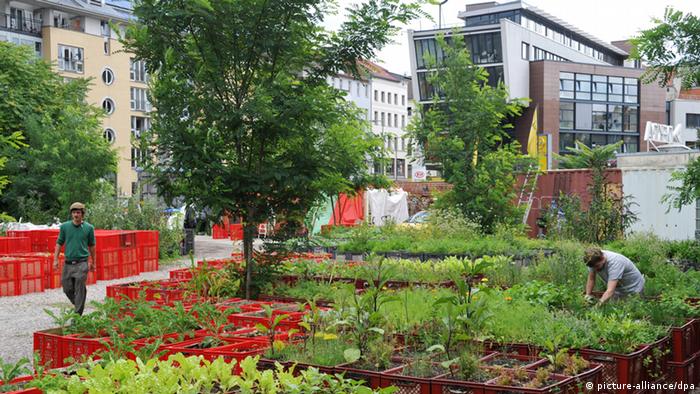
More and more people are turning to foods that are produced sustainably. And Berlin is a cornucopia of organic, regional and seasonal produce.

Urban Gardening project
An American gourmet magazine recently declared Berlin the vegetarian capital. In any case, more and more people in the German capital are going green when it comes to food. There are several good-sized urban garden projects, and market halls feature locally grown produce. There’s even a gourmet restaurant, Nobelhart & Schmutzig, whose specialties are prepared using ONLY locally grown ingredients.

Refugee starts urban garden for other refugees

The original source of this post can be found @ foxsanantonio.com

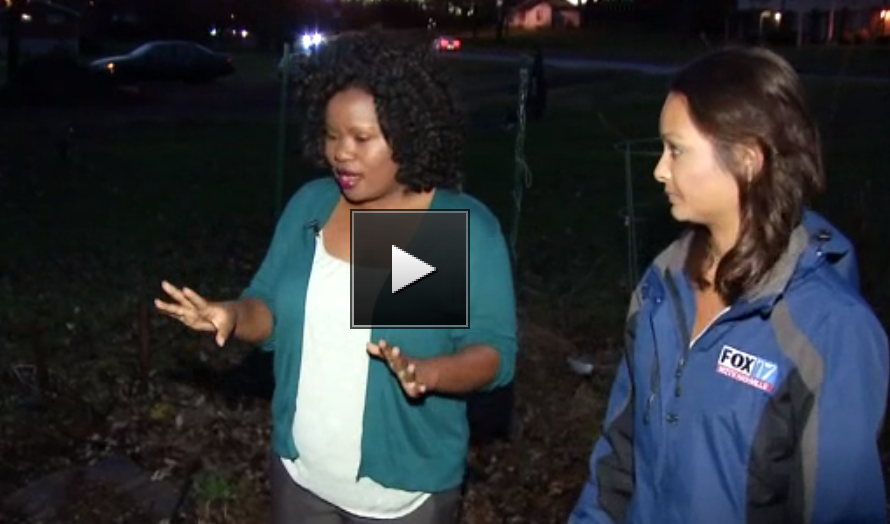
NASHVILLE, Tenn. (Jen French) — Beatrice Gatebuke’s roots are actually in Rwanda. She’s a refugee. At the age of 13, she and her parents escaped genocide.

“Nothing was familiar,” Gatebuke said. “It’s a brand new environment. We didn’t speak the language; we had to go through translators.”

Gatebuke started an urban garden for refugees off of Paragon Mills Road. She said many refugees can’t afford their own vegetables. The non-profit is called FASHA, or Fervent Assistance to Survivors for Healthy Adjustments.

“We had tomatoes,” Gatebuke said. “We have bell peppers. We had okra. Some of our people can’t afford to buy vegetables from the store because it’s just so expensive.”

Gatebuke graduated from Northwestern and now works as an information systems analyst for Community Health Systems in Franklin. She came to the United States through the refugee program.

“We were resettled by the Catholic Charities,” Gatebuke said.

According to the Catholic Diocese of Nashville, Catholic Charities gets federal grants and is contracted by the US government to distribute grants for resettling in Tennessee.

When it comes to state money, such as TennCare and SNAP, State Senator Bill Ketron would like to know how much is going to those forced to settle. He is drafting financial transparency legislation that he plans on introducing next session.

“In the past, nobody would ever give us those numbers,” State Senator Bill Ketron, R-Murfreesboro, said. “We’ve worked diligently to combine these numbers to base our claims on. “What my bill will do is expose a lot of those expenses that nobody knows that we’re paying currently.”

Gatebuke said both of her parents are employed. When her family came to the United States, they were required to pay the federal government back for the plane tickets that got them here.

Gatebuke understands there’s growing tension over the Syrian refugee crisis in Europe. She hopes she can cultivate relationships with new refugees so they can flourish here.

“We are all working and trying to contribute to American society,” Gatebuke said.

Want to join the food revolution? Build yourself a flatpack urban farm.

The original source of this post can be found @ collectively.org

Get the instructions booklet out and make sure all the pieces of your toolkit are in place. For the age of the flatpack farm has dawned. James Clasper speaks to two green-thumbed urban innovators

Forget flatpack furniture. Also forget traditional agriculture. Coming soon to a city near you – it’s the flatpack farm. At least, that’s the ambition of Mikkel Kjaer and Ronnie Markussen, a pair of young entrepreneurs who run Human Habitat, a Danish “urban design lab”.

“We wanted to make urban farming even smarter,” says Markussen over a coffee in central Copenhagen. The duo’s aim, he says, was to design a unit that would increase food security in cities, lower the ecological footprint of food production, create jobs and easily adapt to changes in the urban landscape.

Farm2

What they came up with was the so-called Impact Farm – though it’s much more fun to describe it as a flatpack farm. That’s because it’s built using an assembly-kit of ready-made components that arrive in a saved-from-scrap shipping container. Put them together and you’ve got a two-story vertical hydroponic (or soil-free) farm, which certainly beats a Billy bookcase.

Billy

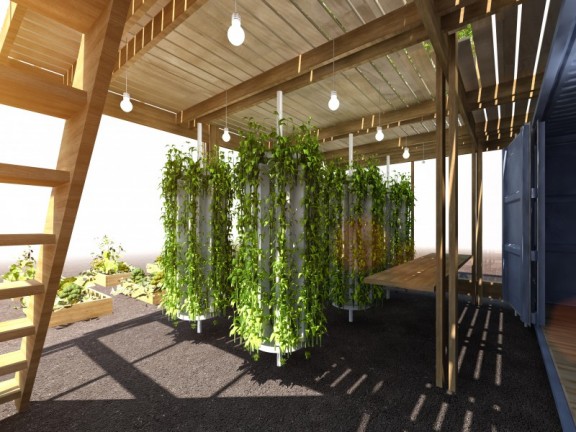
Designed to be self-sufficient in water, heat and electricity, the farm requires a footprint of just 430 sq ft – though once the shipping container has been unpacked and the farm installed, the production area stretches to 538 sq ft. Crops include greens, herbs and fruiting plants.

Human Habitat was born when childhood friends Kjaer and Markussen discovered they shared a similar goal. “We wanted to reconnect people to food by giving them a green space that brings nature back into our cities,” says Kjaer. As a student of development economics at Roskilde University, Kjaer had become interested in “small-scale solutions to the most fundamental of problems – providing food”. Markussen, meanwhile, had trained as a carpenter and worked on ambitious projects such Upcycle House, which was constructed using recycled and upcycled building materials.

Pockmarked with food deserts

The pair subsequently spent a couple of years exploring other models of urban farm, such as GrowUp in London and Edenworks in New York City. And the US is their target market, not only in terms of scale, but also because many American cities are pockmarked by empty, underused space, food deserts, and endemic underemployment, says Kjaer – urban farms are a potential solution to all such problems. Creating new jobs and skilling people up are particularly important facets of the urban farm, he adds.

FARM_FEATURE

In terms of production capacity, Kjaer and Markussen envisage two models. For independent businesses looking to sell herbs and micro-greens to restaurants and markets, the farm could produce nearly 3 tonnes per year. A larger, community-driven project – for example, one seeking to produce vegetables, leafy greens and fruit for distribution to schools, kindergartens and nursing homes – could expect to produce up to just over 6 tonnes per year.

The primary aim is to be able to unpack the farm quickly. It should take 10 days to install, and has been designed with ease of taking apart and relocation in mind. But there are other considerations too, such as designing it so that materials can be replaced. “If in five years there’s a better material that comes onto the market, we can replace it,” says Markussen.

And, in keeping with the farm’s Scandinavian origin, looks matter too. “It has to be aesthetically pleasing,” says Markussen. You see, it may boast innovative technology and food production methods but what makes the Impact Farm stand out is its sustainable architecture and Danish design.

For now, Kjaer and Markussen intend to concentrate on the urban model, which is designed to be built in the gaps in the city, such as abandoned parking lots or vacant land between buildings.

Testing terrain

In time, they want to develop a version of the farm which can help address humanitarian crises, especially where people are packed into refugee camps. That model will have more of a “flatpack” design, allowing it to be transported to, and then assembled in, more demanding environments.

Construction of Human Habitat’s first Impact Farm will begin next week on a residential street in Copenhagen’s Nørrebro neighbourhood, a stone’s throw from where Denmark’s most famous storyteller, Hans Christian Andersen, is buried. Kjaer and Markussen will run it as a pilot project, using a hydroponics system. Later models will use aquaponics.

Local interest is running high, they say. I ask who they see buying these farms. “Catering companies, housing cooperatives, schools, municipalities, restaurants, local communities,” says Kjaer. Then he smiles. “We feel a sense of urgency to get this out there.”

Urban Gardeners Can Harvest Quite a Crop From Small Spaces

Original post can be found at: VoaNews.com

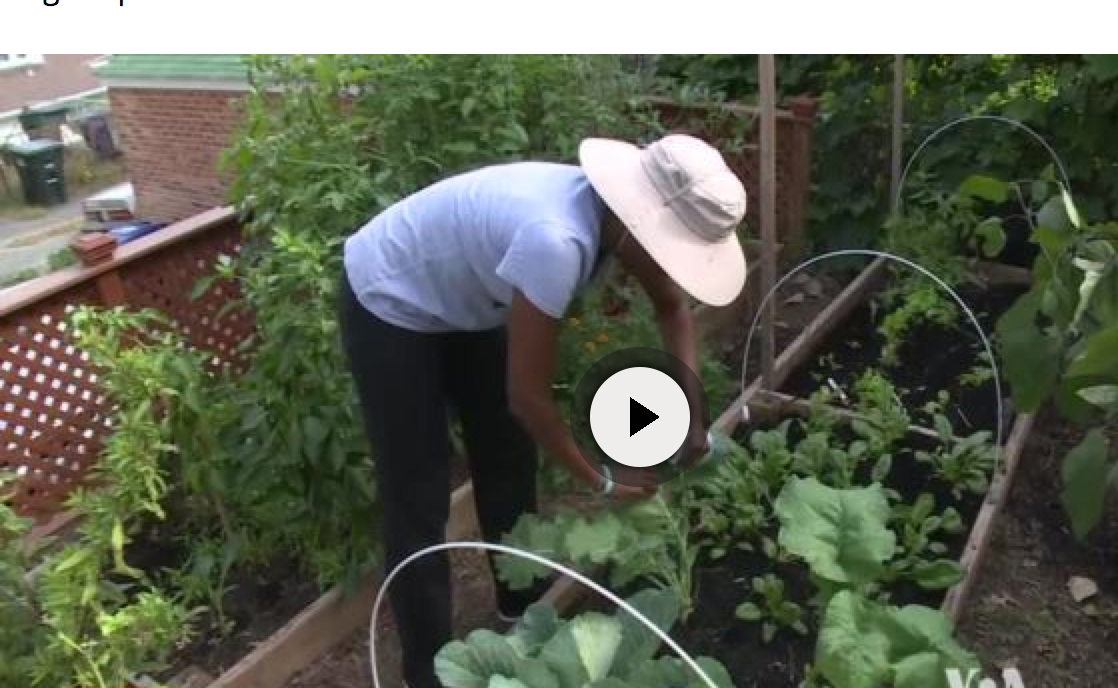
When her family moved to Washington last year, Miles-Cohen started a vegetable garden, inspired by some of her family memories.

“When I was a kid,” she recalled, “my aunt had a garden and she grew all sorts of staples; greens, potatoes and onions. I’ve always loved to sort of get my hands dirty in the soil.”

Now she plans family dinners around her garden harvest. “We have tomatoes and eggplant and okra, sweet peppers and all kinds of greens you can imagine,” she said proudly. “I had to become more creative with recipes. I spend a lot of time on the Internet trying to look up recipes for the vegetables that have been really prolific, like the eggplant.”

Be creative

Miles-Cohen gets help twice a month from gardening coach Natalie Carver, from the garden design company Love & Carrots.

“Here we’re growing out of raised beds,” Carver pointed out. “So there is this structure in the soil, and we really try to plant every square foot. A lot of our favorite summer vegetables, all of our tomatoes and basil, all the things that people want out of their garden, they need lots of sun.”

Planting vegetables in small spaces — urban gardening — is a growing trend, said Meredith Sheperd, who founded Love & Carrots.

“People are interested in where their food comes from these days,” Sheperd said. “They are interested in eating really healthy. They might not trust what they’re buying in the grocery store anymore, so they want to grow it themselves.

“I read a statistic that something like 70 percent of Americans are gardening these days and it’s growing at a rate of 20 percent since 2009. So it’s really just taking off. It has been historically young women who are mostly interested in gardening, but I think young men are catching up.”

Sheperd admitted that urban farming has its limits, but insisted that it doesn’t have to be limiting. She helps her clients find creative ways to grow their favorite vegetables, no matter how small their gardens are.

“If you have a wall that’s nice and sunny, we’ll put a nice, sturdy trellis on the wall and grow something like beans or cucumbers or peas — make use of the vertical space,” she said. “Then have another thing spilling over the front of the garden.

“On a balcony, we’ve used containers. We’ve even used 5-gallon buckets, if people are tight on a budget, to grow tomatoes or cucumbers or something like that. You just have to make sure it can drain and fill it with good soil and keep it watered and healthy.”

Fresher, cheaper

Kaliza Hutchensin grows her vegetables in a tiny garden in front of her townhouse. She said she gets the best flavor and variety, and the food is cheaper.

“I don’t go grocery shopping for vegetables at all. A hundred percent of my vegetables come from my garden,” she said. “I only like to plant what I can eat. Every year I learn what I’ve wasted, what I used practically. In a busy home, where both of us are working, I mostly try to create meals around what I’m growing.”

Hutchensin, who was born in Zambia and grew up in the United States, said her small garden means a lot to her.

“My dad was a farmer, so that was the major reason why I was looking to settle down in a place [where I could have a garden],”she said. “I still enjoy being in an urban environment, but I also missed out on feeling [like] being a part of nature, the environment.”

Her vegetable garden adds color to her home’s entryway and helps her family eat better.

From Vacant Lot to Garden Spot: L.A.-based Nonprofit Greens Up Blighted Land

Viviana Franco is founder and executive director of From Lot to Spot, an organization that spearheads efforts for more community gardens and green space throughout Southern California.  photo courtesy of Viviana Franco/From Lot to Spot
Viviana Franco is founder and executive director of From Lot to Spot, an organization that spearheads efforts for more community gardens and green space throughout Southern California. photo courtesy of Viviana Franco/From Lot to Spot

Los Angeles-headquartered From Lot to Spot is true to its name—the organization transforms unused, vacant lots into vibrant spots of green space and parkland.

According to founder and executive director Viviana Franco, From Lot to Spot has spearheaded several urban and community garden initiatives throughout Southern California, including several in Riverside.

Franco says Riverside hired From Lot to Spot as a partner in building up the gardens, specifically in capacity building and leadership processes. These gardens include Tequesquite Community Garden, Arlanza Community Garden , and East Side Community Garden at Emerson Elementary School.

The Tequesquite Community Garden consists of 1.12 acres at Bonaminio Park. Open to all community residents, it opened in June 2013 and offers garden plots. Arlanza Community Garden was spearheaded by Child Leader Project participants from nearby Norte Vista High School, in partnership with the City of Riverside. Also open to all in the community, the effort has revitalized an underused lot in a strong effort of investment for social change. Founded in 1980, the East Side Community Garden at Emerson Elementary School is Riverside’s oldest. It offers a “garden to salad bar” for Emerson students, and represent a collaborative effort between the school and the City of Riverside.

From Lot to Spot still works with all three gardens. “It’s been an amazing experience,” says Franco. “Every garden has its own different dynamic.”

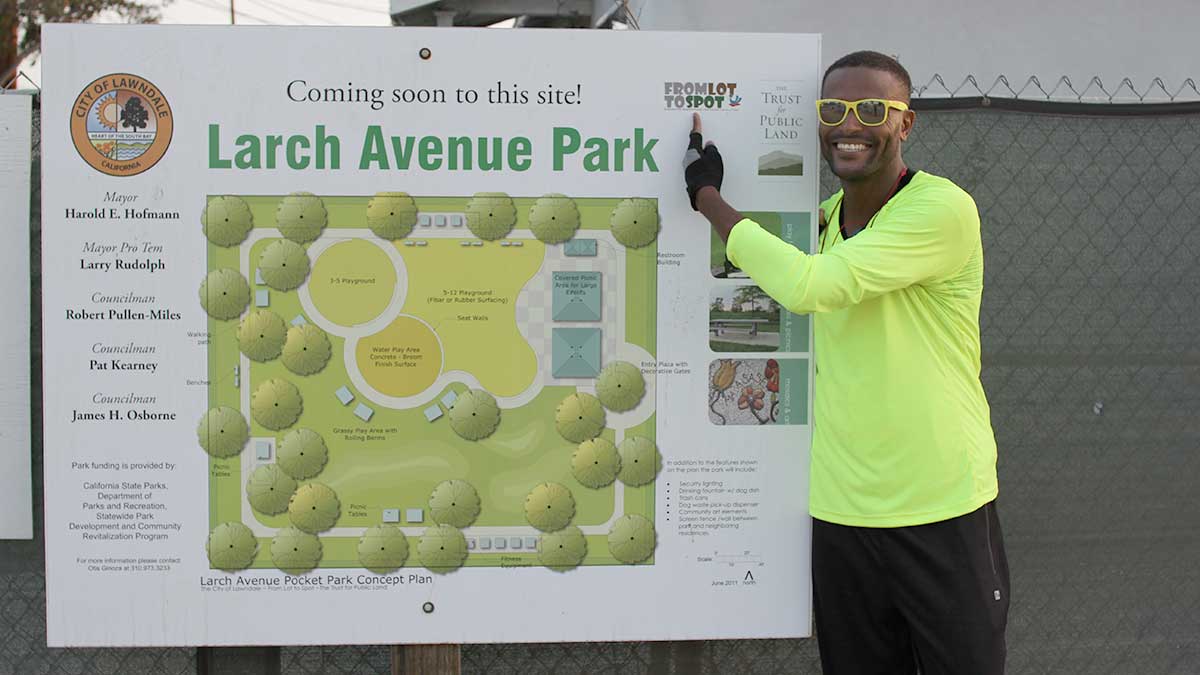
Other From Lot to Spot projects in Southern California include: 118th & Doty Pocket Park in Hawthorne, a community without many parks; Lennox Community Garden, the first community garden in Lennox; Bicentennial Park in Hawthorne, a revitalization project; Larch Avenue Park in Lawndale, another park addition in an area devoid of parkland; Dominguez Enhancement & Engagement Project, a revitalization effort of Dominguez Creek; Stanford/Avalon Community Garden in Los Angeles; and more.

While most of From Lot to Spot’s work takes place in the Los Angeles area, Franco said her group will work anywhere they are needed. “There are no geographical limits of low access to healthy foods,” she says.

“I founded From Lot to Spot seven years ago out of a need in my personal neighborhood  Hawthorne and Inglewood  ,” Franco says. “There was an abundance of vacant lots. So I went to school to learn.” She earned a bachelor’s degree in history and a graduate degree in urban planning from UCLA.

The efforts of From Lot to Spot are concentrated on low-income communities, “food deserts” with little access to fresh, quality food but an abundance of fast food establishments and liquor stores. Franco said that this problem impacts many African-Americans and Hispanics, and often results in obesity and associated diseases such as diabetes.

“From a health and sustainability standpoint, local food is intrinsic,” says Franco, who sees links between green spaces such as parkland and access to good food. These associations include more health and walking benefits and a greater awareness of the importance of diet to health. Also, she believes that both community gardens and parks strengthen their respective local economies by increasing home values  of which the business community takes note. “I call it a great green circle,” she says.

Franco acknowledges that parks are often at the bottom of the barrel of many cities’ budgets, but she firmly believes that parks and gardens bolster the tourist economy and increase connectivity between neighborhoods.

Despite the successes enjoyed by From Lot to Spot, Franco says the journey has not been without its obstacles—chief among them are bureaucracy and the difficulty of coming into a new community, where people may wonder what will be done with a vacant lot. Timeliness is also an issue, she says, as it can take a long time to convert an area into green space. “We’re not there yet,” she says.

So how is “there” defined? According to Franco, the future goal, at least for right now, is 20 more green spaces by 2020. She hopes to attain this goal through From Lot to Spot’s many partnerships, which include Los Angeles County and numerous Southern California cities. An unexpected partnership was one with the Los Angeles County of Public Works  she was surprised that engineers would want to work with environmentalists  .

From Lot to Spot is committed to fostering urban agriculture, says Franco, who is working hard alongside her From Lot to Spot colleagues in increasing local food access in Riverside and throughout Southern California.

South Minneapolis Creates Free Organic Market

On September 19th we met up with Fernanda Hart, the CANDO Sustainability & Food Access organizer, to learn about a project called “Plant Grow Share.”

We spent the day biking through the Center neighborhood of South Minneapolis following handmade maps with the safest quickest routes between gardens. We talked to Fernanda as we biked along side a food cart and a few volunteers. She told us that the project started as way to give families access to materials to make their own raised bed organic gardens.

picfreeorganic4

Fernanda explained Plant Grow Share by saying,

“We’re doing this combined effort and we’re putting our brains together and then dreaming of a project where food can be given away. Where more people will be growing food at home.”

The project itself began as conversations over a backyard fire pit where people came up with the idea to teach people to grow food, and through that process give food away for free.

picfreeorganic2

The project gives families classes with a master gardener and the resources to make a raised garden and help with installation. The agreement between the twenty participating families and the project was to give 3 small harvests a season to the free farmers market. The harvests are moved by a food cart created as part of  volunteers dreamed up to make it all sustainable. That cart now pulled up to the various gardens driven by volunteers who gathered the food to give away for free at the market.

picfreeorganic5

In those rides and harvests we learned that Fernanda really hoped that people came together around growing and sharing food. She felt that process of planting, growing and sharing challenged societies perception of food and changed peoples relationship to the food they ate. She’s excited for next year as she plans to help grow the project to include more families learning to plant their raised bed organic gardens, grow them, and share the food with the community.

Floating Farms: Agricultural Barges to Yield 10 Tons Per Year

Original post can be found at: WebUrbanist.com

offshore farm barges

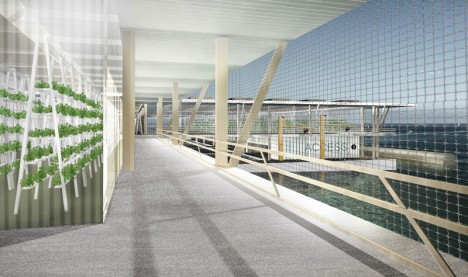
Powered by solar-paneled roofs overhead, these barge farms feature hydroponic space for produce above and support fish farming below, using extant technologies to offshore vast quantities of food to be grown on the water.

floating modular barge farms

Based in Barcelona, Forward Thinking Architecture is pushing its Smart Floating Farms concept to interested cities and investors, boasting the modularity of this system that can start with a single barge or morph into a fleet of connected vessels. Each barge is designed to yield over 8 tons of fruits and vegetables and nearly 2 tons of fish per year.

floating farm yield chart

The barges would be 656 by 1,150 feet and contain its own desalination plant, able to turn saltwater to fresh for farming purposes. Solar, wind and wave power render each platform self-sufficient in terms of energy as well as relatively independent, needing little human interaction or intervention to function.

floating high yield farm

While there is no set date for launching the first of these floating farms, the feasibility of the system is promising. It does not presuppose any technology that does not already exist, and represents a natural expansion of development beyond land to adjacent open spaces on the water.

barge farm interior fish

From the architects: “The world population is predicted to grow from 6.9 billion in 2010 to 8.3 billion in 2030 and to 9.1 billion in 2050. By 2030, food demand is predicted to increase by 50% (70% by 2050). The main challenge facing the agricultural sector is not so much growing 70% more food in 40 years, but making 70% more food available on the plate.”

JetBlue’s New JFK Airport T5 Rooftop Urban Farm Serves Up Farm-to-Air Greens


Original post can be found at: UrbanGardensWeb.com
635713469625116076-3-JetBlue-Paul-Rivera
Photo: Paul Rivera for Gensler via USA Today

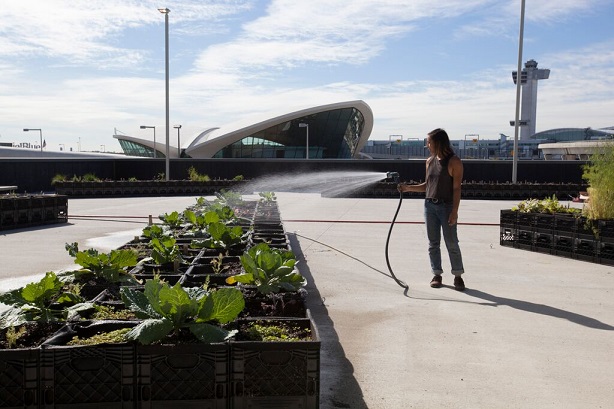
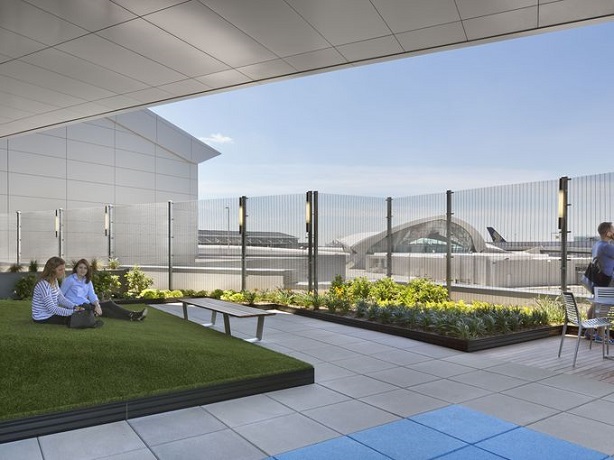
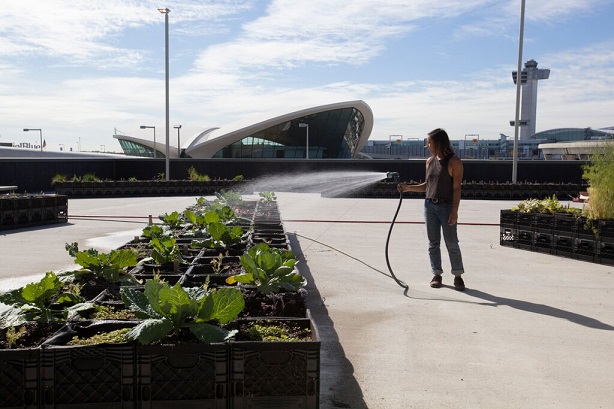
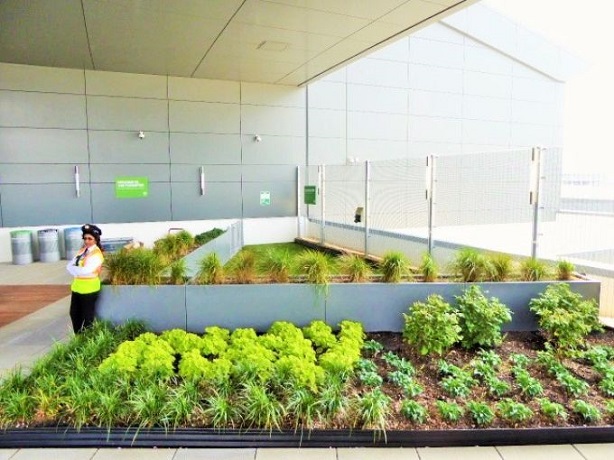
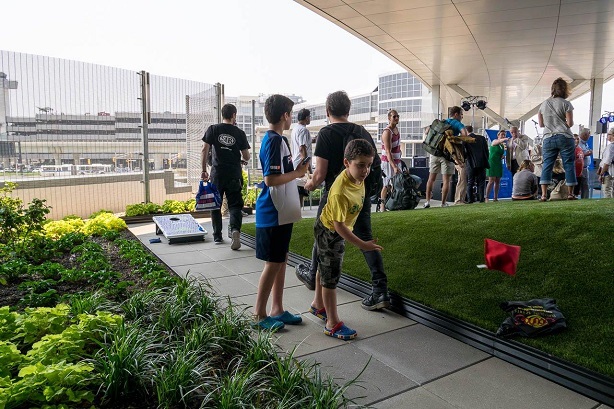
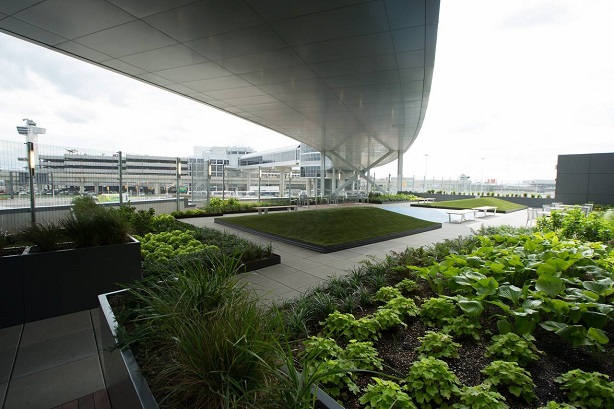
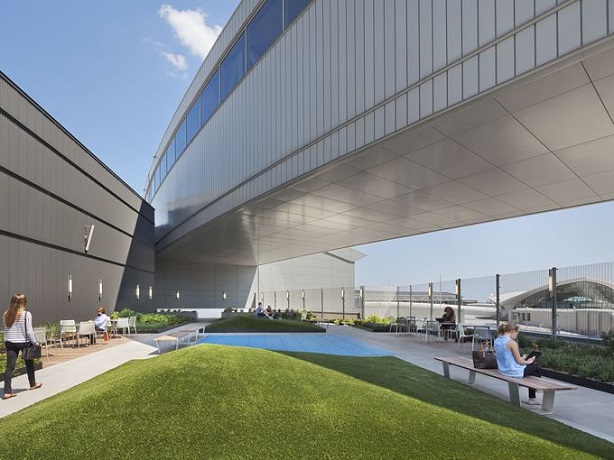
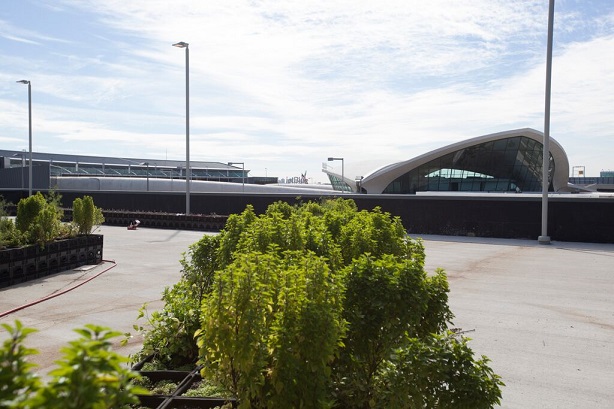
Spreading over 24,000 square feet, JetBlue’s new T5 rooftop urban farm offers a lush lounge where the weary airport commuter can breathe and relax after having endured the stress of endless security lines.

The gardens in their infancy.The farm gardens in their infancy. Photo: Chelsea Brodsky, JetBlue

635713469559282388-JFK-JetBlue-Rooftop-lounge---landscaping-and-beyond-that-the-Wooftop-dog-walkPhoto: Harriet Baskas via USA Today

Farm-to-Air Experience
It’s not the first airport with an indoor farm: inside the G Terminal at Chicago’s O’Hare there’s an aeroponic garden with a bunch of hydroponic towers that supply some of the terminal restaurants with greens. But JetBlue’s lounge has taken the farm-to-table concept one step further by introducing passengers to “farm-to-air” growing and cooking.

Terminal5RoofDeck-TodSeelie-11Photo by Tod Seelie, via Gothamist

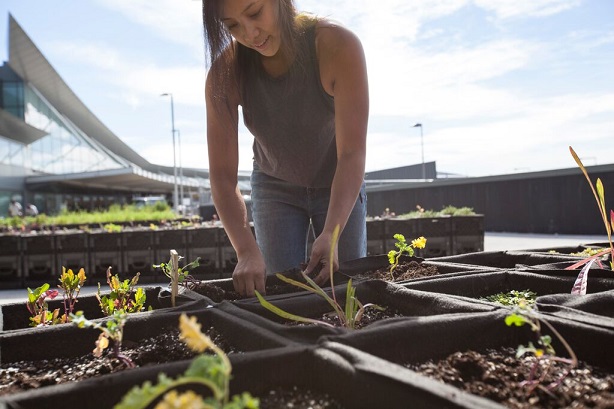
Beyond the viewing pleasure of lush chlorophyll-filled lawns and well-manicured herb and vegetable gardens, this aeronautic rooftop farm will not only supply fresh-picked produce and herbs to some of the various T5 restaurants, but also on-board JetBlue’s flights.

Terminal5RoofDeck-TodSeelie-4Photo by Tod Seelie, via Gothamist

High-Flying Potatoes
In-air passengers will get a special taste of T5’s hyper-local ingredients as the urban farm hosts the world’s first blue potato farm, providing the star ingredient for JetBlue’s signature onboard snack, TERRA blue chips.

“Besides providing a green space for customers and crew members, it will help us become even more sustainable,” said Brian Holtman, JetBlue’s manager of concession programs.

BN-JE250_NYJFK0_M_20150630154053Photo: Kevin Hagen, via WSJ

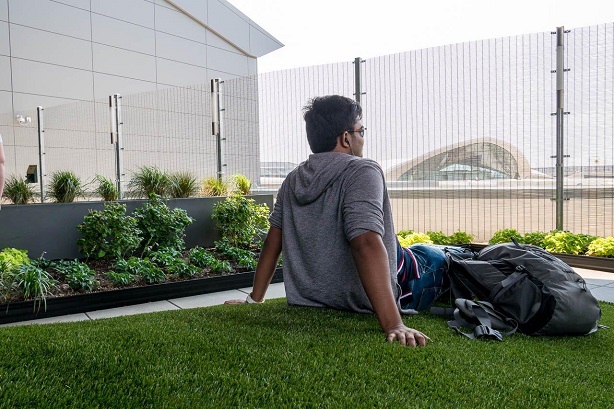
Commuters and crew members alike are encouraged to wander through the garden’s spacious paths to enjoy the magnificent views of both Manhattan and Eero Saarinen’s iconic TWA terminal next door.

635713469625272080-2-JetBlue-Paul-RiveraPhoto: Paul Rivera for Gensler, via USA Today

Wooftop Lounge
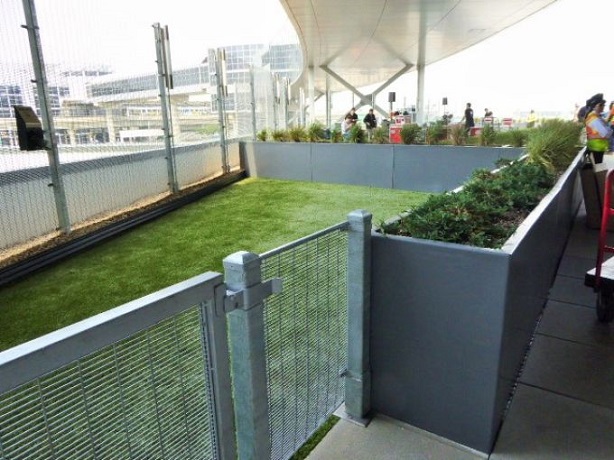
And the pre-boarding relief isn’t just for humans. JFK’s newest outdoor lounge is home to the first post-security dog friendly walking area, or “Wooftop” lounge as it’s playfully called by those in the know.

635713469588611140-Wooftop-dog-walking-area-on-JetBlue-T5-RooftopPhoto: Harriet Baskas, via USA Today

Any frequent flyer knows that traveling these days is not the fun it used to be. Outdoor spaces like this one at T5 may represent a welcome change. If for only an hour or so, winter-bound passengers and crew members can enjoy fresh air outdoors before being cooped up in an airplane during these last remaining beautiful days before the snow flies.

J5o7KsyvV-9yd6dbkNJVOEVy3GfzsVknfnoB7x5f3yM

ThOlXOw1igjdzzZ-lRHuoU8e8_pEwZQZMJgCqN7GTXs
Photo: Chelsea Brodsky, via JetBlue

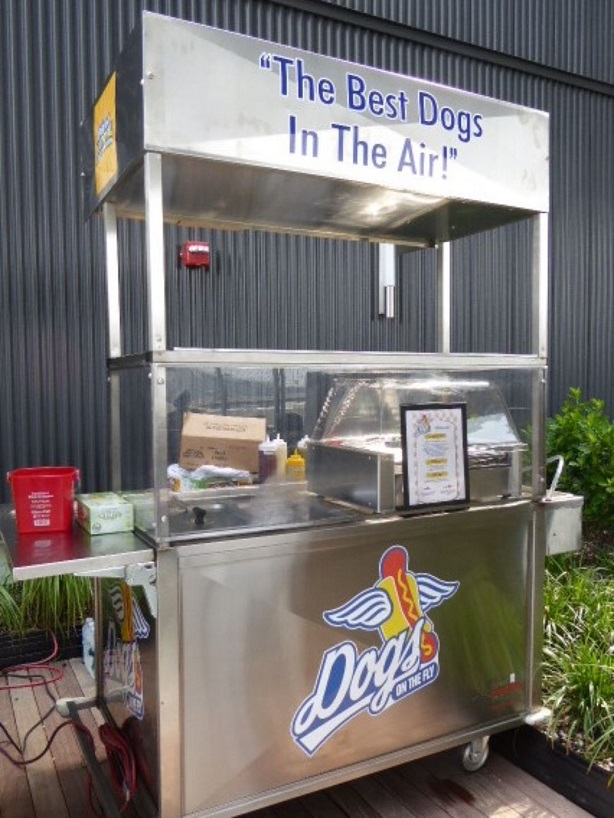
If it’s quintessentially New York food one seeks, food carts serving including Hebrew National Hotdogs and Brooklyn’s Blue Marble ice-cream are on site to satisfy the craving. That means a little sunbathing and NewYork-style gastronomy on the outdoor wooden deck and while waiting to board.

635713469541341928-Hot-dog-stand-cart-at-JetBlue-T5-Rooftop

If you happen to get a chance to experience the T5 farm, please let us know what it was like and if you (and perhaps Fido) enjoyed your greens.

HOLY URBAN GARDENING: BALTIMORE PREACHES GARDENING UP

Original post can be found at: Earth911.com
Urban Pastoral

As the cost of fuel continues to rise, more and more people are realizing the importance of supporting local businesses – especially local farms. It’s one of the reasons urban gardening is becoming so popular. Not only is it good karma to keep your money in the local community, but it makes good sense for Mother Earth too.

By buying local, less fuel is used in transportation. Did you know the average distance from farm to fork is 1,500 miles? This great distance accounts for more than 50% of total production costs. As a result, the cost of transporting a single $2 head of lettuce is $1. That huge cost is passed onto consumers – a.k.a. you.

The added benefit of supporting local agriculture is that produce can be picked ripe. When produce is picked when fully ripe, it is typically more nutritious. Since it’s estimated that 90% of Americans have at least one nutrient deficiency, it’s so important that we eat the most nutritious foods possible.

Urban PastoralIdentifying the need to deliver local, nutritious produce even in dense urban areas where traditional farming is more difficult, Urban Pastoral (UP) set on a mission to make urban gardening possible in Baltimore. Their goal is to set up the first commercial scale hydroponic farm in Baltimore and service the local community with truly local produce.

Rather than using horizontal growing methods that are common with hydroponics, Urban Pastoral will use a vertical growing system with 10-foot vertical towers to maximize space. They will also use recycled rainwater with Arduino technology to allow them to regulate water and nutrient flows. They’re also exploring the idea of using aquaponics to create a closed-loop system.

The plan is to provide delicious, culinary herbs and greens to Bon Appétit and work with the Baltimore Food Hub to keep produce local. Urban Pastoral has also developed relationships with the Abell Foundation and Humanin. These non-profit organizations have agreed to offer workforce development assistance and real estate with the goal of creating a vocational development program for high school graduates or those incarcerated.

Tools of the trade

Urban Pastoral has completed their first step, which was raising the funds to build BoxUP, a modular, 320 square foot shipping container, retrofitted as a growing facility. BoxUP is space efficient, and is versatile enough to operate in any location that has access to water and electrical outputs, like markets, hospitals, schools or unused parking spaces. Using energy efficient LEDs and hydroponic growing towers, one BoxUP can produce more than 700 pounds of fresh produce per month.

Urban Pastoral's BoxUp Growing System

The next step is to get the first FarmUP urban gardening location going. FarmUPs are commercial-scale CEA greenhouses integrated into new and existing real estate developments. Using innovative growing technology at scale, a single FarmUP can produce 30-60,000 pounds of fresh produce each month. That’s enough to feed thousands and employ hundreds.

Urban Pastoral's FarmUp Growing System

Instead of seeing produce transported 1,500 to your table, Urban Pastoral wants to see urban gardening thrive. They promise their produce will only travel a 10-mile radius, keeping transportation costs to a minimum and nutrient density to a maximum.

Keep an eye on this startup. Urban Pastoral plans to expand outside Baltimore and may bring urban gardening to your city.

Is urban gardening on the rise in your area?

Imagery courtesy of Urban Pastoral