

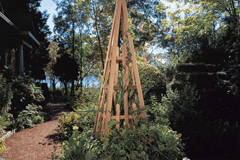
A single cucumber plant can spread out over 12 to 20 square feet when grown in traditional rows or hills. But one way to make better use of space and maximize yields is to grow cucumbers vertically – that is, to let the vines expand upward instead of outward, by supporting them on a raised structure. This is a perfect space-saving solution for anyone growing cukes in containers, raised beds, or other small plots of land (like a narrow side yard).
By the way, if you’re looking for heirloom/non-gmo seeds this is where you can order cucumber seeds online.
There are other benefits to growing cucumbers vertically as well. When plants are raised off the ground, leaves are less susceptible to slugs. Since foliage dries off faster after a rain, fungal problems are reduced. And, vertically-grown plants may have more leaf surface area exposed to the sun, resulting in better growth.
The most important way to ensure success with vertical growing is this: Know the difference between vining and bush types of cucumbers – and choose your seeds or seedlings carefully so you don’t end up with a bush variety!
Bush varieties of cukes have been bred to take up less space when grown flat in the garden. While they’re still sprawling plants, they’re not climbers. Instead, they put out vines that radiate only three feet out from the plant’s center – meaning they require only nine square feet of horizontal space, about a third of what a vining cucumber takes up on the ground. But when you grow a true vining cucumber variety vertically, you can grow one or two plants in just one square foot of ground space.
Many people successfully grow cucumbers on long, low supports – three feet high by five feet long, for example. But when you’re really short on ground space, nothing beats growing them nearly straight up, on a tall support of five feet or more. Always start out with your growing structure in place, and then transplant seedlings around it – you’re less likely to damage roots this way.
If you’re growing in containers, use a pot of 21 inches or more, to allow for root room. You can grow four to six cucumber vines this way, with at least a five-foot trellis in or behind the pot.
Cucumbers climb via tendrils – specialized, touch-sensitive leaves that wrap tightly around objects they contact. If your vines seem reluctant to climb, your latticework may be too far apart or the individual bars may be too wide for the tendrils to grasp. Try stapling chicken wire or netting to your structure, to give the vines a toe-hold.
As you experiment with vertical growing, you can create your own plant supports from materials you have on hand.
Sound off
What other tips do you have for growing cucumbers?
They grow fast and sometimes play hide and seek! We forgot to look at our cucumbers for a few days and ended up with some gargantuan cukes with huge seeds and tough skin.
Produce likes to have fun too 😉
I use the extra large tomato cages, and wrap them around as they grow. It works FANTASTIC! you just have to remember to look down the middle or you will miss some.
So far I’ve been using simple bamboo poles, but it looks like I’ll need something taller!
We used tomato cages and bamboo poles. They did great until recently, when the ants decided to take over. Any suggestions?
I built nice a nice tall trellis for my cukes, and the summer has been so cool here, that they are sill only about 1 foot high… Grow little cucumbers, grow!
My cukes are in a wash bin on the deck, started on a tomato cage, then grew up and all over hanging pots, morning glory vines, and birdfeeders. On a small patio, ya just gotta make due:D I think its nifty to see cucumbers, morning glories, and other plantsall entwined, with finches hopping from here to there, lol.
Good call on that.
Get on that!
Kill the ants 😉
I’ve heard that coffee grinds are a good ant deterrent.
Grow damned it!
Exactly. Gotta make do and you are making do do.
I’ve seen them grown in a section of old chain link fence (a gate maybe?), leaning at an angle. When the cukes are still small, you can push them through to the underside of the fence, making it easier to keep an eye on their growth so you don’t get those big daddies.
Because ours are grown on the ground, we sometimes miss them too. I just peel them, cut them in half length-wise, and scoop the seeds out. Still yummy!
Good tip.
diatomacious earth… or i find a small container of beer, like a tuna can filled with beer. They will crawl in and drown.
Nice. That’s some good stuff.
Another “Just in case the Shiite hits the fan” article, to put with your files of survival info – burnt to disk in case such really great, free, info dries up, or is charged for, here on the net! We grew enough ‘cumbers to make Dill Pickles for three years supply in our garden, in one crop. Chicken wire fence 4 feet high along the end of the yard, about 25 feet long, and the sort of cumber seeds for pickling cumbers, a climbing variety, not the “field” type, not the English type, with daily watering, on the soil only, not on the plants, with humanure – just the urine, well diluted – ten to one, gave spectacular growth, led neighbor to suggest we had planted a new, illegal, GMO type even! Guide the early plants upwards by hand on the chicken wire, nature takes over from there. VIP! Picking and pickling must be done right on time! Horse-radish leaves in each jar keeps pickles “crunchy” give great tangy flavor! So do wild cherry leaves. home grown Dill fed the same way was added. Home grown garlic, and lots of it helped, even put a Jalapeño pepper from the freezer in each jar. Made Sweet pickles, Bread and Butter pickles, fermented pickles (they don’t keep so only make a few!) too. Gave a lot away, to food-banks, neighbors, friends, still had plenty! Thank You Lord.
Another “Just in case the Shiite hits the fan” article, to put with your files of survival info – burnt to disk in case such really great, free, info dries up, or is charged for, here on the net! We grew enough ‘cumbers to make Dill Pickles for three years supply in our garden, in one crop. Chicken wire fence 4 feet high along the end of the yard, about 25 feet long, and the sort of cumber seeds for pickling cumbers, a climbing variety, not the “field” type, not the English type, with daily watering, on the soil only, not on the plants, with humanure – just the urine, well diluted – ten to one, gave spectacular growth, led neighbor to suggest we had planted a new, illegal, GMO type even! Guide the early plants upwards by hand on the chicken wire, nature takes over from there. VIP! Picking and pickling must be done right on time! Horse-radish leaves in each jar keeps pickles “crunchy” give great tangy flavor! So do wild cherry leaves. home grown Dill fed the same way was added. Home grown garlic, and lots of it helped, even put a Jalapeño pepper from the freezer in each jar. Made Sweet pickles, Bread and Butter pickles, fermented pickles (they don’t keep so only make a few!) too. Gave a lot away, to food-banks, neighbors, friends, still had plenty! Thank You Lord.
Nice man. I’m coming over your spot when it all goes down!
I am growing cucumbers vertically in a hot and dry climate. I have made hills of compost and vermicompost to plant the seeds. It seems to be working well, but when the sun comes out the leaves wilt. Later in the day when the sun sets or goes to the other side of my house the leaves perk up again. Is this normal? Is this something that I should worry about?
Last time I grew cukes I lived on 26 acres and had lots of room. This is my first try at containers. Will 1/2 barrels work or can you suggest something better?
Poop
Cucumbers are the biggest drinkers of water, even more than watermelons.