
My Fire Escape Garden and the Fire Code

The complaint that I often hear about my fire escape garden is that it is a fire hazard and that I’m putting lives at risk.

I do respect the fact that it is a fire escape and a means for people to evacuate the building in case of an emergency. This is something that I take seriously because on January 29, 2003, my apartment burned down.

This is just one reason why I make sure that there is a clear foot path for people to walk and that the hand rails are available to use.
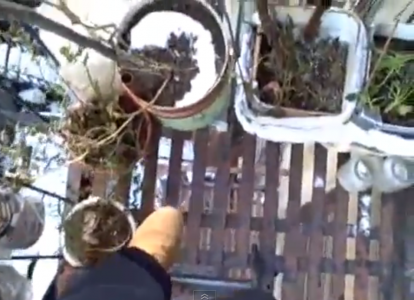
Screenshot 2014-04-10 17.40.00Technically, my garden violates the fire code because I am storing items on it. I also break the law daily when I j-walk. I’m not trying to be a smart ass, but it’s one of those laws that’s not always enforced.

The landing space of the fire escape is about 2’x3′ with the containers taking up about 8″. That leaves 16″ of foot space, which is plenty of room for someone to safely walk.

The one potential hazard was the cherry tomato plant, which wasn’t a small plant. I won’t be growing that on the fire escape in the future.

With all of that being said, I do maintain the integrity of the fire escape while using the available space to grow fresh organic vegetables.

What do you think about my fire escape garden?
My Fire Escape Garden Isn’t Outside Of My Room

One misconception about my fire escape garden is that it is outside of the window in my room. Well, it’s not.

The fire escape is actually outside of my roommate’s window. So I have to go through his room to get to it.

One of the windows in my room is where I initially planned to garden. I even built a window garden, but it gets absolutely no sunlight.

Having the fire escape outside of his window puts me at his mercy for taking care of the garden. If he sleeps in late or goes to bed early, I can’t tend to it. I also have to be extra cautious when bringing things to and from the garden, especially compost.

Having the garden out of his window is also one of the reasons that during the winter months, I couldn’t take the containers in and out during the night.

This is what I go through for my fire escape garden.

httpv://www.youtube.com/watch?v=gtbIF80duZM

Help Buying Vegetable Seeds For The First Time

The kind people at SeedsNow.com have contacted me and offered to help me out with some seed packets to get my garden started.

I’ve never started from seed before and I like experimentation (with growing vegetables that is). My plan is to continue the fire escape gardening, backyard vegetable gardening and potentially expand that to the garden beds.

I’m leaning towards some of their Seed Banks.  What would you recommend me getting or would like to see me experiment with?

Building A Cheap Hoop House With Andrew Odom

Andrew Odom (@AndrewOdom) is one of my imaginary friends that I met on Twitter. He lives and gardens down south in Georgia.

He built an almost recycled hoop house for his garden for under $30. I’m jealous.

Since the small plastic greenhouses that I made failed, this is something that I will definitely consider for my backyard vegetable garden in Brooklyn next winter.

Curious as to what went into the construction of Andrew’s and the results, I asked him a few questions that he kindly answered.

Where’d you get the idea of the hoop house?
I wanted to grow beyond the traditional season and I still had some plants that were hanging on and I definitely wanted to try something out of my comfort zone. After seeing The $50 Greenhouse, I knew I had it in my to give it a try.

How much did it cost to make?
It cost about $29 in actual legal tender but about $75 worth of begging, borrowing and pleading.

How long did it take? Actual time spent working on it? And actual time from beginning to end?
It took me about a week to get all the materials together (including the plastic and PVC), about 6 hours of actual labor. I kept it up from about November 4 to about January 16. Full photo set of building the hoop house.

What was the most difficult part in making it?
The most difficult part was manipulating the plastic without putting any holes in it or allowing for any air draft. The plastic needed is in one large sheet and required a second and third set of hands at times.

What were the results? Did it work?
The results were about 3 harvests of baby romaine lettuce, 1 harvest of purple cabbage (7 heads) and 25 or so sweet onions. We did lose some plants to an unpredictable (and totally unexpected) freeze in early January. Because we were using geothermic temperatures as well (the raised beds were actually one inch into the soil causing the roots to dig into actual earth and not just developed bed) we had to deal with unseasonable ice. It worked well though…especially for a first (and rather unorthodox) try.

What was it like deconstructing it?
Deconstruction was easy. The plastic was contractors plastic so I didn’t expect it to work more than one season. Because it had weathered – stretched and sagged a bit – I ended up just kind of ripping it off and folding it to be used later on random projects. The PVC I took down, labeled for next year and taped up. Check out his hoop house deconstruction photo set on Flickr.

Would you do it again? If so, what would you change?
I would do it again, for sure, but I would make the skeleton a little more stable using a wood framework for the front and back and only using PVC in the middle structure. I would also give myself more plastic to negotiate rather than being so specific with my measurements.

Thanks Andrew. Now I feel like a complete lazy ass for putting a garbage bag over my containers and calling it a day. This would’ve been so much more practical. Great work my man!

Troubleshooting My Worm Composting Problems

It’s time for me to troubleshoot my worm composting problems again.

After starting my worm composting bin in my kitchen, they died when I made a composting mistake and drowned them out. This time I kept the bin too dry and the worms died.

I brought the container into the worm lady at the Lower East Side Ecology Center in the Union Square Farmers Market. I wanted to see if the bin was the issue.

She looked over the bin and said that it looked fine. Her recommendation was to fill up the bin about 3/4 of the way full with shredded newspaper bedding and to gently rinse it with water until they are moist, but not dripping wet.

After I wetting the bedding (get it wetting the bedding?), she told me to dump the worms on top and let them sit out in the light for a few minutes until they dug themselves into the bedding.

When they dug themselves into the bedding, I was to put some food scraps in the bin for them and continually add throughout the week. She also recommended to sprinkle coffee grinds or to put tea bags into the bin to keep up the moisture, but not too much. I learned that lesson already. If you don’t have either, you can use a spray bottle to mist the bedding.

This is my third time with the worms. Any additional advice for me? What else might I be doing wrong?

httpv://www.youtube.com/watch?v=PtOWyt3Zjpc

Making An Outdoor Compost Bin

I decided to make an undercover outdoor compost bin at my grandmother’s for my backyard vegetable garden in Brooklyn.

Why is it undercover? It is because my Grandmother would flip out if she knew I was composting in her backyard? Why would she flip out? I dunno. She’s 90 and does that kind of thing. We are talking about the woman who freaked out when I brought my first harvest into her house.

Making this outdoor compost bin was very similar to the aerobic compost bin in my kitchen.

This bin also had no cost in putting together as well. All of the tools and materials I already had.

    Here’s how the construction went down:

  • Drilled 1/4″ holes in the bottom of the can.
  • 1/4″ holes were then drilled vertically along the sides of the can about 2″ apart. Horizontally they were about 4″ apart.
  • Collected leaves from the backyard and filled it about half full, then pressed them down until it was about a quarter of the way full.
  • Some of the plants and soil from the containers that I broke down were put on top of the pile.
  • Topped that with some of the Jamaica Bay Sticky Icky (seaweed).
  • Put one last pile of leaves on top.
  • More holes were drilled along the sides to allow for more aeration.

This was a two-day operation. By the time the second day rolled around much of the soil was frozen and couldn’t be used. Luckily, the seaweed didn’t freeze up.

When completed, the compost was put back way in the corner of the backyard where my Grandmother doesn’t go anymore.

Unfortunately, in this weather the compost has froze up. You think it’ll last? How long until I should have some good usable compost?

httpv://www.youtube.com/watch?v=fbpMD-_Dv4c

Breaking Down and Composting My Fire Escape Garden

Since my fire escape garden died after the snow storm in December, I needed to break it down.

Breaking these down were definitely easier than breaking down the ones at my Grandmother’s.

Yes these froze up as well, but I was able to bring them indoors to defrost for a day.

Some of the dead plants that were above the soil line weren’t completely frozen. I was able to trim those off and toss into my indoor aerobic compost bin.

The rest I had to wait to defrost. I put them in my room next to the heater. For those of you that have never been in an NYC apartment, the heat is controlled by the building and is blasted. It’s 20 degrees out and I still have my windows open.

Needless to say, the next morning they were defrosted. I piled on a layer of the potting soil onto the plant trimmings, followed by a layer of blended food scraps and coffee grinds.

I then layered on another big layer of soil to help balance out the greens. The lesson that I learned back in May still sticks with me – don’t put too many food scraps into your compost pile. That smell was horrific.

To make doubly sure I put a layer of shredded newspaper on the pile as well. It’s now all covered up and sitting in my kitchen.

I also kept a container of soil to use and put on the compost pile as needed. The excess and muddy soil I brought to my community compost center.

This was my final step in finishing up my first season of fire escape gardening.

I’ll have to look back at my success and failures and start to get ready for the spring plantings.
httpv://www.youtube.com/watch?v=-iUYIUOPZgU

Breakdown Your Self Watering Containers Before They Freeze

My winter container gardening ended in December, so I started to break down the self watering containers at my Grandmother’s. Once the sun went down the cold became freezing and I had to stop.

When I woke up the next morning to finish breaking down the containers, they were frozen solid. All of the soil that I had been storing in the wheelbarrow was frozen as well.

Unfortunately, I can’t do much until the soil defrosts, which I don’t see happening in the next few weeks. So I’ll have to wait to break down the rest.

There is also about 0 percent change of my Grandmother letting me bring the containers indoors. You heard her reaction when I brought some fresh picked lettuce into the house.

So that’s another lesson learned for me – don’t wait until it’s too cold to breakdown your containers.

Do you have any similar stories to breaking down your gardens in the winter?

httpv://www.youtube.com/watch?v=ZiezAh4q2fY

Breaking Down the Self-Watering Containers in Brooklyn

Since my backyard vegetable garden died, I needed to clean it up as the first step for getting ready for the spring season.

The first step was to breakdown the self-watering containers. Here is how I did that in my Brooklyn garden:

  • Tilted the container so that the water drained out of the drainage hole. I leaned the container up against a fence for a few minutes.
  • Laid a sheet on the floor to capture the soil.
  • Cut the remaining plant down at the soil line and put into the compost.
  • Turned the container on it’s side and gently shook out the remaining soil.
  • Broke up all the roots and clumps of soil.
  • These steps might seem easy, but it resulted in a mess. I’m likely going to change the way that I made them to make the breakdown easier.

    If you were just going to dump everything or making them for one time usage, it wouldn’t be a problem. I am composting the contents and reusing the soil, so that made it much more difficult and messy.

    The water and wet soil was getting everywhere and made for an unpleasant cold and windy day.

    Do you think there would’ve been an easier way for me to break these down?

    httpv://www.youtube.com/watch?v=ZXTNH4jx-U4

    Finding Seaweed For My Compost

    I’ve heard from many people that seaweed is supposed to be real good for your plants and compost. It’s said to be high in all kinds of nutrients and minerals.

    So I decided to head out to the beaches in Brooklyn on a fine winter day and hunt for some seaweed. No better time than the present huh? And yes Brooklyn has beaches.

    Before I headed to the beaches I hit up the Canarsie Pier. I hoped that I’d be able to find some that people fishing tossed away. There was none to be found though.

    The first beach that I went to was Manhattan Beach. Of course the beach was closed, but I was still able to get onto the sand and walk along the shore. There was not a trace of seaweed to be found. It was just me freezing my ass off.

    Then I ventured over to Brighton Beach. I found much of the same here – a lot of wind and nothing.

    At that point, I decided to call it quits and head back to my Grandmother’s. There was some traffic along the Belt Parkway (surprise), so I decided to pull over and check out Plumb Beach.

    I was able to find some seaweed there. When I was walking along the beach I saw the Marine Park Bridge and a light bulb went off in my head – Mike.

    Who is this Mike? He is my boy who lives in Mill Basin and has a house on the water with a dock. I hit him up and asked him if I could swing by for some seaweed. He gladly obliged.

    After seeing that low tide was later that evening, we decided to get some seaweed that night. We headed down to the water and started to scrape some off the rocks.

    It wasn’t until we used the nets in the water that we started to really rake in the seaweed (Jamaica Bay Sticky Icky). It also wasn’t until 20 minutes into the collection of the seaweed that he asked me what I was going to use it for. He thought I was going to eat it.

    For the first time I collected a good amount to start my compost, but definitely know where I’ll be going the next time I need some more of that Sticky Icky.

    The real lesson that I learned is not to go looking for seaweed on beaches in the dead of winter.

    What’s been your experience with using seaweed in your garden?

    httpv://www.youtube.com/watch?v=FwFrBJK1ezQ

    There Will Be No Winter Gardening For Me

    My winter container gardening has already ended on my fire escape. It’s also ended for my backyard vegetable garden in Brooklyn as well.

    This can be attributed to a few things. The first being my neglect. I didn’t go to my Grandmother’s for two weeks to tend to the plants. I’m sure that the snow and cold weather also contributed to the plants dying.

    Now that they are dead, I’ll have to look back on how the vegetable performed, what my mistakes were and how I can improve for the 2010 season.

    The next step is to empty out the containers and started a top-secret composting operation at my Grandmother’s.

    I have big plans for her backyard in 2010. Anything that you think I should do or would like me to experiment with?

    httpv://www.youtube.com/watch?v=JvKb4XHMnPY

    My Winter Container Gardening Ended In December

    My fire escape container garden did not make it through the first big snowfall of the season.

    Once the snow cleared up a little, and I was able to check things out. The small plastic greenhouse was sunken in because of the snow. When I took the cover off, the red peppers and kales were dead. Luckily I was able to get one last harvest out of the kale a few weeks back.

    Unfortunately, I hesitated on the cherry tomatoes and they died.

    The tops of the miniature greenhouses were nearly all blown off and one of the hanging soda bottle planters looked like it was growing snow.

    Now that everything is done I’ll be able to look back on my first season of gardening and see all of the lessons that I learned. I’ll have to clear off the fire escape and get ready for the spring.

    What advice do you have for me for the 2010 season?

    httpv://www.youtube.com/watch?v=ZuQSrM74L0g