Testing Soil pH the Old Fashioned Way

There’s a lot out there on the importance of testing the pH balance of your soil in order to grow healthy vegetables. I wasn’t interested in buying some fancy pH test kit or something like that.

CleanAirGardening had a post a few weeks ago titled, “Dare you taste your soil?” It was about how they used to test the pH levels of their soil back in the day – by tasting it.

I took it as a personal challenge and test tasted my soil. No, I didn’t taste the soil of the cherry tomatoes that I urinated on.

The purpose of testing the pH of your soil is to test whether it’s acidic or basic. To put it into perspective lemons are acidic, sea salt water is basic and pure water is neutral.

From what I’ve seen a soil pH that is slightly acidic is optimal for growing.

If your soil is to acidic, you can add limestone in it to make it more basic. If it’s too basic, you can add more compost to make it more acidic.

So the results of me tasting my soil were – it wasn’t very good. Besides that it actually did taste a bit on the acidic side.

Just saved me at least $20.

How do you test your soil?

httpv://www.youtube.com/watch?v=SNBIhEpFlFQ

What I Learned About Planting Herbs Together

I learned a good lesson about planting herbs together in the same container. It’s not best to do so. Similar to planting celery in the same container – nothing horrible will happen, but the herbs won’t grow as well.

When I first planted them in my backyard vegetable garden in Brooklyn, the herbs were planted two to a container.

It just happened to work out that my grandmother had just enough containers to accommodate that, and I didn’t want to buy any more.

So they were planted based on what I thought tasted well together. Made perfect sense to me. Rosemary and thyme, chocolate and spearmint and so on.

The thyme totally dominated the container and the rosemary barely grew. While both of the mints grew, they got entangled and didn’t last too long.

I definitely think that the herbs would’ve done much better if they were planted in their own containers.

Another lesson learned and no one or thing was harmed.

What’s your experience with planting herbs together?

httpv://www.youtube.com/watch?v=Ie2A1rkvkdo

Advice for Planting Celery in Self Watering Containers

Learned my first lesson about planting celery during my first harvest. It’s definitely best to plant a celery plant per container.

When I first planted the celery in my backyard vegetable garden, I planted in two containers. The first container had one plant in it and the second had several.

I harvested them the other day and it’s apparent that celery plants like to be on their own. The one that was solo was much thicker and deeper color. The celery that was packed in was, um, pathetic. Ok, not pathetic just inferior.

You know what? That’s what this is all about for me. Doing, seeing the results and improving for the next time.

The other thing that I learned about celery is that harvesting it is a challenge. At least harvesting it out of the container was.

Check out this video to see what I’m talking about as I struggle getting the celery out of the container.

httpv://www.youtube.com/watch?v=Rng3ZtquLpo

Urinating on my Tomato Plants

There’s been a lot about urine in the news lately. Juan Manuel Marquez was saying that he was drinking his own urine leading up to his fight with Floyd Mayweather.

As fascinating as that story is, the story that piqued my interest even more was the one about urinating on your tomatoes and how it can help to give you fruits four times larger.

I decided to give it a go and urinated on my cherry tomato plant on my fire escape garden. Don’t worry before I started, I looked and gave a yell so no one got hit with some unexpected rain.

According to the research done by the Finnish team, it’s actually a mixture of urine and wood ash that is the ultimate eco-friendly fertilizer. I just used my urine.

Pepper Plants are Blooming Again

A few weeks ago I said that I wouldn’t recommend growing red peppers in small spaces because they weren’t productive. I might’ve spoken too soon because they are starting to bloom again and are showing a lot of buds.

I’m wondering if I should’ve harvested the others earlier, which would’ve allowed these to come through. It’s started to get cold here fast with it reaching the low 70s during the day and 50s at night.

That’s making me wonder if the peppers will be able to survive in this cold weather. Guess I’ll have to wait and see.

What’s your thoughts?

httpv://www.youtube.com/watch?v=0CNRHoHcPCE

Urban Garden Update – Sept 18, 2009

Photos from the week:
Backyard vegetable garden in Brooklyn. September 14, 2009.Cinder block garden. Septebmer 14, 2009.Red malabar spinach plant. September 14, 2009.Fire escape vegetable garden. September 15, 2009.Fire escape vegetable garden. September 15, 2009.Fire escape vegetable garden. September 15, 2009.

It’s been a while since I gave an overview on both of the urban gardens, so thought now was a good time.

I’ll start with my backyard vegetable garden in Brooklyn.

  • Changed the layout due to my Grandmother’s excessive sprinkler use.
  • Harvested my first cucumbers. Got two of them.
  • Planted some kales and more arugula.
  • Sweet pepper plant is starting to fruit more.

On my fire escape vegetable garden:

  • The cherry tomato plant continues to grow, but still producing. Harvested about a half dozen more cherry tomatoes.
  • Lettuces under the cherry tomato plant are slowly growing.
  • Harvested some of the kales and swiss chard.
  • Lettuces in the kale and chard bucket didn’t make it and got drowned out.
  • Harvested two chili peppers.
  • Looks like some more sweet peppers are starting to bloom.

httpv://www.youtube.com/watch?v=OiGQxt7GMK0

Urban Gardening in Washington DC

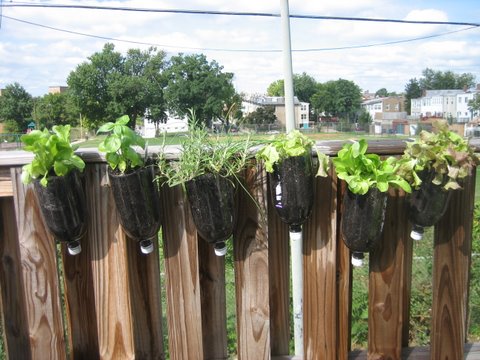
Received an email from another reader, Annie from Washington DC, that wanted to start her own urban garden. She had the space on her deck that got plenty of sun. Her concern was that it was too late in the season.

She had a few questions and concerns, but just told her to stop worrying and to start growing her vegetable garden.

So I challenged her to get it done. Since she’s not one to back down from a challenge, she showed me up and planted some herbs and vegetables on her deck.

A few days later, I got an email from her with the pic above. She recycled 2-liter soda bottles and planted buttercrunch and red leaf lettuce, rosemary, chives, and basil.

All the excuses are gone and she got it done. Mariann got it done too.

You’re next. Let me know how it goes.

Planting Some Head Lettuce

At the advice of Trina from Silver Height Farm where I buy my plants from, she recommended the Pablo Head Lettuce.

I bought a 6-cell pack and got them all in there. Each cell contained a few plants that I separated out. They were planted about 3-4 inches apart.

When planting these I noticed that the soil was pretty shallow, maybe 2-3 inches at some points. This could be a reason why the onions didn’t get to be very large. At other spots the soil was about 4-6 inches.

Either way, it should be good for the lettuce. I’m hoping to be able to harvest these for a few weeks.

httpv://www.youtube.com/watch?v=L0H-6z9uYmM

Moving my Cucumber Plant for Better Support

Three cucumbers have started to come through on my cucumber plant, so I needed to relocate it to another part of the garden for better support. I moved it closer to the fence where I was able to train it up with some string.

I was pretty happy to see the cucumbers since the leaves at the bottom have been drying out and dying. They were picked off and the cucumber trellis that I made was readjusted and tightened.

After the trellis was tightened, the plant had to be propped back up on it and secured to the fence.

Now I’m hoping that this will allow the plant to grow up and be more productive.

httpv://www.youtube.com/watch?v=7mdKcOfxfJ0

Getting Creative With Cinder Block Gardening

Now that I’m a bit more comfortable with this urban gardening, I’m starting to see things a bit differently. I look at things and think, “how can I use that to plant something?”

In walking around my neighborhood, the East Village, I saw something that really struck my eye. It was a cinder block turned on it’s side with some plants in it.

Cinder blocks wouldn’t work on my fire escape garden, but definitely would work in my backyard garden, especially since my grandmother already has cinderblocks.

They are also the perfect price. Free.

So I hit up the farmers market, bought some cinnamon basil, some fancy Italian dandelion and olive leaf arugula and got them planted in the cinder blocks.

httpv://www.youtube.com/watch?v=37jBY6V0WLo

I Wouldn’t Recommend Growing Peppers in a Small Space

Three months after starting my fire escape garden, I was finally able to harvest my red peppers.

I harvested a grand total of two red peppers with the possibility of some more. Yes, it was rewarding and felt great to put them in my salad, but I was hoping for more.

If you are gardening in a small space and looking for productivity, I wouldn’t recommend planting red peppers. I’d either experiment with something else or plant something that is productive like lettuces or greens.

For those of you with more space to grow, then plant some red peppers. I’d plant them again in my backyard garden in Brooklyn.

Not sure if it was the kind of red pepper, Jimmy Nardello’s Sweet Italian, or just red peppers in general. What I do know is that next season, I won’t be planting red peppers on my fire escape again nor would I recommend it for you.

httpv://www.youtube.com/watch?v=woZ5o3xpJ28